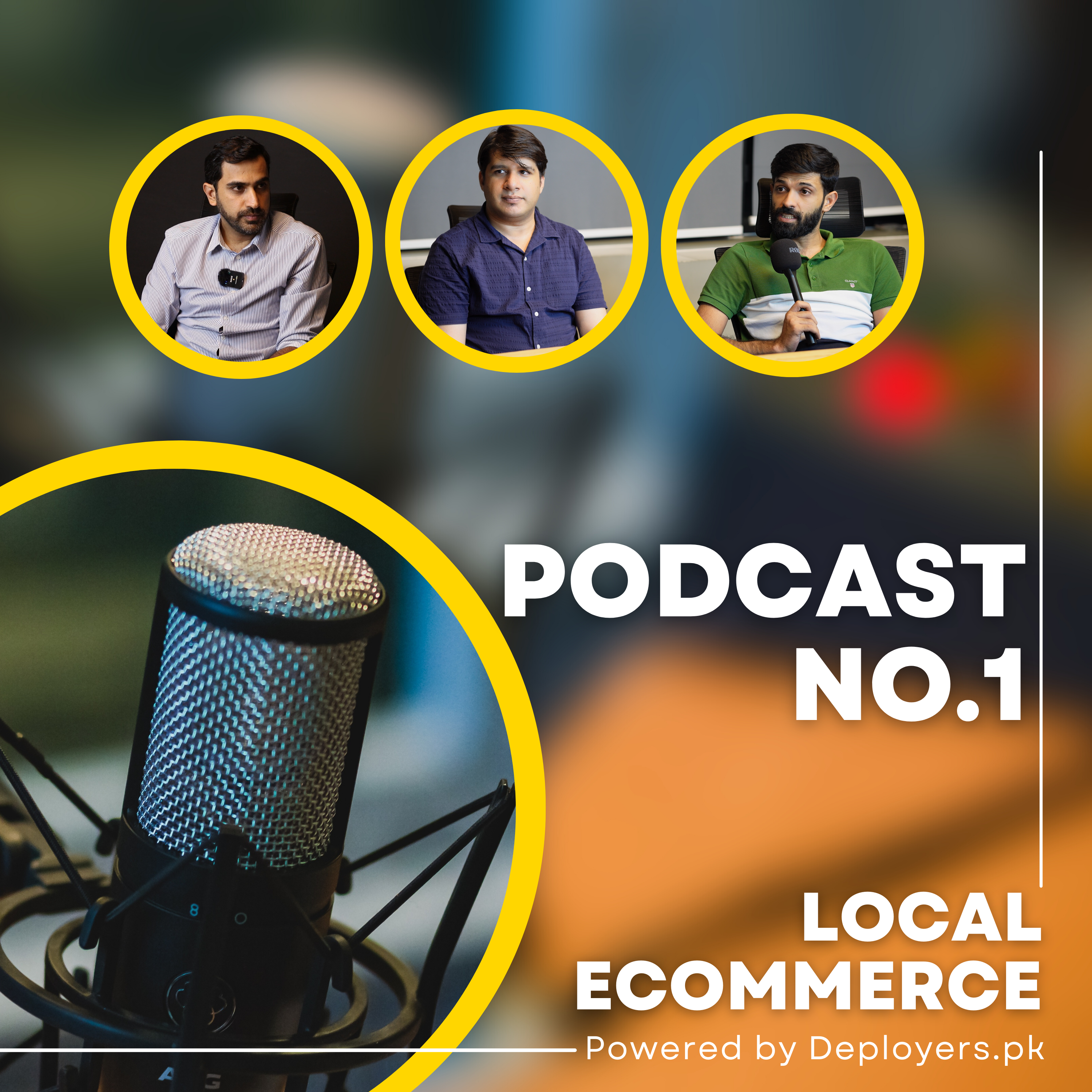
Ecommerce Baithak Episode 62: Grand Baithak at the University of Lahore powered by Innovation Hub UOL and Insta Retail

The Baithak team promised a Grand Baithak for December and, as the host puts it, did it in November. Episode 62 was recorded live at the University of Lahore, in collaboration with Insta Retail and The Innovation Hub. Retail CIOs gave their view of online share, the owner of Rawaj Mahal described starting with a worn-out phone and a home karahi, an Amazon expert argued that local ecommerce has more potential than selling abroad, and a Gujranwala speaker explained how a dead item, the tawa, was sold by solving a morning rush. The rest of the hour covered WhatsApp-first selling, ads versus organic content, Google My Business, AI and jobs, 11.11 operations and influencer marketing.
Based on Ecommerce Baithak Episode 62. Names are spelled from an auto-transcript, speakers are identified from context, and every figure about a brand or a person is that speaker’s own claim. About 27 minutes to read.
Figures in these tiles are as stated by the speakers on the show. They have not been audited.
The wider picture, from outside sources
The payment figures come from a news summary of an SBP review and measure online payments, not the share of retail that is online. Alibaba’s release gives brand-level milestones and no platform total.
In this guide
- Four hosts and a full panel
- A promise kept a month early
- 11.11: Alibaba as the example, and one Pakistani brand’s own numbers
- What retail executives say about online share
- Rawaj Mahal: no perfection, a worn-out phone and a home karahi
- The Amazon expert: local ecommerce has more potential
- Retail 20%, ecommerce 60%: one group’s numbers
- The tawa: selling a “dead item” by solving a pain point
- Start with your WhatsApp list
- Service ecommerce and a wellness brand
- The youth, ecommerce and support at home
- Ads or organic? The argument that started a Baithak
- Google My Business for local services
- Selling services and the value of a network
- AI and jobs: what the speakers expect
- Preparing for a big sale: a year of groundwork
- Audience stories and the origin of the Baithak
- Is the market saturated? Make the product unique
- Influencer marketing: UGC, macro creators and AI
- Costing, returns and where to learn them
- Why ecommerce will keep growing: rent and property
- Ten moves to borrow
- Show versus outside data
- Questions people ask
Four hosts and a full panel
Episode time 0:00
The hosts
- Haider Ahmed Qazi. Ecommerce teacher and industry veteran with 15+ years of experience, Meta and Google certified growth hacker, GM E-commerce at Stylo Group and Managing Director of Global Digital Awards. He moderates most of this session.
- Omer Mubeen. Community builder, founder of Deployers and Deployers School, chairman of the Pakistan Ecommerce Association (PEA) and founder of Global Digital Awards.
- Syed Jahangir Ali. Technical ecommerce operator who knows SEO, content and daily store operations. The hosts describe him as Head of Ecommerce at Insignia; earlier he worked on ecommerce at Stylo and Gul Ahmed. He was not at this Baithak: an audience member notes at 49:58 that he was missing that day.
- Chaudhry Waleed Shahbaz. Teacher and entrepreneur who teaches Shopify and ecommerce at UCP, runs a digital marketing agency and teaches store building, dropshipping, Amazon and Etsy.
The panel and speakers
- Yameen sahab. CIO of a retail group with three brands, as the host introduces him. The captions garble the group’s name and also spell his name Amin and Yamin.
- Jameel sahab. CIO of Almas, as the host introduces him.
- Rawaj Mahal’s owner. Founder of a hair-oil brand who says he started from scratch. The captions garble his name; it reads like Mustansir.
- Fahim bhai. Introduced as the Amazon expert. He says he has worked in international markets since 2011 or 2012.
- Master Fahim. Introduced as the person behind Techno X, who built a brand through content. A “Fahim Raza” is also named near the end, and the captions do not say whether he is one of these two.
- Ali bhai. From Gujranwala. He tells the tawa story, and another speaker credits “Ali Reza bhai” with the WhatsApp-first advice. We treat them as one person.
- Sana Khan. Introduces herself as a brand runner; the brand is Fem Fit, a brand aimed at women (the captions spell its name several ways).
- Maryam. Says she has been an educationist for 26 years, including City School, Beacon House and universities, and now runs a training company that the captions render as Learn to Grow.
- Ms Maryam. A trainer who, by an audience member’s question, trains women under PSDF. She says she has trained “thousand plus” women; the captions drop the digit.
- Audience members. Students and entrepreneurs, including Fahad Rashid of selfield.pk and Shahnila Kiran, who asks the influencer question.
Host lines come from the hosts' own profiles and public listings; panel lines are what each speaker said on the show. The captions carry no speaker labels, so people are identified from context and names may be misspelled.
A promise kept a month early
Episode time 1:00
On the showThe host opens by saying this is a special Baithak. The team had promised the audience a Grand Baithak, had said December, and it happened in November. He thanks the University of Lahore for supporting the session, says the panel will answer questions on ecommerce, growth, potential and online business, and says the floor will open for audience questions.
In the team’s own description, the event was held in collaboration with Insta Retail and The Innovation Hub. The captions name only the University of Lahore.
11.11: Alibaba as the example, and one Pakistani brand’s own numbers
Episode time 2:18
On the showThe host says November is seen as the biggest ecommerce sale month in the world and uses Alibaba and 11.11 as his example. He says the 11.11 event came from there, whereas this month used to be known for campaigns such as Black Friday, that China organised it well, and that Alibaba has registered 11.11 so nobody else can run it in China. We did not check that last claim. He then says one day of ecommerce sales on Alibaba equals Pakistan’s whole debt, and puts last year’s one-day figure at about $150 billion and this year’s at about 1.7 trillion yuan, roughly $250 billion. These are the host’s figures.
On the showThen he turns to home. He says he is affiliated with a brand that generated 17,500 orders in a single day and about 1.78 lakh orders in a six-day campaign, all dispatched within Pakistan. His point: people dismiss Alibaba as another world, so he is giving a Pakistani example instead. He adds that a shoe brand sold heavily because women often buy shoes only for every seventh suit, since one pair goes with many outfits, which he takes as a sign of how large the potential is.
Outside numbers
- Alibaba’s release on its 2025 11.11 festival, dated 15 November 2025, reports growth rates and brand-level milestones: 34,091 brands doubled their sales compared with the previous festival, and nearly 600 brands had passed RMB 100 million in sales by 14 November.1
- The release gives no platform-wide total and no single-day sales figure.1
So the one-day and yearly totals quoted on stage could not be matched to Alibaba’s own release. Treat them as the host’s estimates.
In this stretch the host also cites a named local company’s yearly online sales and says his own brand will overtake it. This article leaves that out, because it is a claim about a named company that we could not check.
Learning. A big number from abroad starts the conversation, but the useful step is the local one. Count your own orders per day and per campaign, so the next sale can be planned against real numbers.
What retail executives say about online share
Episode time 4:56
On the showThe host introduces the two retail CIOs and asks how business is going and how much ecommerce can grow. The first CIO says physical and online run side by side. He says about 15 to 20 percent is online and the rest still happens in physical stores; the captions suggest he means the whole world, but they are garbled. Food and grocery have grown fastest online, he says. Shoes sell online once your size is settled with a brand, but fabric still needs a look, a feel and a wearing test. Despite Pakistan’s difficulties, such as cable cuts and firewall problems, he says ecommerce growth here is higher than in countries that are ahead of us, because we are far behind them, and he expects it to rise further in the coming years. The youth prefer online and value their time differently, he says. Over the next ten years he sees the potential for up to 40 percent of areas like fashion and grocery to shift.
On the showA second panelist says that for a large brand, ecommerce is about 10 to 15 percent of overall sales today. Pakistan lacks an ecosystem, he says: logistics companies cannot support new startups. If those issues were solved, he says, ecommerce could reach 25 to 30 percent of sales. The host adds that this is the point of the Baithak: bring your ecommerce problems, such as dealing with companies, logistics, supply chain, inventory and investment, and the panel shares its experience.
Online share, as different speakers put it
Outside numbers
- The State Bank of Pakistan’s Payment Systems Review for the first quarter of FY26 (July to September 2025), as reported by INP-WealthPk, counts 250 million online e-commerce payments worth Rs 343 billion. Wallets and accounts handled 94% of the volume and 80% of the value.2
This is a news summary of an SBP review. It measures online payments, not the share of all retail sales that is online, so it can neither confirm nor contradict the percentages on stage.
Learning. Treat online-share figures as directional. The speakers gave a spread from 10% to 40% depending on what is measured and over what time. All of them expect the number to rise, and the panelist who gave 25 to 30 percent named logistics as the brake.
Rawaj Mahal: no perfection, a worn-out phone and a home karahi
Episode time 8:22
On the showThe host introduces the owner of Rawaj Mahal, a hair-oil brand, as someone who started from scratch, and asks for a motivational story. The owner says that in Pakistan universities and colleges teach you to work with perfection, but when he started there was none, only a decision to do the work. He says he had a phone worth around 17,000 rupees, in poor shape (the captions are unclear on the amount), and used it to make content. He worked alone for about three months and says he has since paid salaries to 153 people through Rawaj Mahal.
On the showTo a student who asked earlier how to buy stock when it costs a lot, he answers from experience. He had no bottles when he began; he arranged with a supplier to buy bottles as he needed them, started at home and filled orders one by one. He told customers delivery would take four to five days. His production gear, he says, was a small home karahi of the kind used for pakoras in Ramadan. His advice is to pick up the handmade product someone near you makes and praise it truthfully, because what reaches the customer must be what you said. He adds that some local ecommerce sellers show one thing and sell another (the captions are garbled here). The host says a full case-study episode with him is on YouTube.
How Rawaj Mahal started, as the owner tells it
- Start with what you have.A phone, an idea and a decision to begin.
- Make content.He recorded with the phone he had.
- Arrange stock without cash up front.He agreed with a bottle supplier to buy as orders came.
- Promise a longer delivery time.Customers were told four to five days.
- Produce at home.A small home karahi was the first equipment.
- Deliver what you showed.The product that arrives must be the product that was promised.
- Add people later.About three months alone first; he says 153 people have been paid since.
Learning. Do not wait for perfection or for stock. Take orders with an honest, slower delivery promise, produce to demand, and make what arrives match what you showed.
The Amazon expert: local ecommerce has more potential
Episode time 10:32
On the showThe host turns to Fahim bhai, the Amazon expert, and asks whether Amazon work can be done from here. Fahim says he has worked in international markets since 2011 or 2012. People, he says, see dollars passing before their eyes and imagine earning in dollars in the US or UK, but dollars do not grow on trees. International selling is a challenge worth taking if you accept it. Even so, he says, the potential in local ecommerce is, in his honest view, not even there on Amazon. As his evidence he points to the 17,500-orders-a-day brand the host mentioned, and says Rawaj Mahal has similar order volumes with a single hair oil. We did not verify that.
On the showHe says abroad there are laws rather than logistics gaps, so operations run smoothly if you have skill, investment and a plan. Marketplaces other than Amazon, such as eBay, TikTok Shop and Etsy for digital products, also do good business. But without planning, projections or a feasibility study, he says, you cannot think of going international, whereas in Pakistan you can start without a plan.
On the showThe host adds an example of his own: a brand owner from Gujranwala who ran only a Facebook fan page for a football club, converted it into a business, now sells women’s garments and dispatches about 2,000 orders a day on average, by the host’s account. A speaker also says the Faisalabad, Gujranwala and Sialkot triangle generates about 40 percent of Pakistan’s GDP through exports. We did not check that figure and do not repeat it as fact.
Learning. Compare the options honestly. Selling abroad rewards planning, legal formation and capital; the local market lets you start small and learn, and the stage examples suggest it can scale too.
Retail 20%, ecommerce 60%: one group’s numbers
Episode time 14:08
On the showAsked how retail shops compare with online buyers, the CIO who represents a group of three brands says the group is growing about 20 percent on the ground, while his ecommerce growth is about 60 percent against last year. Ecommerce used to be weak for them, he says, and now most of the group’s growth comes from it, with the least coming from retail. He adds that when the product that arrives matches the product promised, an online customer’s trust settles and the customer comes back.
On the showThe Almas CIO adds that many Pakistani cities have no big malls, so shoppers there experience a brand online. When Almas runs a sale, he says, everything sells out in two hours. He asks where the orders come from: not from Lahore, Karachi or Islamabad, where people can walk into a store, but from places such as Sahiwal and Multan, where the brand has no store. Shoppers who have already experienced Almas products are confident to buy online, he says, though stores still matter. Later a speaker returns to Mandi Bahauddin and says it ranks third in a top-ten list the captions call “stores”; whether that means store locations or order cities is unclear.
Growth against last year, as the three-brand CIO states it
On the showAnother panelist says that in the UK, mall stores are mostly showrooms: people check sizes and fittings there and then buy online through Amazon and other platforms. This is one speaker’s observation and we did not check it.
Learning. Online is not only a second channel. It reaches customers where no store exists, and a sale that sells out in two hours is a demand signal from cities the physical network has not reached.
The tawa: selling a “dead item” by solving a pain point
Episode time 17:11
On the showThe discussion turns to timing. The host recalls a guest who, during Ramadan, saw that making sehri on one tawa takes many parathas and a lot of time, so they made the tawa bigger, to fit three or four parathas at once, advertised it, and, in the host’s words, sold crores of rupees’ worth of one big tawa. He asks Ali bhai how it was done.
On the showAli bhai says the tawa was a challenging product because it is considered a dead item: many households still use the one that came in a bride’s dowry, so nobody buys it often. They were given a company’s product to sell, so they started from the pain points. In his words: early in the morning everyone wants breakfast quickly and wants parathas, and in mostly joint families many parathas are needed, so a tawa that cooks several parathas at a time answers a real problem. He jokes that because they are from Gujranwala their minds run toward food.
The tawa story, step by step
- A dead item.The tawa is rarely bought, and many homes use one from a dowry.
- A real pain point.Rushed mornings and joint families that need many parathas.
- A redesigned offer.A bigger tawa that cooks three or four parathas at once.
- Timing.Advertising built around Ramadan sehri.
- The result.Crores of rupees in sales, by the host’s account. We did not verify the figure.
Learning. Do not ask whether the product is exciting. Ask what problem is felt at a specific hour. The tawa did not change; the reason to replace it did.
Start with your WhatsApp list
Episode time 19:13
On the showA speaker, whom another panelist later credits as Ali Reza bhai, turns to the students’ real problems. He takes a woman in the audience who says she is a designer and that her family likes her designs. To a new person who wants to do local ecommerce he says: go one step back from local and start from your own WhatsApp. First tell your own mind, even standing in front of a mirror, that from today you are starting a business. Many people open a store in their village and tell neither neighbours nor family, then complain it does not run.
On the showHe then lays out the plan: make a video of your product, put it on your status and share it with the two, four or five hundred numbers in your contact list. Those five hundred people, he says, are people whose trust in you is not an issue. In performance marketing, money goes into building trust; here trust is already full, and their contacts can pass the word on. He expects 50 to 100, even 200 orders this way. A second speaker seconds him and adds that the first orders come from personal branding, while the second order comes from quality: if the product is good and the buyer enjoys the experience, the second and third orders follow. This is experience-based expectation, not a guarantee.
The WhatsApp-first plan, as described
- Tell yourself and your circle.Say clearly that from today you have a business.
- Make a video.A short clip of your product.
- Post it to your status.Your contacts see it first.
- Share it with 200 to 500 contacts.These are people who already trust you.
- Expect the first orders from trust.The speaker’s guess is 50 to 200.
- Earn the second order with quality.A good experience brings repeat buyers.
Learning. Your first customers are already in your phone. Starting there lets you test the product and the delivery before paying for ads.
Service ecommerce and a wellness brand
Episode time 21:11
On the showThe host says ecommerce is not only about products; there is also service ecommerce, which gives women in particular a large opportunity to work from home. He invites Sana Khan, who introduces herself as a brand runner and whose brand is Fem Fit, to explain how she launched it and what has come from it. Later a host calls healthcare one of the most interesting niches to market: people know how to sell products and services, but how do you sell healthcare? A woman speaker adds that healthcare is being digitised and that many women can start through basic social media, with WhatsApp as the first platform. She says women often block their whole family from seeing their business pages at first, out of shyness.
The health claims made on stage are left out of this article, and nothing here is medical advice. For any health question, ask a doctor or pharmacist.
The youth, ecommerce and support at home
Episode time 27:03
On the showSana asks Maryam, who guides women on how to build themselves up, what she would say. Maryam says she has been an educationist for 26 years, has worked in the City School system, Beacon House and universities, and now runs her own company where she is also a corporate trainer. She works on youth development, she says, and wants people to learn to be better and happier. Later she says she learned ecommerce from zero with the help of a student who now works with international clients, that the youth are 65 percent of the population, and that in her view ecommerce is the only solution for this generation. She says she is planning an event, Gen Connect, to connect Gen Z with people like the panelists.
On the showThe Fem Fit speaker says the biggest support when she began talking publicly about her work was her husband’s. Without a husband’s support, she says, women often block people on WhatsApp so nobody finds out. The host asks for applause for two people by name, Saqib bhai and Fakhr bhai, who made the event happen, and says it could not have happened without Fakhr bhai.
Learning. Support at home is part of the business plan. When a family sees the work, a founder no longer has to hide the page from the people most likely to become the first buyers.
Ads or organic? The argument that started a Baithak
Episode time 33:27
On the showThe host says the audience has seen a path from idea to online business, and that the next question is the one a beginner with no marketing money asks: how do I run ads on Meta? He says one or two people in the room do not waste money on ads and tell others that the direction is wrong. At one time, he says, the team disagreed with them, and then an update arrived on the platform they advertise on (he calls it Andromeda) that wrecked everyone’s results: money spent, no sales. He hands over to Master Fahim, who built a brand through content.
On the showMaster Fahim says a second or third Baithak began with this very argument: some said do not run ads on Meta, others said they would. He himself was not saying to stop ads, but to keep organic in view. Ads trigger a defensive reaction, he says, because a person who sees a product ad first becomes cautious, whereas someone you educate online through content, workshops and programmes connects with you. His formula is: if you want to spend 70 percent on ads, keep at least 30 percent of the budget for organic content, and work on the top of the funnel. If Meta becomes a problem one day, he says, people will still know you by your name and face. He says his own brand runs ads only on a Lahore base and the rest is organic, and that he showed Ali bhai some numbers the night before and was not believed.
Master Fahim's budget rule
- Ads: the share you spend on paid reach.
- Organic content: the minimum he says to keep, mainly for the top of the funnel.
Learning. Paid reach rents attention and organic content builds an audience. Keeping a share for the second means a platform change hurts, but does not end, the business. This is one practitioner’s rule, not a law.
Google My Business for local services
Episode time 36:27
On the showThe host explains two kinds of marketing: paid, where you spend money and get sales, and organic, where you use techniques and win sales without paying. He introduces Chaudhry Waleed Shahbaz as someone with a skill in Google My Business and search engine optimisation, who used it to grow a friend’s work until the friend ran it himself, and asks about security-camera SEO. Waleed says ecommerce is not only product selling; there are two types, products and services. With products most people think of fashion because it leads the market, but commercial products and services such as CCTV cameras, plumbing and electrician work can be promoted without ads in your own area.
On the showHis example: someone with an electrician problem in DHA searches for the best electrician or a plumber near me, and the near-me result comes from a Google Business Profile, which promotes the business through its content. He says it is totally free of cost. You create a profile, can rank your page, and serve the surrounding areas. For content, he says, you need not write much: take real-time pictures of the work you are doing and add a short description, with an AI writing tool if you like. After each job, ask the customer for a rating, and he says Google then promotes you on that basis. His conclusion is that people who say ecommerce does not make money without ads can look at service businesses too.
Outside numbers
- Google’s help page on local ranking says results are based mainly on relevance, distance and prominence, and that more reviews and positive ratings can help a business rank locally.3
- The same page says there is no way to request or pay for a better local ranking on Google.3
A complete profile and good reviews help Google match you to a search, but a profile does not guarantee a top place.
Learning. If you sell a local service, your first storefront may be a map listing. Keep the profile complete, post real photos of real work and ask satisfied customers for honest ratings.
Selling services and the value of a network
Episode time 39:28
On the showThe host says that if you have these skills you can also sell them to others, and that the most important thing in selling services is your network: the more people you know and meet, the further it carries you. He asks Omer Mubeen how he runs Deployers and D-Logics, serves clients inside and outside Pakistan, and what benefits came from forming the Pakistan Ecommerce Association (PEA) and strengthening that network.
On the showOmer says that when he left a job and moved to the business side, he had the option of making himself the product. That setup, he says, runs well, with no tension about inventory or production, and he offers digital marketing and ecommerce consultancy services. If you sell services rather than products, he says, almost the whole world is waiting for you. He adds that building PEA is a long journey with continuing costs, carried for the betterment of the community and the industry.
Learning. A service business has no stock to hold, so the early risk is time rather than money. Your network is how that time turns into clients.
AI and jobs: what the speakers expect
Episode time 42:22
On the showBefore audience questions, the host raises one last topic: how much AI has empowered people, and whether it will eat jobs. One speaker says AI use rose sharply and many trends followed, but that with policy and algorithm changes, both organic and paid reach on Instagram get compromised if AI is not used wisely. In the speaker’s words, Meta has changed its policy, and if AI content is tagged, organic or paid reach will be limited. So when you create content with AI, the speaker says, adjust it with manual editing tools such as Canva, Illustrator and video editors, to give it as much organic touch as you can and raise reach.
On the showRamsha says she trains “thousand plus” women in ecommerce so they can start businesses, and that some of them come from remote areas with little or no signal, travelling to places where they can get internet access. She says one of them makes small art and craft products and earns one million a month; the captions do not make clear the currency or whether that is per woman. Her message is that ecommerce needs just one step from the basic social media platform you already use. Another speaker says AI will take the jobs of the idle (“nikamme”), that smart people will work alongside it, and that those who are awake and understand it face no threat.
Outside numbers
- Engadget reported on 31 August 2026 that Instagram announced a new “AI-generated profile” label for profiles that feature an AI-generated person. It quotes a spokesperson saying that accounts that skip the label “may soon see limits to their reach”.4
That rule concerns unlabelled AI personas. It is not the same as the claim on stage, and we could not confirm from the pages we read that tagged AI content in general gets less reach. Check Meta’s current guidance before changing your workflow.
Learning. Use AI for speed and human editing for taste. Whatever the platform rule is this month, content that looks like a real person made it is the safer asset.
Preparing for a big sale: a year of groundwork
Episode time 45:14
On the showIn the open floor, an audience member asks the host two things. First, how much of an operational queue builds between order and fulfilment when a flash sale hits; he says many brands are hurt when their operations are not settled, and trust and quality go with it. Second, the story behind the Baithak.
On the showThe host says the team was caught out in the last two years when this kind of surge arrived, so this time it prepared for a full year: what the products would be, the price, the timing, the offer, the colour and scheme, where to highlight what, how much to spend, with the spend ready and the ad account not blocked. He says it was the biggest sale of his brand’s career and that, believe it or not, they had no issues: 85 percent of the orders were already delivered. Using a rough “let’s suppose” comparison, he says last year, with around 30,000 orders against a lakh now, they got stuck. This time they put warehouse management software in place urgently, and courier systems were online, so staff only had to put goods in. Some products had not even arrived when orders were taken, and were packed as they came.
On the showHis lesson is to plan so well that you do not meet problems, though the first operation will never be perfect: you fall, and that is when you rise. His figures are the host’s own claims about his own brand, and we did not verify them.
The preparation list the host describes
- Products.Decide what will be on sale.
- Price and offer.Fix the price, the offer and the scheme in advance.
- Timing and colour.Plan when it goes live and how it looks.
- Where to highlight.Choose what gets the most attention.
- Spend.Have the ad budget ready and the ad account in good standing.
- Operations.Warehouse software and couriers ready before the first order.
Learning. A sale is won in the months before it. Treat the warehouse, couriers and ad account as part of the offer, because a delayed order undoes the trust the ad bought.
Audience stories and the origin of the Baithak
Episode time 49:42
On the showAn audience member, Fahad Rashid of selfield.pk, says his ecommerce store began about two years earlier, when the Baithak started, with no previous experience. He says he followed the videos step by step, from the Facebook page to courier problems and internet outages.
On the showA host explains how the Baithak began. The team had been making videos for five or six years, on irregular timing, each person recording when they could. One day they were sitting together with Yamin bhai (as the captions read), and it was suggested that they sit down and make a proper baithak, one full video. The captions garble who then started it and gave it the name Baithak. It has now run for more than a year and 62 episodes. He says getting everyone together is hard because of full-time jobs and responsibilities, and thanks the CIOs who make time. Another host says the team treats it as giving back to the community: each episode takes time, equipment and editing, and if even one viewer benefits, that is the return.
Learning. A habit of showing up, recorded and shared, can become a community. The beginners in the room are proof that the advice gets used.
Is the market saturated? Make the product unique
Episode time 53:06
On the showAn audience member asks Ramsha, who trains women under PSDF and whose trainees, the questioner says, include some earning up to a million in profit, how a beginner should compete when the market is saturated and almost the same products sell on Daraz and Instagram. Ramsha says many of the women she trains have not even logged in to Facebook, so she teaches account basics too. On saturation, she says, do not start from the fear that many people already sell; when ten or twelve people sell the same thing, think about how to make your product unique. Her own core expertise is brand building: the product may be a suit, but what is the story behind it, and why should a customer connect with it? Build something that touches your customer and relates to them, she says. Do not watch the competition; watch whether you can talk to your customer.
Learning. In a crowded category the product is rarely the difference. The story, and the way you talk to the buyer, is.
Influencer marketing: UGC, macro creators and AI
Episode time 54:57
On the showShahnila Kiran asks whether influencer marketing can become a major pillar of ecommerce marketing in Pakistan over the next ten years, whether it can serve every stage of the funnel on its own, and in what form it will last: human influencers, AI influencers, user-generated content (UGC) creators, or AI-generated UGC.
The answers differed, which is useful in itself:
- Own content first. One speaker splits organic into parts and starts with UGC (user-generated content): engaging customers by showing what they will buy and what they will get, as raw, unfiltered, unedited video. Another says that if you make videos yourself you can easily make 25 to 50 in a day for free, while trust in influencers has fallen.
- Macro creators with a defined audience. A speaker says mega-influencers who promote many brands with no defined audience are close to finished, while a macro influencer who has defined their audience can make content that helps sales.
- Regional macro creators. A brand representative says the brand used macro influencers in regional languages from places such as Gwadar, Pishin, Noshki, Quetta, Abbottabad, Mansehra, Dadu, Sehwan and Larkana (the list is garbled in the captions), cities not connected to the mainstream. It embedded them in an affiliate sales programme on its main Instagram account and promotes them there, so they earn from sales and their following grows. Some had zero income before, the speaker says. The brand name is garbled in the captions.
- AI influencers. A speaker who runs a marketing agency says AI influencers still perform well for service-based businesses, while for product-based businesses human content still performs better. This is one speaker’s opinion.
- Show your process. Another says content can be simple and unpolished. Show the whole process, as Rawaj Mahal’s owner puts his karahi in front of the camera. Do not go to paid at the start, he says; make a hundred videos of your product and expect a few to do well. This is advice, not a promise.
- Brand, not just sales. One speaker says influencer marketing is for brand building rather than sales, and that if you want sales you should become the influencer. A second disagrees: the right influencer still sells, and brands that save money by not hiring one then wrongly say influencer marketing does not work.
Learning. The speakers disagreed on whether influencers sell or only build a brand. They agreed that you should choose a creator whose audience matches your buyer, and keep making your own content as the base.
Costing, returns and where to learn them
Episode time 1:02:36
On the showAn audience member says everyone is doing ecommerce, but nobody explains how to cost a product: after a year, a new seller looks at the end and finds a loss. He also asks how returns, which arrive because of mistakes on the courier or buyer side, can be turned back into sales. A host replies that finances, margins and costing cannot all be covered in one hour, but that Rawaj Mahal’s owner has already explained, in his videos, what the product is, what the price should be and how much is left. Watch those, he says, and you will find answers. The Baithak, he adds, is a short awareness session about ecommerce and its future.
Learning. Costing is the first lesson, not the last. Work out the margin before the first order, and treat returns as a cost line, not a surprise.
Why ecommerce will keep growing: rent and property
Episode time 1:03:35
On the showOne speaker says the business of the future will be the one that has adopted ecommerce fully from today. Ten years ago, he says, people were thinking about starting online, and those who did would be earning in the billions now. A second speaker gives another reason ecommerce will grow: property prices. Everyone knows how fast they are rising, he says; some cannot buy and some cannot sell. Mall rents are so high that not every brand can open or run a shop there, so as rent rises, ecommerce will grow, and that is an opportunity for the audience. The captions end there, at the end of the recording.
Ten moves to borrow
From the whole session
- Do not wait for perfection. Rawaj Mahal’s owner started with a phone, a supplier and a home karahi.
- Sell the first batch to people who already trust you. The WhatsApp-first plan starts with your own contact list.
- Find the pain point, not the product. The tawa sold because it answered a rushed morning.
- Compare local and international honestly. Fahim bhai argues that local potential is larger; going abroad needs planning, law and capital.
- Keep a share of effort on organic content. Master Fahim’s rule: if 70 percent goes to ads, keep at least 30 percent for organic.
- Claim your local listing. For local services, a complete Google Business Profile and honest ratings are the first storefront.
- Prepare for a big sale a year ahead. Products, price, offer, spend, warehouse software and couriers, all ready.
- Say what is unique. Ramsha’s answer to a crowded market: the story behind the product and a real conversation with the buyer.
- Show your process. Real, simple content beats a polished ad that nobody trusts.
- Learn costing before you launch. Work out price and margin first, and plan for returns.
Show versus outside data
Where the sources agree, add or stay silent
Alibaba’s 11.11 totals
Reach for AI content
Google My Business
Online share
Questions people ask
Quick answers
Where was Ecommerce Baithak Episode 62 recorded?
It was recorded live as the Grand Baithak at the University of Lahore, which the host thanks for its support. The team describes it as held in collaboration with Insta Retail and The Innovation Hub.
Who spoke in Episode 62?
The hosts were Haider Ahmed Qazi, Omer Mubeen and Chaudhry Waleed Shahbaz; Syed Jahangir Ali was absent. The panel included two retail CIOs, the owner of Rawaj Mahal, Fahim bhai, Master Fahim, Ali bhai, Sana Khan, Maryam and Ramsha, with students asking questions.
What is the 70/30 ads and organic rule?
Master Fahim says that if you want to put 70 percent of your effort on ads, you should keep at least 30 percent of the budget for organic content. It is one practitioner’s rule, not a platform guideline.
Can you start an online business with no stock?
The Rawaj Mahal owner says he arranged bottles with a supplier, bought as orders came and told customers delivery would take four to five days. That worked for him; check what your own category and customers allow, and always be honest about timing.
Does tagging content as AI reduce reach?
One speaker says so. We could not confirm it. Instagram has announced a label for profiles that feature AI-generated people and has warned that unlabelled ones may see limits to their reach, which is a different rule. Check Meta’s current guidance.
Outside figures were checked against these pages. Statements about the brands and people themselves come from the episode and have not been independently verified.
- Taobao and Tmall’s 11.11 Shopping Festival Delivers Solid Growth for Brands. Alibaba Group, 15 November 2025.
- E-commerce payments reach 250 million transactions as digital shopping accelerates in Pakistan. INP-WealthPk, Moaaz Manzoor, 31 December 2025, reporting the State Bank of Pakistan’s Payment Systems Review for Q1 FY26.
- Tips to improve your local ranking on Google. Google Business Profile Help.
- Instagram will demote AI-generated influencers if they don’t clearly label their account. Engadget, Karissa Bell, 31 August 2026.
This article is based on the auto-generated transcript of Ecommerce Baithak Episode 62. Auto-captions can misspell names and garble numbers. Episode times come from the caption file and were not checked frame by frame, so they may be a few seconds off. Please check anything you plan to quote against the video.
Watch the full conversation
The Grand Baithak from the University of Lahore, in one sitting of about an hour. Ask your own questions in the YouTube comments.
Watch Episode 62 on YouTube