New Taxes on E-commerce, Freelancers & Content Creators Explained - Finance Bill 2026-27 Pakistan
Budget & Tax Analysis · FY 2026–27
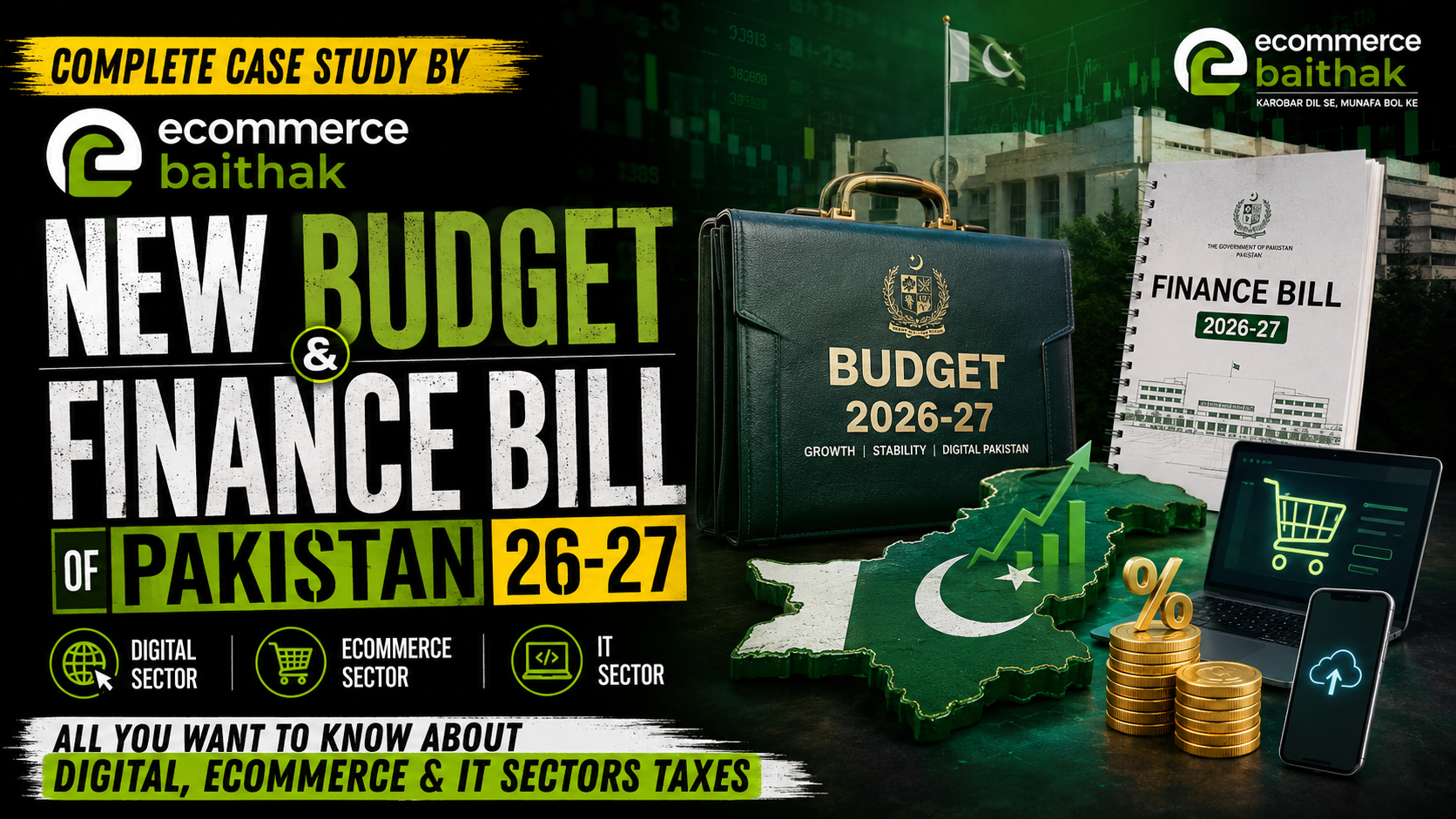
Finance Bill 2026–27: The New Tax Map for Pakistan's Digital Economy
A practical, baithak-ready breakdown of what changed for e-commerce sellers, freelancers, content creators, and IT & startup founders — with real-number case studies and the questions your audience will actually ask.
The Big Picture Before We Zoom In
The headline budget story is relief for salaried Pakistan. The quieter, more consequential story for our audience is how the government is redrawing the line between "formal digital exporter" and "domestic digital earner."
The Rs18.771 trillion federal budget for FY2026–27 sets an FBR collection target of Rs15.264 trillion — a steep 17.6% jump over the revised Rs12.983 trillion estimate for the outgoing year. To hit that number while still delivering political relief, the government took a clear two-track approach:
- Track 1 — Reward documented, export-earning digital activity. IT exporters, PSEB-registered freelancers, startups, and venture capital funds got multi-year certainty and new exemptions.
- Track 2 — Formalise domestic and platform-monetisation income. Social media content creators are, for the first time, placed inside an automatic bank-deducted withholding regime, and the e-commerce withholding framework introduced last year continues with one notable refinement.
On the broader fiscal side: the 9% surcharge under Section 4AB has been abolished entirely, the second income-tax slab drops from 5% to 1%, and super tax has been restructured on a sector basis — banking, petroleum/oil-refining (Fifth Schedule) and fertilizer companies stay at 10% above Rs150 million income, while every other company now pays only 8%, and only above Rs500 million (effectively zero super tax for general companies between Rs150–500 million). The carbon levy on petrol and diesel is also set to double from Rs2.5 to Rs5 per litre — a quiet cost increase for courier- and logistics-heavy e-commerce operations.
Two other quieter changes are worth flagging before we get to the digital-economy specifics. Section 7E — the long-litigated 1% "deemed income" tax on immovable property — has been omitted entirely, and the Capital Value Tax on foreign movable and immovable assets of resident Pakistanis (relevant to many freelancers, overseas-linked founders, and creators with foreign bank balances) has been abolished. At the same time, FBR itself is being rebuilt around algorithms: a National Faceless Centre, an AI-driven "Algorithmic Settlement Mechanism," and mandatory bank reporting of large account activity are rolling out alongside the new digital-economy taxes — we cover what that means for online businesses in Section 03.

What Actually Changed: A Measure-by-Measure Ledger
Nine changes that matter if you sell online, freelance abroad, create content, or run a tech startup.
Tax on social media & content creator income
For the first time, income from YouTube, TikTok, Facebook, and Instagram monetisation falls under a dedicated withholding regime. Every bank or financial institution must deduct 5% at the time of credit of any payment received from a social media platform.
For resident filers, this is a minimum tax. For non-residents without a permanent establishment in Pakistan, it is a final tax. The Bill itself doesn't yet spell out how banks will identify which incoming credits count as "social media revenue" — that mechanism is expected via rules FBR prescribes before 1 July 2026.
New regime"Independent professionals" — including software engineers — now withheld at 15%
The Bill explicitly lists doctors, lawyers, architects, accountants and software engineers as "independent professionals," moving their domestic service payments to a 15% withholding rate — up sharply from the old general-services treatment. General services WHT also rises from 6% to 7%, while payments to electronic/print media for advertising are withheld at 1.5%.
This is separate from the 0.25% Section 154A regime, which applies only to export proceeds of IT/ITeS. A developer or agency billing Pakistani clients does not get the export rate — they fall under this 15% bracket instead.
New burdenStandard 18% sales tax now applies to many D2C product categories
Twenty-one new categories of retail-packed goods move into the Third Schedule, meaning 18% sales tax is charged on the final retail price across the whole supply chain, not just at one stage. The additions include footwear, cosmetics & toiletries, dairy & infant preparations, bags/wallets/luggage, plastic household goods & kitchenware, automotive accessories, tissue paper, and bathroom/sanitaryware.
For online sellers in fashion, beauty, baby products, and home goods — some of the most active categories on Daraz, Instagram, and D2C storefronts — this is arguably the single biggest pricing change in the entire Finance Bill.
Cost pressureIT & freelance export tax regime extended 3 years
The concessionary 0.25% Final Tax Regime on IT and IT-enabled services export proceeds — due to expire 30 June 2026 — has been extended through Tax Year 2029. This applies to PSEB-registered software houses, agencies, and freelancers billing clients abroad.
Crucially, this track is now explicitly separated from social media monetisation income, which sits under the new 154B regime instead.
Continuity winE-commerce withholding tax — now partly adjustable
The 2% sales tax withholding on digitally-ordered goods, collected by couriers and payment intermediaries at the point of delivery or payment, continues largely unchanged from the Finance Act 2025 framework.
The one real change for FY27: for sellers with annual turnover above Rs200 million, this withheld amount is now adjustable against their actual tax liability rather than treated as final — a direct response to complaints from thin-margin online retailers.
Partial reliefForeign card payment tax slashed by 90%
Advance tax on payments made abroad via debit, credit, or prepaid cards drops from 5% to 0.5%. This directly lowers the cost of cloud hosting, SaaS subscriptions, AI tools, ad spend, software licenses, and marketplace fees paid internationally — a recurring cost for almost every digital business.
ReliefStartups exempted from Section 153 withholding
Registered startups no longer have withholding tax deducted from client payments under Section 153 — meaning they receive full invoice value upfront instead of waiting months for refunds, easing cash flow at the most fragile stage of growth.
ReliefVenture capital funds get tax pass-through treatment
VC funds investing in Pakistani startups are no longer taxed at the fund level — tax applies only when investors realise returns. This aligns Pakistan's VC structure with international norms and is aimed at making it easier to attract foreign limited-partner capital.
ReliefCarbon levy doubles — an indirect cost for logistics
The carbon levy on petrol and diesel is scheduled to rise from Rs2.5 to Rs5 per litre. It isn't an "e-commerce tax" on paper, but for any business leaning on courier-based delivery (which is most of Pakistani D2C), it quietly raises fulfilment costs.
Cost pressureFBR Goes Digital Too: Faceless Audits, Bank Data & AI Settlements
Four changes that don't target e-commerce or freelancing directly — but change how every digitally-active, banked business in Pakistan gets monitored from here on.
Banks now report your big transactions automatically
Under new Section 165AB, every bank and Electronic Money Institution must upload details of accounts where deposits or withdrawals exceed Rs100 million in any 6-month period to FBR's Central Data Hub — opening/closing balances, peak credits, total credits, all of it. This data is run through algorithmic cross-matching against declared income to flag mismatches automatically. For a fast-growing online retailer or agency, crossing this threshold is increasingly a "when," not an "if."
Audits, assessments and appeals are going faceless
A National Faceless Centre (Section 227D) will assign cases algorithmically, with the identity of the officer handling your file kept confidential — and you can't challenge an order on the basis that you don't know who issued it. Faceless audit and assessment (Section 122E) and faceless appeals (Section 129A) follow the same model. The stated goal is reducing face-to-face interaction (and the rent-seeking that can come with it); the trade-off is less personal context in how your case gets handled.
The Algorithmic Settlement Mechanism (Section 134B)
This is one of the more interesting new tools: at any point before a formal assessment, FBR's system can generate a settlement offer based on your compliance history, the stage of proceedings, and the nature of the discrepancy. You have 10 days to accept via IRIS, pay, and file a revised return — in exchange, the audit or notice abates and no extra penalty or default surcharge applies. It's designed to clear backlog quickly, but tax advisors are right to caution against accepting an offer without checking it against your actual legal position first.
Penalties just got a lot more expensive
Section 182 penalties rise broadly 4x to 20x — late filing penalties jump from Rs25,000 to Rs100,000, company defaults from Rs40,000 to Rs500,000 plus personal liability for the Principal Officer, and financial statements filed as PDFs, scans, or password-protected files are now deemed "blank" and penalised as if not filed at all. Companies must file machine-readable statements (CSV, XLSX, XML, XBRL, JSON) from Tax Year 2026 onward.
Sector-by-Sector: Who Wins, Who Adjusts
1. E-commerce sellers & D2C brands
For the majority of small and cottage-industry online sellers (turnover under Rs200 million), nothing structurally changes: the 2% withheld by your courier or payment gateway at the point of sale remains your final sales tax liability. It's simple — but it's also non-refundable even if your real margin-based liability would have been lower.
The shift matters most for scaling D2C and electronics/FMCG resellers crossing Rs200 million in turnover, who can now treat the 2% as an advance payment and reconcile it against actual liability at filing time. The Pakistan E-commerce Association's headline demand — a flat 0.25% rate on both COD and digital payments, matching the IT export regime — was not adopted.
Foreign marketplaces serving Pakistani consumers remain subject to the sales tax registration requirement for non-resident sellers introduced last year, though the "level playing field" debate with platforms like Temu, Shein, and AliExpress continues largely unresolved.
2. Freelancers & IT exporters
This is the budget's clearest good-news story for digital exporters. The 0.25% Final Tax Regime — which was due to lapse on 30 June 2026 — now runs through Tax Year 2029, giving PSEB-registered freelancers and software exporters three years of policy certainty. Combine that with the 90% cut in foreign card payment tax (5% to 0.5%), and the effective cost of running a freelance or agency operation — tools, subscriptions, marketplace withdrawals — drops meaningfully.
The catch: this favourable treatment is increasingly tied to PSEB registration and routing income through proper banking channels. Informal freelancers outside this system don't automatically get these benefits.
3. Content creators & social media influencers
This is the sector experiencing the sharpest change. Section 154B formally separates "platform monetisation income" from the IT export framework and subjects it to automatic 5% withholding at the bank. For many creators who previously operated informally — or relied on inconsistent enforcement of the older 5% "online income" advance tax — this is the first time tax becomes mechanically unavoidable, deducted before the money is even visible in their account.
The Pakistan Freelancers Association had asked for a three-year moratorium on creator taxation pending a fair revenue-sharing framework with platforms — that request was not granted.
4. Startups & the VC ecosystem
Two structural fixes long requested by the startup community arrived together: exemption from Section 153 withholding (so client payments arrive in full, not minus advance tax pending refund), and restored pass-through tax treatment for VC funds. Together, these address two of the most common complaints from early-stage founders and fund managers — cash flow drag and double taxation at the fund level.
5. Digital infrastructure — the part nobody's celebrating
Commentary published alongside the budget (notably in Dawn's Business & Finance pages) points to a structural gap: tariffs on fibre-optic cable and network equipment remain high, even as the government talks up "Digital Pakistan." For e-commerce, freelancing, and IT — all of which depend on affordable, reliable broadband — the cost of the underlying infrastructure hasn't moved in step with the tax incentives layered on top of it.
Seven Receipts: Before vs. Now, Explained Step by Step
Seven everyday people and small businesses, each affected by a different part of the Finance Bill. For every one, we explain the rule in plain language first, then show exactly what their numbers looked like before 1 July 2026 and what they look like now. Figures are illustrative round numbers to show the mechanics — not official tax advice. Always confirm specifics with a tax practitioner.
Ahmed builds software for a client in the United States. The payment arrives in dollars and is converted into his Pakistani bank account — this counts as an "export of IT services," a category the government has protected for years with a special low tax rate under Section 154A. That rate was due to expire on 30 June 2026, so going into this budget, Ahmed genuinely didn't know if it would survive. Separately, Ahmed pays for the tools he relies on — ChatGPT, GitHub Copilot, AWS hosting — on an international card, and a different tax applies to that card spending.
Before · FY 2025–26
Now · FY 2026–27 (from 1 July 2026)
Bilal does almost identical work to Ahmed — building websites and apps — but his clients are companies based in Pakistan, who pay him in rupees. Because the payment doesn't come from abroad, this is not an "export of IT service" — the 0.25% rate never applied to Bilal, and still doesn't. His income instead falls under Section 153, the everyday withholding tax Pakistani businesses must deduct when paying for services. This year's Bill specifically names "independent professionals" — grouping software engineers together with doctors, lawyers, architects and accountants — and gives this group its own, higher withholding rate.
Before · FY 2025–26
Now · FY 2026–27
Sara makes videos and posts that get monetised through YouTube's ad programme and paid brand partnerships. The money arrives from international platforms (Google/YouTube, brand payment processors) straight into her Pakistani bank account. Until now, this kind of income lived in a grey zone: a 5% "advance tax on online income" technically existed on paper, but banks had no clear, automatic way to apply it — so in practice most creators received the full amount and dealt with taxes (or didn't) separately at filing time. Section 154B changes that completely: it creates a specific, mandatory rule that banks must follow the moment qualifying money lands in the account.
Before · FY 2025–26
Now · FY 2026–27
Hira runs a small clothing brand entirely through Instagram. Customers order via DM and pay cash when the courier delivers (Cash on Delivery, or COD). Since last year's Finance Act (2025), couriers and payment companies handling "digitally ordered goods" must withhold 2% sales tax on the value of every order before passing the rest to the seller. For sellers under Rs 200 million in annual turnover, this 2% is a final tax — once it's deducted, Hira's sales tax obligation for that order is completely settled. Nothing more to file, pay, or claim back.
Before · FY 2025–26 (introduced under FA 2025)
Now · FY 2026–27
GlowCo brings in skincare products and shoes, packs them for individual retail sale, and sells them online. Pakistan's sales tax (GST) is usually charged at a specific point in the supply chain — often at import or manufacturing, based on a wholesale-type value — rather than on the final price the customer actually pays, in every category. The Finance Bill adds 21 new categories of retail-packed goods — including footwear and cosmetics — to the "Third Schedule." Once a product sits in the Third Schedule, 18% sales tax must be calculated on its actual retail price (the shelf price the end customer pays), consistently through the chain.
Before · FY 2025–26
Now · FY 2026–27 (Third Schedule)
CircuitHub sells phones, laptops, and accessories online — a high-volume, thin-margin business, which is completely normal for electronics. Like Hira, every order CircuitHub fulfils has 2% sales tax withheld by the courier or payment company at the point of delivery — that part of the law hasn't changed since FA2025. The question that matters here is: what happens to that 2% afterwards? Until now, the answer was the same for every seller, regardless of size: it was final, full stop. This year, for sellers above Rs 200 million turnover, the answer changes.
Before · FY 2025–26
Now · FY 2026–27 (turnover > Rs 200m)
Niazi Labs sells a subscription software product to Pakistani businesses. Whenever a client pays an invoice, Section 153 normally requires that client to withhold a percentage and deposit it directly with FBR on Niazi Labs' behalf — Niazi Labs gets the rest, and can claim the withheld amount back later as a credit or refund when filing its return. For a large, established company, that's a manageable paperwork routine. For an early-stage startup on a tight runway, every rupee held back — and every month spent waiting for a slow refund — actually hurts.
Before · FY 2025–26
Now · FY 2026–27 (Clause 43F — registered startups)
The Honest Scorecard
Strip away the headlines and a consistent pattern emerges: the government has rewarded documented, foreign-exchange-earning digital activity — IT exports, registered freelancers, startups, and venture capital — with multi-year certainty and new exemptions. At the same time, it has moved to formalise domestically-facing digital income, most visibly through the new automatic withholding on social media monetisation, while leaving the core e-commerce withholding structure largely intact.
Industry associations got partial wins, not full ones. PAFLA's push for a decade-long guarantee on the 0.25% rate became a three-year extension. PEA and CAP's request for a flat, low-rate regime mirroring IT exports wasn't adopted for e-commerce. And the request to hold off on taxing content creators for three years was overtaken by the new 154B regime instead.
Layered on top is the infrastructure question: tax policy can make formal digital activity cheaper, but if fibre and network equipment costs stay high, the foundation those businesses run on doesn't get any cheaper to build.
Baithak Prep: 16 Questions Your Audience Will Ask
Tap any question to expand the full answer — built for reading on stage or repurposing as on-screen text.
In one line, what's the single biggest change for the digital economy?
For the first time, social media content monetisation has been carved out of the IT-export tax framework and placed into its own automatic 5% withholding regime under Section 154B — while freelancers and IT exporters got three more years of certainty on their existing 0.25% rate. The budget essentially draws a new line between "exporting digital services" and "earning from platform content."
Is the 5% tax on YouTubers and TikTokers a brand-new tax, or just better enforcement of an old one?
A bit of both. A 5% advance tax on "online income" existed on paper before this budget, but enforcement was inconsistent — many creators simply weren't captured. Section 154B converts that into a mechanical, bank-level deduction. It builds directly on two regulatory steps: SRO 545(I)/2026, which required non-resident social media earners to file quarterly withholding returns, and a draft SRO 546(I)/2026, which extends a similar framework to resident creators. So the rate isn't new, but the automatic, unavoidable collection mechanism is.
How does "minimum tax" work here — could a creator end up paying more than 5%?
Yes. For resident creators, the 5% withheld is a minimum tax — meaning the total tax for the year cannot be less than that amount, no matter what. If the creator's actual computed income tax liability for the year turns out to be higher than the 5% already withheld, they pay the difference at filing. If it's lower, the 5% still stands as the floor. For non-residents without a permanent establishment in Pakistan, the 5% is instead a final tax — no further liability, but also no refund below it.
How will banks actually know a payment is "social media income" and not something else?
This is the honest gap in the Bill as currently drafted: Section 154B says banks and NBFIs must deduct 5% "at the time of credit of revenues received from social media platforms," but doesn't itself define how a bank distinguishes a YouTube AdSense payment from, say, a regular foreign remittance or freelance invoice landing in the same account. Tax practitioners expect FBR to prescribe identification rules before 1 July 2026 — likely based on the originating payment processor or platform. Until those rules land, creators should assume any payment that plausibly originates from a social/content platform could be caught, and keep their own records to support their position at filing time.
Why were freelancers and IT exporters treated so differently from content creators?
The government's framing centres on foreign exchange. IT and IT-enabled services exports brought in about $3.39 billion in remittances over July–March of FY26 (up roughly 20% year-on-year), and freelance remittances hit around $856 million, up about 51%. That growth story is the justification for extending the 0.25% regime to 2029 — it's treated as a strategic export sector worth protecting. Social media monetisation income, by contrast, is framed differently: much of it isn't structured as a registered "export of services" in the same way, and policymakers appear to view it as a separate, largely domestic-facing income stream that had been under-taxed. Whether that distinction is fair is very much a live debate — PAFLA itself argues creators deserve the same patience the IT sector got.
I'm a freelance developer but most of my clients are in Pakistan, not abroad. Do I get the 0.25% rate?
No — and this is one of the most consequential distinctions in the whole bill for freelancers. The 0.25% rate under Section 154A applies specifically to export proceeds of IT and IT-enabled services, i.e. money coming from abroad for work done for foreign clients. If you bill Pakistani clients for software development, design, or similar services, the Finance Bill now explicitly classes you as an "independent professional" under Section 153 — alongside doctors, lawyers, architects and accountants — with withholding at 15% on those domestic payments (up from the previous general-services treatment). It's adjustable against your final liability, but it's a much bigger upfront deduction than before. The practical message: if you can structure your work as genuine export of services and route it through proper export channels, the gap between 0.25% and 15% is enormous.
Did the 2% withholding tax on online orders change in this budget?
Mostly no. The 2% sales tax withholding on digitally-ordered goods — collected by couriers and payment intermediaries at the point of delivery or payment, introduced under the Finance Act 2025 (Section 6A / 153(2A), 11th Schedule) — continues as-is. The one change for FY27 is that sellers with annual turnover above Rs 200 million can now treat this 2% as adjustable against their real tax liability rather than as a final amount.
What's the practical difference between "final tax" and "adjustable tax" for an online seller?
Final tax means the 2% withheld at delivery is the complete sales tax liability — simple, no further filing needed for that liability, but also no refund even if your real margin-based liability would have been lower. This continues to apply to cottage-industry and non-Tier-1 sellers under Rs 200 million turnover. Adjustable tax means the 2% is treated as an advance payment; at filing, it's reconciled against the actual computed liability, with any excess refundable or carried forward. This now applies above the Rs 200 million turnover line — mainly benefiting larger, thinner-margin online retailers like electronics or grocery resellers.
Does this budget add new sales tax on things people commonly sell online, like shoes, cosmetics, or bags?
Yes, and this one flew under the radar compared to the social-media tax headlines. Twenty-one new categories of retail-packed goods have been added to the Third Schedule of the Sales Tax Act at the standard 18% rate — including footwear, cosmetics and toiletries, dairy and infant preparations, bags/wallets/luggage, plastic household goods and kitchenware, automotive accessories, and bathroom/sanitary fittings. Third Schedule treatment means 18% sales tax is charged on the retail price, consistently through the supply chain. If you sell shoes, skincare, baby products, or home goods online — extremely common D2C categories in Pakistan — this directly affects your landed cost and pricing from 1 July 2026.
What's the "Algorithmic Settlement Mechanism" and the new bank-data rule — should online sellers worry?
Two separate things, both relevant if your business has meaningful bank turnover. First, under new Section 165AB, banks must now report account data — balances, peak credits, total credits — to FBR's Central Data Hub whenever deposits or withdrawals exceed Rs100 million in a six-month period, for algorithmic cross-checking against declared income. Second, the new Algorithmic Settlement Mechanism (Section 134B) lets FBR's system offer a computed settlement amount before a formal assessment, which you can accept within 10 days to close the matter without extra penalties. Neither is an "e-commerce tax" as such, but together they signal that high-turnover online businesses should expect more automated, continuous visibility into their accounts — all the more reason to keep documentation clean and filings current.
How does the cut in foreign card payment tax (5% to 0.5%) actually help people?
Almost every digital business pays for something abroad on an international card — cloud hosting, AI subscriptions, design tools, ad platforms, marketplace fees, or inventory from AliExpress/Amazon. Previously, 5% of that payment was withheld as advance tax. Now it's 0.5% — a 90% reduction in that specific cost. For a freelancer or agency spending even a modest amount monthly on tools, this adds up to real annual savings, and it lowers the effective cost of staying plugged into global digital infrastructure.
What's in this budget specifically for tech startups?
Two structural changes: first, registered startups are now exempt from Section 153 withholding tax under Clause 43F, so they receive full payment value from clients instead of having a percentage withheld and stuck in the refund process. Second, venture capital funds get restored pass-through tax treatment under Clause 57(2), meaning the fund itself isn't taxed — only investors are, when they realise gains. Together these address two long-standing founder and investor complaints: cash flow drag and fund-level double taxation.
The e-commerce association wanted a flat 0.25% rate like IT exporters. Did they get it?
No. The Pakistan E-commerce Association and the Chainstore Association of Pakistan had pushed for a flat 0.25% rate on both cash-on-delivery and digital payments — arguing this would level the playing field with foreign marketplaces and reduce pressure on small sellers and women-led businesses. The Finance Bill 2026–27 didn't adopt this; the 2% regime continues, with only the turnover-based adjustability change described above. Expect continued advocacy from this sector heading into the next budget cycle.
Does this budget address competition from foreign platforms like Temu, Shein, or AliExpress?
Only indirectly. The requirement for non-resident e-commerce sellers and marketplaces serving Pakistani consumers to register for sales tax — introduced under the prior framework — remains in force. But local industry's complaint isn't just about whether the rule exists on paper; it's about enforcement consistency and whether the effective tax burden on local sellers (2% withholding plus other compliance) versus foreign platforms creates a real cost gap. This budget doesn't resolve that gap, so it remains an open point of friction — with legitimate arguments on both sides: government revenue and documentation goals versus local business cost-competitiveness.
If I sell online or freelance, what should I actually do differently starting 1 July 2026?
A few practical steps: get onto FBR's Active Taxpayer List if you aren't already. If you do IT or digital export work, confirm or complete PSEB registration and make sure your invoicing clearly documents the income as export proceeds — that's what unlocks the 0.25% rate through 2029 instead of the new 15% domestic "independent professional" rate. If you earn from content monetisation, start tracking that income separately, since banks will begin auto-deducting 5% — budget for that reduction in your cash flow and watch for FBR's rules on how it identifies these payments. If you sell footwear, cosmetics, bags, or similar goods in retail packing, review your pricing now — the new 18% Third Schedule rate likely needs to be reflected in shelf prices. If your e-commerce turnover is approaching Rs 200 million, talk to your accountant about claiming the now-adjustable withholding and your registration status under the updated retailer definition. Keep your financial statements in proper electronic formats (not scanned PDFs) if you're a company. And review your foreign-currency card spending — the 0.5% rate makes international tools meaningfully cheaper than before.
Overall — is this a "pro-digital-economy" budget?
It's a mixed picture, and that's worth saying plainly on air. For export-earning IT companies, registered freelancers, startups, and VC funds, this is genuinely one of the more favourable budgets in years — multi-year tax certainty, a major cut to foreign payment costs, and two structural cash-flow fixes for startups. For domestic e-commerce sellers, the core ask for a lighter, IT-style regime wasn't met. And for content creators, this is the most significant new tax obligation introduced in this cycle. Add the infrastructure critique — that fibre and network equipment tariffs remain high — and the honest summary is: strong on tax incentives for exporters, more cautious and formalising for domestic digital income, and still incomplete on the cost side of digital infrastructure.