Ecommerce Case Study of Khaadi - Meta, Instagram, Google and Tikto Ads - Prepared by Ecommerce Baithak
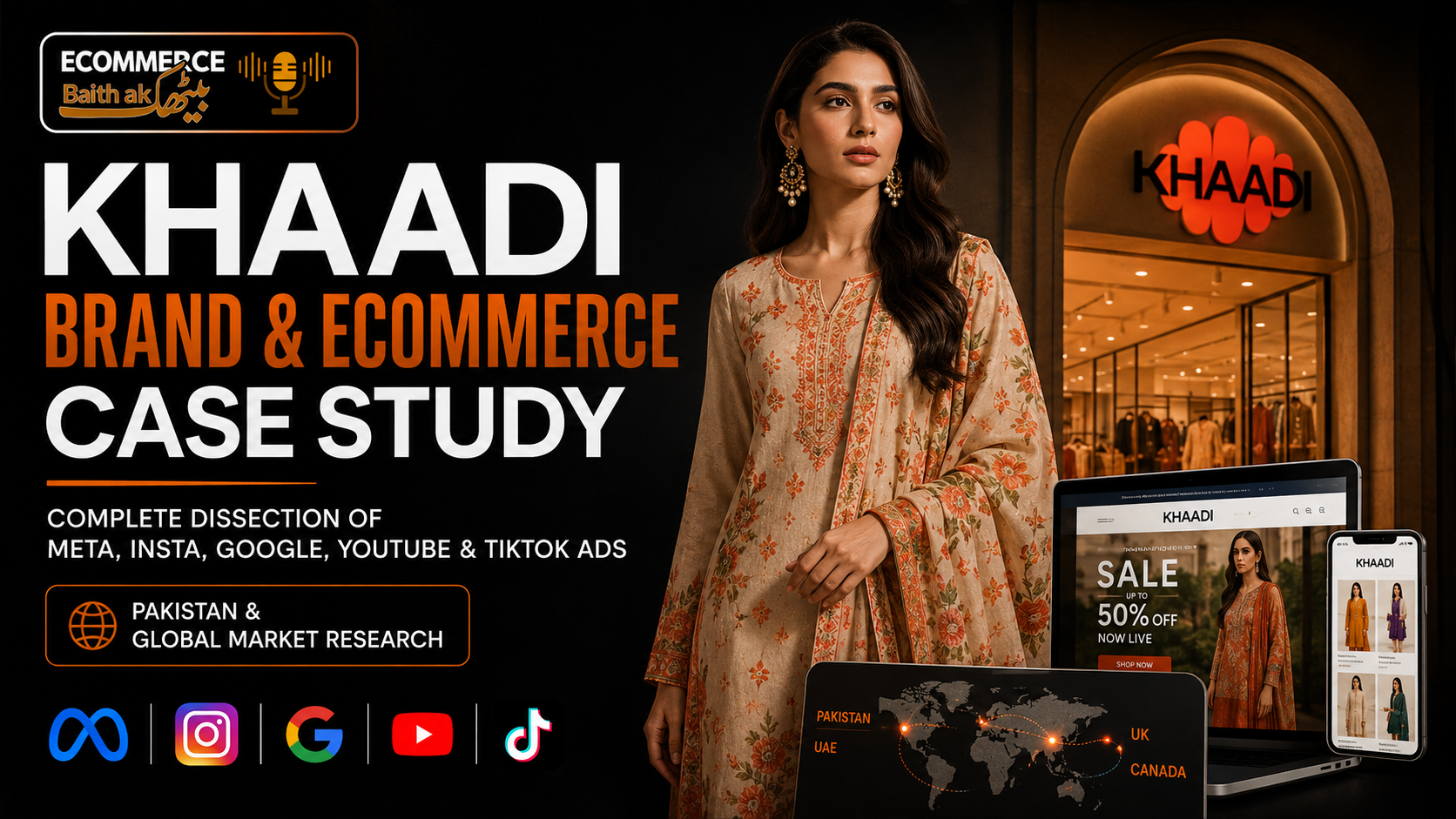
Khaadi: From One Handloom in Zamzama to Pakistan's Best-Known Fashion Name Ek dhaage se shuru hone wali kahani — Karachi se duniya tak.
A complete baithak-style breakdown of Khaadi's history, retail footprint, digital advertising across Facebook, Instagram, Google and TikTok, pricing, product lines, competition, and a full SWOT — built for anyone studying Pakistan's fashion ecommerce market.
The Story: How a Handloom Idea Became a Retail Giant
Khaadi is an Urdu word for hand-woven cloth. Shamoon Sultan, a textile-design graduate, opened his first shop in Karachi's Zamzama area with the simple idea of reviving handloom khaddar fabric for modern wardrobes. What began as a single small store selling handwoven fabric and basic kurtas grew — within a generation — into Pakistan's most recognised high-street fashion and lifestyle brand, with product lines spanning women's wear, menswear, kids, home textiles and fragrances, and a retail footprint across four continents.
The First Store, Zamzama
Shamoon Sultan launches Khaadi as a handwoven-fabric brand out of a small outlet in Karachi's Zamzama district — initially menswear and unstitched khaddar, pivoting fast once women's demand took over.
Ready-to-Wear Arrives
Khaadi pioneers the "ready-to-wear" concept in Pakistan's retail market, shifting shoppers away from a tailor-first culture toward off-the-rack fashion — a genuine category-creating move.
Khaadi Khaas Launches
A premium/luxury formal-wear line is introduced, stretching the brand upward into embroidered, occasion-wear territory without losing the everyday core range.
First International Move — UAE
Khaadi becomes one of the first Pakistani fashion retailers to go international, opening in Dubai and later Abu Dhabi.
Khaadi Kids & Khaadi Home
Category extension into children's wear and home textiles, turning Khaadi from a clothing label into a broader lifestyle brand.
UK Entry & the Fast-Fashion Pivot
Stores open in Birmingham's Bullring, Westfield London, Westfield Stratford City and Highcross Leicester. In 2015, Khaadi formally repositions as a fast-fashion retailer, with a 22,000 sq.ft flagship at Dolmen Mall Clifton, Karachi.
Khaadi Fragrances
The brand extends into perfumes and personal care, deepening its lifestyle positioning.
Pandemic Reset & The Experience Hub
Covid-19 forces a hard rethink of retail; Khaadi accelerates its online business and, working with Landor & Fitch on brand transformation, opens The Experience Hub in Dolmen Mall — a 32,000 sq.ft space combining retail with a café/food concept ("Kanteen"), turning the store into a destination rather than a transaction point.
IFC Invests $25 Million
The International Finance Corporation invests in Khaadi to support formal employment, supply-chain strengthening and gender-diversification programmes in a workforce where women make up a significant share of textile employment.
US Market Entry
Khaadi opens stores in the United States (Tysons Corner, Virginia; Houston, Texas; New Jersey), and today runs its global ecommerce operations for UK, UAE, Qatar, Bahrain, KSA, Europe, US and Canada through Weaves Group, headquartered in Dubai.
How Many Stores, How Many Square Feet
Khaadi's physical network has scaled steadily since the 2015 fast-fashion pivot — from a handful of boutiques to a multi-country mall-anchor chain. Store counts are publicly reported and change as leases turn over, so treat exact figures as directional rather than a live inventory.
| Market | Reported store count | Notable format / size | Store role |
|---|---|---|---|
| Pakistan | ~60 stores in ~30 cities | The Experience Hub, Dolmen Mall Karachi — 32,000 sq.ft with in-store café | Volume + flagship brand theatre |
| Karachi (Dolmen Mall Clifton) | Flagship location | 22,000 sq.ft store opened 2015 | Fast-fashion flagship |
| United Kingdom | Multiple stores (Birmingham, London, Leicester) | First UK store: 1,630 sq.ft, Bullring Birmingham (2014) | Diaspora + mainstream UK high street |
| UAE | Multiple stores since 2010 | Flagship near City Centre Mirdif, Dubai | First international entry market |
| Qatar & Bahrain | Store presence via Weaves Group | Mall-based format | GCC expansion |
| United States | Stores from 2024 onward | Tysons Corner (VA), Houston (TX), New Jersey | New diaspora + fashion-forward market test |
Offline vs Online: How Khaadi Splits Its Strategy
Offline / Retail Stores
- Mall-anchor stores in high-footfall locations (Dolmen, Park Towers, Emporium, Packages Mall)
- "Experience Hub" format — retail + café + events, not just a shop
- Trial, fitting and instant gratification for wedding/festive shopping — a category where Pakistani buyers still prefer touch-and-feel
- In-store staff drive up-sell across unstitched, pret and accessories in one visit
- Physical stores double as brand billboards in prime real estate
Online / Ecommerce
- khaadi.com (Pakistan) + global.khaadi.com run separately for international markets via Weaves Group
- Nationwide reach beyond the ~30 cities with physical stores
- Peak dependency during Eid, lawn-launch and winter sale windows when site traffic spikes hard
- Cash-on-delivery + card + wallets locally; card/PayPal-style checkout internationally
- Social commerce and WhatsApp-assisted ordering supplement the website for quick, low-friction sales
The pandemic accelerated this balance permanently: Khaadi has been explicit that Covid-19 forced a rebuild of its online capability, and the brand now treats ecommerce and retail as one connected system — buy online / return in store, browse in store / reorder online — rather than two separate businesses.

Khaadi — Facebook/Meta Ad Library Analysis
Market: Pakistan | Status filter: Active ads | Pulled: 1 September 2026 | Advertiser Page: Khaadi (verified brand page, "Clothing (brand)" category)
1. Executive Summary
Khaadi is currently running one integrated campaign across Meta's placements (Facebook, Instagram, Messenger, WhatsApp status, Threads) built around a single creative concept — "Let the pattern do the talking." The Ad Library shows roughly 12 active ad units in Pakistan, all launched on the same day (28 August 2026), which is the signature of a single campaign split into multiple ad variants for testing and placement optimization rather than 12 distinct campaigns. Ten of the twelve are near-identical static image ads, one is a 33-second video, and one is a boosted-post variant that routes to Facebook rather than the website. The strategy is a textbook "new season/new arrivals" push for Khaadi's Ready-to-Wear line, optimized for e-commerce click-throughs to pk.khaadi.com.
2. Campaign Overview
| Attribute | Detail |
|---|---|
| Advertiser | Khaadi (page also runs regional variants in UAE, UK, and Canada per Meta's "similar regional ads" panel) |
| Total active ads (PK) | ~12 |
| Campaign start | 28 Aug 2026 (all ads, same date) |
| Core message | "Let the pattern do the talking." |
| Headline | New Arrivals |
| Body copy | "Discover new arrivals in 2026. Find Ready to Wear dresses, Fabrics, women's co-ords, kurtas, pants and western tops at Khaadi Pakistan." |
| CTA button | Shop now |
| Primary destination | pk.khaadi.com (10 of 12 ads); 1 ad points only to "FB.com" (a Page post, not the site) |
| Placements | Facebook Feed, Instagram, Messenger, WhatsApp, Threads (all icons active on every unit) |
| Spend/reach data | Not disclosed — Pakistan isn't in a region where Meta requires spend/impression transparency for commercial (non-political) ads, so no budget, reach, or demographic data is available in the Library |
3. Ad Types & Formats Used
Khaadi is running three distinct format types within the same campaign:
A. Static single-image ads (the bulk, ~9 of 12 units). Each is a portrait/square product-style photo of a single female model wearing one printed or striped Ready-to-Wear piece (kurta, co-ord, or shirt), shot against a plain white or light-grey studio backdrop. Nearly every ad uses a different print/colourway (navy chevron stripes, black-and-white abstract geometric print, green-and-black tribal-style print, fine pinstripe), which strongly suggests these are automatically generated dynamic/catalogue-style creative variants — same layout and copy, different product images — used for creative rotation and audience testing rather than hand-built individual ads.
B. Video ad (1 of 12, 33 seconds). Structured in three acts: (1) opens tight on a model in a printed shirt with sunglasses — a "hook" shot with personality/attitude; (2) cuts to a 3×3 grid/lookbook collage of nine different models wearing nine different prints simultaneously — visually reinforcing "pattern variety" in one frame; (3) closes on a macro/close-up shot of fabric print texture, and elsewhere in the timeline a full-body shot against a clothes-rail backdrop suggesting a styled retail/runway environment. This is the most production-heavy asset and does the best job of literally delivering on the "let the pattern do the talking" concept. Meta's Library also flags this creative as reused — "2 ads use this creative and text" — i.e., it's running as more than one ad unit (likely different placements/aspect ratios).
C. Boosted Page-post variant (1 of 12). Visually identical product image to the static ads (green/black print co-ord) but with no description line, a "FB.com" destination instead of the website, and a slightly shorter format. This reads as an engagement/awareness ad (driving likes/comments/shares on the organic post) rather than a conversion ad — a different objective mixed into the same creative concept.
4. Creative & Visual Style Analysis
- Photography style: Consistent, clean e-commerce/editorial studio photography — plain neutral backgrounds (white/light grey), even lighting, no props or lifestyle context. This keeps total visual focus on the garment and print, which matches the "let the pattern do the talking" idea, but it also makes the ads feel more like a catalogue than a lifestyle campaign.
- Talent: All ads feature a single female model archetype (fair-to-medium skin tone, styled hair, minimal jewellery, neutral expression or slight styling pose). There is no visible variation in model age, body type, or presentation across the sampled ads — the entire set uses a narrow beauty standard.
- Color/pattern strategy: The unifying device is print/pattern diversity — stripes, chevrons, geometric prints, and abstract motifs — while everything else (background, pose, framing, typography, CTA) stays fixed. This is a strong, disciplined "system" for a seasonal collection push.
- Branding: The Khaadi logo/profile picture anchors every unit; there's no additional on-image text, logo watermark, or price/discount callout burned into the creative itself — text is carried entirely in the caption and link description, not the image.
- Video vs. static coherence: The video's grid-collage and macro fabric shot are more dynamic and tactile than any of the static images, and arguably the strongest single asset in the set — but it's outnumbered roughly 9:1 by static images, so most of the audience's actual exposure will be to the more static, catalogue-style version of the concept.
5. Copywriting Analysis
- Primary text ("Let the pattern do the talking.") is short, on-brand, and repeated verbatim across every single ad with zero copy testing/variation — no alternate hooks, no urgency, no offer, no seasonal framing beyond "2026."
- Headline ("New Arrivals | Ready to Wear") and description ("Discover new arrivals in 2026. Find Ready to Wear dresses, Fabrics, women's co-ords, kurtas, pants and western tops at Khaadi Pakistan.") are functional and keyword-heavy (dresses, fabrics, co-ords, kurtas, pants, western tops) — good for covering multiple product categories in one line, but generic and not tailored per creative (e.g., the striped-shirt ad and the tribal-print ad carry identical copy despite showing different products).
- CTA is a single, safe choice ("Shop now") throughout — no variant testing (e.g., "Explore the Collection," "See New Arrivals").
- No pricing, discount, or promotional urgency anywhere in the sampled ads — this is a brand/collection-awareness push, not a sale-driven direct-response campaign.
6. Strategic Read: What Khaadi Appears to Be Doing
This looks like a single always-on "new season" catalogue campaign, launched in one batch, that leans on Meta's automatic placement and creative-variant delivery (many image versions of the same template + one hero video + one engagement-objective variant) rather than a hand-curated set of distinct ad ideas. It's an efficient, low-effort-to-produce structure — one shoot, one copy block, many crops/products — built for reach and consistency rather than novelty or storytelling.
7. Positives (Strengths)
- Strong creative consistency: identical tagline, layout, and CTA across every ad builds immediate brand recognizability regardless of which specific unit a user sees.
- Clear single-minded concept: "let the pattern do the talking" is a simple, ownable idea that's easy to execute at scale and easy for the audience to grasp instantly.
- Good format diversity for delivery: mixing static images, a video, and a Page-post/engagement variant gives Meta's delivery system more creative options to optimize against different placements (Reels vs. Feed vs. Stories) and objectives (clicks vs. engagement).
- Full placement coverage: every ad is eligible across Facebook, Instagram, Messenger, WhatsApp, and Threads, maximizing potential reach without extra creative work.
- The video ad is genuinely well-made: the hook shot + grid collage + macro fabric texture sequence is the strongest execution of the core idea in the whole set, and shows the team can produce more ambitious content when they choose to.
- Clean, distraction-free product photography keeps attention on the garments, which suits a fashion/retail catalogue objective.
8. Negatives (Weaknesses & Risks)
- Zero copy variation across ~12 ads is a missed opportunity — there's no A/B testing of hooks, no urgency, no pricing/promo angle, and no personalization of description text to the specific product shown. This makes optimization harder and risks ad fatigue quickly, since every exposure looks and reads the same.
- Repetition/ad fatigue risk: because 9+ ads share the same tagline, layout, and CTA, a user who sees more than one in their feed will likely perceive it as literally the same ad, not a fresh message — this can suppress performance (lower CTR, rising frequency) faster than a genuinely varied creative set would.
- Lack of model/representation diversity: every sampled ad uses a visually similar single model type — no visible variation in body type, age, or styling context — which narrows relatability for a broad Ready-to-Wear audience.
- No lifestyle or context photography: all-studio, all-white-background execution is safe but flat; there's no in-use/lifestyle imagery (street style, occasion-based styling) that could build more aspirational or occasion-driven appeal (e.g., for festive, formal, or daily-wear positioning).
- No urgency or offer mechanics: with no discount, limited-time framing, or stock/scarcity cues, the campaign leans purely on brand affinity — likely fine for awareness, but weaker for driving immediate conversion versus competitors running promotional messaging.
- Inconsistent objective mixing without clear signalling: the "FB.com"-destination variant (engagement/boost) is visually identical to the conversion-focused ads, which could confuse performance reporting or simply be a lower-value ad unintentionally competing for the same impressions/budget as the direct-to-site ads.
- No visible price, size range, or availability info in copy — a user has to click through with no idea of cost before landing on the site, which can hurt click quality/intent.
- Static images significantly outnumber the stronger video asset (~9:1), so most audience impressions get the less dynamic version of the idea rather than the best-performing creative type.
9. Recommendations
- Introduce 2–3 copy variants (different hooks/CTAs) to test against the current control and reduce fatigue risk.
- Add at least one lifestyle/occasion-based creative set (festive wear, workwear, casual daily) rather than 100% studio-white backgrounds.
- Expand model diversity across the rotation to widen relatability.
- Weight delivery/spend more toward the video asset, which is the strongest execution of the brand idea, and consider producing 1–2 more short-form video variants (9:16 for Reels/Stories) rather than relying mainly on static images.
- Separate engagement-objective ads clearly from conversion ads in campaign structure so budget isn't unintentionally split between a Page-engagement post and direct-to-site traffic ads using the same creative.
- Test a light urgency/offer layer (e.g., "New season just dropped," limited sizes, or a seasonal discount) for at least one variant to compare against the pure-awareness message.
POSITIVES:
The clearest way to put it: the single best part of Khaadi's strategy was the video — the hook shot into the nine-model print grid into the macro fabric close-up. It's the one piece of creative that actually delivers on the tagline "let the pattern do the talking" instead of just stating it, and it's genuinely more engaging than anything else in the set.
The single worst part is the total lack of variation across the other ~11 ads. Same tagline, same layout, same CTA, same white studio background, repeated verbatim a dozen times with only the garment swapped out. That's the one decision that undercuts everything else — it caps how much a repeat viewer can stay interested, since every exposure reads as the same ad.
Beyond those two standouts, the broader positives were consistency and coverage: instant brand recognizability from the repeated tagline and layout, full placement spread across Facebook, Instagram, Messenger, WhatsApp and Threads, and clean, distraction-free product photography that keeps focus on the clothes.
NEGATIVES:
The broader negatives were the flip side of that same discipline: no lifestyle or occasion-based imagery (everything is flat studio-white, nothing shows the clothes actually being worn out in the world), a narrow, single model type with no visible diversity, and no pricing, urgency, or promotional hook anywhere in the copy — so the whole campaign runs purely on brand affinity with nothing pushing someone to act now rather than later. There's also a structural weak point worth flagging: the one ad that routes to Facebook instead of the website uses the same product photo as the conversion ads, which risks quietly splitting budget between an engagement objective and a sales objective without any visible distinction between the two.
International Market Ads:

United States — This is actually the one hiding under the "Canada and other locations" label in Meta's regional list. It's currently running 6 active ads, all started 29 Aug 2026 (one day after the Pakistan campaign), using the identical "Let the pattern do the talking" concept and the same studio-shot single-model format — but with a US-specific print assortment (a black polka-dot/circle print I didn't see in the Pakistan set) and US-specific copy: PayPal payment messaging, "shipped from the US," and "kurtas, pants, shalwars and western dresses" instead of Pakistan's "co-ords and fabrics" phrasing. It also has the same video creative and the same FB.com engagement-post variant. Essentially a near-identical clone of the Pakistan campaign, localized.
Canada — Zero ads, active or historical. Despite the page being labeled "Canada and other locations" in Meta's system, there's no evidence Khaadi is actually targeting Canadian users directly right now; that label seems to cover the US operation instead.
United Arab Emirates — Zero ads, active or historical. No sign of any Meta advertising activity for this market at all currently.
United Kingdom — Zero active ads right now, but a large historical record (~2,200 total results, all inactive). This is the most mature and most promotional-heavy of all the regional operations. Past campaigns include a Boxing Day Sale (50% off, live online 25 Dec–in stores 26 Dec), an Eid Collection push (festive fits), and multiple sale waves through spring and summer 2026 at 30–50% off with actual "Was £X / Now £Y" pricing shown directly in the ad. Copy consistently pushes urgency and financing — "Sale is now live," Clearpay and Klarna buy-now-pay-later messaging, easy returns, UK-only shipping — and several ads use short video (10–15 seconds). The last UK campaign ended 1 Aug 2026, so the market is currently in a gap between pushes rather than running anything live.
The overall pattern: Pakistan and the US are running the same evergreen, discount-free "new arrivals" brand campaign in parallel: quiet, consistent, no urgency. The UK is a completely different playbook when it's active — aggressive, price-led, sale-and-holiday-driven, with financing options built into the copy. And UAE/Canada currently show no Meta ad activity at all, which either means those markets are being served through other channels (in-store, email, a different platform) or aren't actively targeted on Meta right now.
Khaadi — Google Ads Transparency Center Analysis
Market: Pakistan | Advertiser of record: Weaves Pakistan (SMC-Private) Limited (identity verified by Google, based in Pakistan) | Domain: khaadi.com | Pulled: 1 September 2026
1. Executive Summary
Google's Ads Transparency Center shows roughly 200 ads run by Khaadi's legal entity, Weaves Pakistan (SMC-Private) Limited, targeting Pakistan, with data available going back to 2018 and the most recent ad last shown on 31 August 2026 — meaning the account is currently active. Unlike Khaadi's Meta campaign in Pakistan, which is a single evergreen "new arrivals" brand push with zero discounting, the Google Ads account is overwhelmingly a direct-response, discount-driven sales channel: Search ads lead with "up to 50% off," Display banners carry sale badges baked directly into the creative, and even the video ad is framed around a specific promotion. This is a meaningfully different playbook from the same brand on a different platform, and the contrast is one of the most interesting findings here.
2. Account & Format Breakdown
| Attribute | Detail |
|---|---|
| Legal advertiser | Weaves Pakistan (SMC-Private) Limited — identity verified |
| Total ads (Pakistan, all-time) | ~200 |
| Format mix | Image/Display: ~142 ads (majority) · Text/Search: 38 ads · Video: 20 ads |
| Platforms seen | Google Search, Google Display Network (incl. third-party publisher partners), YouTube/video partners, Google Shopping (only 2 ads — minimal use), Google Maps and Google Play (not observed) |
| Historical range | Ad data available back to May 2018 |
| Most recent activity | Last shown 31 Aug 2026 (i.e., still running as of the day before this pull) |
3. What the Ads Actually Say and Look Like
Search (text) ads split into two clear buckets. One bucket is straightforward brand-navigational: "Khaadi PK – Khaadi Official Online Store," pointing simple shoppers to the site with generic sitelinks (Ready to Wear Collection, Embroidered Formal Wear, Fabrics Collection). The other, larger bucket is aggressively promotional: headlines like "Enjoy up to 50% Off Sale – Co-ord Sets at Up to 50% Off," "Khaadi Sale | Up to 50% Off – Now at Up to 50% Off," and a culturally-timed "Khaadi Azadi Sale 2026" (tied to Pakistan's independence day). These ads are stacked with sitelink extensions — "3 Piece Khaadi Suit on Sale," "Fabrics Sale," "Ready to Wear Sale," "New Arrivals" — packing multiple entry points into a single ad unit, which is a classic high-intent, high-conversion search tactic.
Display (image) ads are the dominant format by volume and look nothing like the Meta creative. Instead of clean studio product shots, these are lifestyle-style banners — for example, a model in an embroidered kurta shot against a scenic mountain backdrop, with a bold "KHAADI SALE UP TO 50% OFF — FURTHER REDUCTIONS" graphic overlaid directly onto the image, plus a supporting headline ("Khaadi Sale on Kurtas") and body copy underneath naming specific product types (kurtas, shalwars, dupattas) and the discount. The sale messaging is baked into the creative itself, not left to the landing page.
Video ads run through Google's video/display partner network (shown with a "Sponsored" partner placement rather than natively on YouTube's own feed in the example captured). The one reviewed is notably more editorial and emotive than anything on Meta: a tight, dramatic close-up of a model in gold jewellery pulling a printed dupatta/scarf across her face against a deep maroon backdrop, captioned "Khaadi Summer Sale. Buy printed and embroidered co-ord sets at up to 50% Off sale at Khaadi." It's a stronger, more culturally-rooted piece of creative than the flat product photography used elsewhere, similar in spirit to Meta's one standout video but with a heavier sales hook attached.
Shopping ads are essentially a non-factor — only 2 were found, suggesting Khaadi is not leaning on Google Shopping/product-feed listings as a meaningful acquisition channel in Pakistan, despite running an e-commerce site that would be a natural fit for it.
4. Cross-Channel Comparison: Google vs. Meta (Pakistan)
This is the headline finding. On Meta, Khaadi Pakistan runs one quiet, discount-free "let the pattern do the talking" brand campaign with clean studio photography and no urgency. On Google, the same brand runs a much larger (~200 ad), much noisier, almost entirely promotion-led operation: "50% off," "Azadi Sale," "Summer Sale," sitelinks stacked with sale pages, and sale graphics baked into the display creative. In other words, Meta is being used for brand-building and top-of-funnel reach, while Google is being used as the primary conversion and sales engine. This mirrors what we found on Khaadi's UK Meta page — which is also heavily promotional and financing-driven when active — suggesting Khaadi's broader playbook is "brand content on social, hard sell on search/display," at least in the markets and platforms sampled.
5. Positives (Strengths)
- Full-funnel format coverage: Search captures high-intent shoppers, Display/image ads build reach and retarget browsers, and video adds an emotive, editorial layer — a much more complete format mix than the Meta side alone.
- Aggressive, clear promotional messaging: "Up to 50% off" stated plainly in headlines and creative is unambiguous and likely to drive strong click-through and conversion intent compared to vaguer brand messaging.
- Sitelink-rich Search ads do a good job surfacing multiple product categories (co-ords, fabrics, formal wear, sale pages) in a single ad unit, increasing the odds of matching a searcher's specific intent.
- Verified advertiser identity builds a baseline of trust/transparency for anyone checking the brand through Google's own tools.
- The video creative is genuinely strong — more atmospheric and culturally resonant than the flatter Display banners, and a good example of Khaadi's team being capable of higher-craft work when they invest in it.
- Long-running account (since 2018) indicates sustained, consistent investment in the channel rather than a one-off campaign.
6. Negatives (Weaknesses & Risks)
- Heavy, near-constant discounting risk: if "up to 50% off" is the default message across most Search and Display creative rather than an occasional event, it risks training price-sensitive customers to never buy at full price and can erode perceived brand value over time — a classic risk of a promotion-led paid search strategy.
- Visual inconsistency with the brand's own Meta creative: the clean, minimal studio aesthetic used on Facebook/Instagram is largely abandoned on Google Display in favor of banner-ad-style sale graphics with bold overlay text — a shopper who sees both is getting two quite different brand impressions.
- Shopping ads are barely used (2 ads found), which is a likely missed opportunity for an apparel e-commerce business — Shopping/product-listing ads typically perform very well for retail because they show the product, price, and image directly in search results.
- Text-ad creative leans generic in the "official store" bucket — headlines like "Khaadi PK – Khaadi Official Online Store" do little to differentiate or persuade beyond brand recognition, essentially just capturing branded-search traffic that would likely convert organically anyway.
- No visible evidence of remarketing-specific or urgency-based dynamic creative (e.g., "items left in your cart," countdown timers) in the sample reviewed — the promotional lever pulled is almost always a blanket percentage discount rather than more targeted tactics.
- Reliance on discount-network partner placements for video (the "Sponsored/P" partner badge rather than native YouTube in-stream) may reach lower-attention inventory compared to in-feed YouTube placements, depending on where exactly these are served.
7. Recommendations
- Test a non-discount brand/quality-led message on at least a portion of Search and Display spend, mirroring the Meta brand campaign, to see whether it can convert without a 50%-off anchor.
- Build out a proper Google Shopping feed — for an apparel retailer with a large product catalogue, this is normally one of the higher-ROI formats and is currently almost unused.
- Align Display creative more closely with the cleaner brand aesthetic used on Meta, or intentionally differentiate the two with a clear rationale (e.g., Display = sale-driven performance layer, Meta = brand layer) rather than an apparently unplanned split.
- Expand video investment given it's clearly the strongest creative in the account — consider more native YouTube in-stream/in-feed placements rather than relying mainly on partner network delivery.
- Layer in urgency/personalization tactics beyond blanket discounts — cart abandonment remarketing, limited-time countdowns, or new-arrival-specific messaging — to reduce dependence on price as the only lever.

04 · Digital Advertising, DURING SALE DAYS END OF JULY 2026 ANALYSIS:
Social Media & Ad Strategy: Facebook, Instagram, Google, TikTok

This is the standard playbook fashion retailers like Khaadi run on each platform in Pakistan's market — built from how the brand's channels, catalogue and seasonal calendar behave. Treat the tactics as a strategic framework rather than a leaked media plan.
Based on a comprehensive audit of Meta, Instagram, Google Search, Google Display, YouTube, Google Shopping and TikTok, Khaadi operates one of Pakistan's most mature always-on digital advertising ecosystems, but significant optimization opportunities remain. On Meta, the brand has ~3.7 million Facebook followers and ~6 million Instagram followers, yet only 13 active ads in Pakistan across 2 core campaigns, primarily promoting Sale (Up to 50% Off) and New Arrivals. The account demonstrates solid performance marketing fundamentals through full-platform delivery across Facebook, Instagram, Messenger, Audience Network and Threads, dynamic catalog ads, and consistent landing pages. However, creative diversity is limited, with 10 static images, 2 videos and only 1 dynamic catalog ad, while there is no carousel advertising, no UGC or influencer ads, no visible retargeting campaigns, no vertical-first Reels creative, and no urgency mechanics such as countdowns or low-stock messaging. Internationally, Meta execution is stronger, with localized campaigns in the UK and UAE using region-specific BNPL providers, shipping incentives and seasonal messaging, while Canada currently has no active Meta advertising, leaving an untapped market. On Google, Khaadi runs an extensive always-on program with approximately 200 active creatives in Pakistan, including 64 Display creatives, 48 Search ads and 21 YouTube video ads, supported by verified advertiser status and responsive creative variations. Search campaigns are well optimized with sitelink extensions and seasonal promotions, while Display and YouTube maintain consistent premium branding. However, Google Shopping is significantly underutilized with only 3 Shopping listings in Pakistan, despite being one of the highest-converting formats for fashion e-commerce. Internationally, the UK leads with over 120 Google creatives and 38 Google Shopping listings, demonstrating a true full-funnel, product-feed-driven strategy, while the UAE operates 35 creatives focused mainly on the Pakistani diaspora and Canada only 14 Search ads with no Shopping, Display or YouTube presence. Across all platforms, the audit identified several recurring weaknesses including an overdependence on discount-led messaging, repetitive creative concepts, limited emotional brand storytelling, inconsistent QA issues such as incorrect destination URLs, no Urdu-language advertising, minimal local store marketing through Google Maps, and a heavy reliance on static brand-produced content. The most critical finding is TikTok, where despite being Pakistan's fastest-growing product discovery platform for Gen Z shoppers, Khaadi has approximately 30,000 followers and no official TikTok advertising whatsoever, while third-party resellers are actively promoting Khaadi products using TikTok ads. Overall, Khaadi possesses a strong digital marketing foundation with broad platform coverage and international expansion, but the audit reveals substantial growth opportunities through creator-led content, TikTok commerce, Google Shopping and Performance Max expansion, stronger retargeting, vertical-first video, localized creative, and a greater balance between brand storytelling and discount-driven performance marketing, positioning the brand to significantly improve customer acquisition, engagement and long-term digital growth.
Broadest-reach channel; still Pakistan's largest social user base across all age groups.
Formats used- Catalogue/dynamic product ads (retargeting cart abandoners)
- Collection ads for new lawn/winter drops
- Click-to-WhatsApp ads for assisted ordering
- Boosted video for collection launches
- Lookalikes from purchaser/website-visitor lists
- City + gender + interest layering (e.g., women 20–45, fashion/beauty interests, Tier-1 cities)
Primary visual storefront — highest engagement channel for a fashion-forward, urban, mobile-first audience.
Formats used- Reels for lookbooks, styling and behind-the-scenes shoots
- Shoppable posts / Instagram Shop tagging products directly
- Stories with swipe-up/link stickers during sales
- Influencer & micro-influencer seeding for collection launches
- Instagram content typically drives more likes/comments per post than Facebook for fashion brands
- Feeds directly into UGC that gets reposted to Stories for social proof.

Inside Khaadi's Meta & Instagram Ad Strategy: A Complete Breakdown
A deep-dive analysis of Khaadi's active Facebook and Instagram advertising, based on a full review of the Meta Ad Library.
Khaadi is one of Pakistan's most recognizable fashion retailers, and its Meta advertising account offers a great real-world case study in how an established fashion brand runs performance marketing at scale. Below is a complete breakdown of what Khaadi is running, how it's structured, what's working well, and where the gaps are.
Brand & Page Snapshot
- Page created: December 2008 — a long-established, verified brand asset
- Facebook followers: ~3.7 million
- Instagram followers: ~6 million
- Managed by: Khaadi Pakistan (SMC-Private) Limited, with admins based in Pakistan
- Global footprint: Khaadi also runs parallel active ad campaigns in the UK, UAE, and Canada, showing a coordinated international marketing operation rather than a one-off local push
Total Ad Volume
- ~13 active ad units currently running under the Pakistan Page
- These fall under just 2 distinct creative campaigns
- One "ad" is actually a dynamic unit cycling through 6 different product images, so the real number of unique visuals in circulation is higher than the headline count suggests
Campaign Breakdown
Campaign 1: "Your Favourites Restocked – Up to 50% Off"
- 4 total ad units
- 1 unit is a dynamic/catalog-style ad rotating 6 product images (different colors/styles), each with its own real strikethrough price (e.g., "Was PKR 3,500 → Now PKR 1,750")
- 3 units are identical static images of three models together under a bold "SALE" tag
- All four link to the same sale collection page on PK.khaadi.com
Campaign 2: "An Outfit for Wherever the Day Takes You" (New Arrivals)
- 9 total ad units
- 2 units share one 37-second lifestyle video (car interior shots, styling close-ups, ambient textures)
- 7 units are static outdoor lifestyle images of a model in a garden/home-exterior setting
- Almost all link to the New Arrivals page, except one outlier that oddly links to fb.com instead
- One unit uses a mismatched "See details" CTA instead of the "Shop now" used everywhere else
Ad Formats Used
- Single static image — the dominant format (10 of 13 units)
- Dynamic/catalog-style multi-image ad — 1 unit, cycling 6 variants with individual pricing
- Video — 2 units sharing one 37-second asset
- Carousel format — none found
- Collection/storefront format — none found
- Vertical, Reels/Stories-native video cuts — none found; assets look feed-cropped rather than purpose-built
Visual Styles in Rotation
- Studio catalog style — clean light background, one product per frame, price front and center
- Group "sale event" style — multiple models together, bold SALE tag, energetic and promotional
- Outdoor editorial/lifestyle style — single model, natural garden/home backdrop, soft aspirational tone
- Video moodboard style — quick-cut, ambient, native-feeling edit designed to blend into Reels/Stories
Oldest vs. Newest Ads
- Oldest active ads: the 3 static "SALE" group-shot units, launched 12 June 2026
- Dynamic sale ad: launched slightly later, 29 June 2026
- Newest campaign: the entire "New Arrivals" set (video + static), launched 3–4 July 2026
- In short: one ~3.5-week-old sale push is running alongside a brand-new arrivals campaign just days old
What Khaadi Is Doing Well
- Full-funnel platform coverage — every ad runs across Facebook, Instagram, Messenger, Audience Network, and Threads simultaneously, maximizing Meta's ability to find cheap impressions
- Built-in creative testing — multiple ad units share identical creative but different Library IDs, pointing to deliberate testing across audiences/ad sets
- Smart use of dynamic creative — the 6-version rotating sale ad lets Meta's algorithm shift budget toward whichever product/price combo converts best, rather than betting on one static image
- Offer-led, dual-purpose copy — pairs an emotional hook ("an outfit for wherever the day takes you") with a functional line naming specific product categories, appealing to both browsers and intent-driven shoppers
- Aspirational, native-feeling visuals — real outdoor lifestyle settings and Reels-style video editing instead of flat studio shots
- Consistent landing pages — most ads route to a matching, theme-specific page rather than a generic homepage
- Strong brand authority — a 15+ year-old verified Page with millions of followers adds built-in trust
Negatives, Gaps & What's Missing
- Very limited creative variety — only 2 real campaign concepts are live at once, risking fast ad fatigue for repeat viewers
- No carousel or collection ads — a format proven to perform well in fashion e-commerce by showcasing multiple products and linking straight to product pages
- No UGC or influencer/testimonial content — everything is polished, brand-produced photography, missing the "native," trust-building feel of creator content
- Execution inconsistencies — one ad uses a different CTA button ("See details" vs. "Shop now"), and one links to fb.com instead of the actual storefront
- No real urgency mechanics — sale ads rely only on the discount percentage, with no countdowns, stock indicators, or offer deadlines
- No visible retargeting strategy — no cart-abandonment ads, dynamic product retargeting, or "still thinking about it?" messaging for warm audiences
- No vertical-first video — all assets appear built for feed rather than shot specifically for Stories/Reels
Best Practices Khaadi Should Adopt
- Introduce UGC or creator-style content into the rotation to build trust and add variety
- Build proper dynamic retargeting campaigns for site visitors and cart abandoners
- Test carousel or collection ads linking directly to individual products
- Add genuine urgency mechanics (real countdowns, live stock indicators) to sale campaigns
- Produce dedicated vertical video cuts for Stories and Reels instead of reusing one feed asset everywhere
- Run a basic QA pass across all live ads so CTAs and destination URLs stay consistent — small mismatches like the ones found here quietly erode performance at scale
Summary of Local Ads:
Khaadi's Meta advertising is well-structured at the foundation — broad placement coverage, dynamic pricing creative, and consistent landing pages show a mature, intentional setup. But the account is currently coasting on just two creative concepts with no carousel, UGC, retargeting, or vertical video presence, which are exactly the formats driving the strongest returns for fashion e-commerce advertisers right now. Closing that gap is the clearest opportunity for improvement.
Khaadi's Global Meta Ad Strategy: UAE, UK & Canada Deep-Dive
Following the Pakistan analysis, I reviewed Khaadi's Meta Ad Library presence in three more markets — UAE, UK, and Canada — using the same page-by-page approach (checking every ad, its "multiple versions," format, copy, and destination). Here's the complete regional breakdown.
United Arab Emirates (UAE)
Ad Volume & Campaign
- ~7 active ad units, all under one single campaign: "The best-dressed version of you starts here"
- All 7 units launched on the same date, 1 July 2026 — a coordinated, single-day campaign rollout rather than a staggered test
- Offer: "50% Off Sale | Now Live", positioned as a sitewide sale rather than a specific category
Formats Used
- Static images — the majority format, including a bold graphic-overlay creative reading "SALE 50% OFF EVERYTHING (Excluding New Arrivals) — NOW LIVE" in a vertical, Stories-friendly crop
- Editorial portrait shots — close-up model shots in embroidered outfits with statement jewelry, styled more like a fashion editorial than a plain product photo
- One 10-second video — a close, intimate shot of a model adjusting a shawl/scarf, shorter and more "scroll-stopping" than Pakistan's 37-second video
Regional-Specific Strategy
- Copy explicitly calls out local payment and logistics incentives: "Get free shipping on orders over 300 AED and enjoy easy payments via Tamara & Tabby" (Tamara and Tabby are popular Gulf-region buy-now-pay-later services)
- This is a smart localization touch — Pakistan's ads never mention shipping thresholds or BNPL, but the UAE ads lead with it every time
United Kingdom
Ad Volume & Campaigns
-
~10 active ad units, split across two campaigns:
- "Explore what's trending with our best-selling styles this season" — a single, evergreen browse-style ad, and the oldest active ad in the entire UK account, running since 29 June 2026
- "The best-dressed version of you starts here" — the main sale push, launched 1 July 2026, mirroring the UAE campaign's headline almost word for word
Formats Used
- Two dynamic/catalog-style ads ("multiple versions" ads), each cycling through several product images with real discount pricing (e.g., "Was £30 → Now £15" and "Was £50 → Now £25") — the same dynamic-creative approach seen in the Pakistan sale campaign
- Single static images for most other units, including sub-themes like "50% Off | Tailored Sets," "50% Off | Sale," and "All Under £15"
- The same bold "SALE 50% OFF — NOW LIVE" graphic banner creative used in the UAE campaign, confirming this asset is shared/reused across regions rather than built separately for each market
Regional-Specific Strategy
- Copy highlights UK-specific trust and payment signals: "Enjoy easy returns and flexible Clearpay or Klarna payments. Orders ship from the UK." — swapping in the BNPL providers relevant to the UK market (Clearpay/Klarna vs. UAE's Tamara/Tabby)
- Explicit "ships from the UK" messaging addresses a common overseas-retailer objection (shipping delays/customs), which is a thoughtful, market-specific trust signal not used in Pakistan or UAE copy
Execution Issues Found
- 2 of the 10 ad units link to fb.com instead of UK.khaadi.com — the same type of broken/inconsistent destination URL issue found in the Pakistan account, suggesting this is a recurring setup oversight across markets rather than a one-off mistake
Canada
Ad Volume
- Zero active ads — Khaadi is currently running no Meta or Instagram ads targeting Canada
- Checking both "Active ads" and "All ads" filters confirmed the same result: "This advertiser isn't running ads in the selected country and ad category at this time"
- Interestingly, the Page listed under "Canada and other locations" is actually @KhaadiUSA, indicating this single Page is meant to cover North America broadly (US + Canada), but it currently has no live campaigns in either the Ad Library filter for Canada
Cross-Region Comparison
- Shared creative DNA: the UAE and UK campaigns use identical headline copy ("The best-dressed version of you starts here") and at least one identical graphic sale banner, showing Khaadi builds a master international creative kit and localizes only the offer/payment copy per market, rather than producing fully custom creative for each region
- Dynamic/catalog-style pricing ads appear in both Pakistan and the UK, suggesting this is a deliberate, repeated tactic across markets rather than a one-off experiment
- Localized trust signals differ by market: Pakistan's ads focus purely on price and restocking; UAE and UK both add payment flexibility (BNPL) and logistics reassurance (shipping cost/origin), showing more mature, objection-handling copy in the more competitive international markets
- The fb.com destination-link error appears in both Pakistan and UK accounts, reinforcing that this is likely a systemic account-setup issue worth flagging to Khaadi's marketing team
- Canada is a clear gap: with zero active ads, Khaadi is leaving an entire market's paid social presence dormant, despite maintaining a dedicated, verified Page there
Best Ad Types Across All Regions (Structural Assessment)
- The dynamic/catalog-style multi-version ads (seen in Pakistan and UK) remain the structurally strongest format, since Meta's delivery system can automatically favor whichever product/price variant performs best
- The UAE's short-form 10-second video is a stronger native-video approach than Pakistan's 37-second cut, since shorter videos generally hold attention better in feed and Reels placements
- The vertical "SALE" graphic banner shared between UAE and UK is a strong, scroll-stopping design choice — bold typography and high contrast make it more attention-grabbing than Pakistan's plain strikethrough-price format
Oldest Ads by Region
- Pakistan: oldest active ads started 12 June 2026 (sale campaign)
- UK: oldest active ad started 29 June 2026 ("Explore what's trending")
- UAE: all ads started on the same date, 1 July 2026 — no older ad exists
- Canada: not applicable — no active ads currently running

Captures existing intent — people already searching for the brand or a product category.
Formats used- Search ads on branded terms ("Khaadi sale", "Khaadi lawn 2026")
- Shopping ads (Performance Max/product feed) surfacing SKUs with price and image
- YouTube pre-roll for major seasonal campaign films
- Remarketing display network for site visitors who didn't check out
- Organic search is typically the single largest traffic source to khaadi.com — paid search protects that branded real estate from competitors bidding on it
-

Khaadi on Google Ads: A Deep-Dive Analysis of Its Advertising Presence
Using Google's Ads Transparency Center, I examined the advertising activity of Khaadi, one of Pakistan's largest fashion and lifestyle retail brands, whose Google campaigns are legally run under the entity Weaves Pakistan (SMC-Private) Limited, based in Pakistan. The account carries a "verified identity" badge from Google, and across the Pakistan region alone the transparency tool surfaces roughly 200 distinct ad creatives spanning search text ads, display images, and video, with the most recent creatives still being served as of early July 2026 — meaning the brand runs an essentially always-on, continuously refreshed advertising program rather than short isolated bursts.
Scale and Format Breakdown
Khaadi's Google advertising is spread across three core creative formats. Image-based display and Discovery-style ads make up the largest share, with 64 distinct creatives identified, followed by 48 text-based Search ads, and 21 video ads. On the platform side, Google Search carries the bulk of visible activity with 63 ad instances, while Google Shopping shows only 3 listings. YouTube also carries video inventory, and there is no meaningful visible presence on Google Maps or Google Play, which is unsurprising for a fashion retailer without a dedicated app-install goal.
Each individual creative in the transparency tool is typically catalogued with two to three "variations," indicating that Khaadi relies on Responsive Search Ads for text and multiple aspect-ratio or audience variants for image and video creatives — a standard sign of automated testing rather than single static ad units.
Search (Text) Ads
The Search campaigns center heavily on promotional intent. Headlines follow a consistent pattern built around seasonal sales and discount percentages, commonly referencing "up to 50% off" or "up to 70% off" framed around specific occasions such as Eid or summer lawn season. Descriptions reinforce the same discount angle and mention specific product categories like kurtas, co-ord sets, and lawn fabrics. The ads make heavy use of sitelink extensions, branching out to categories such as ready-to-wear, casuals, the Signature line, and dedicated Eid sale pages, which gives searchers multiple direct entry points into the site rather than a single generic landing page. Notably, Khaadi also runs Search ads pointed at its international storefront (for the US market), suggesting a deliberate strategy to capture demand from the Pakistani diaspora abroad, not just domestic shoppers.
Display and Image Ads
The image ad set is visually polished and consistent with Khaadi's brand identity: professional lifestyle photography featuring models in traditional and contemporary Pakistani outfits, often set in garden or outdoor lifestyle scenes, with the brand's red-orange floral logo mark placed prominently. Many creatives are essentially sale banners overlaid on this same lifestyle photography, again tied to specific seasonal campaigns like Eid specials or summer collections. The visual language is cohesive across creatives, reinforcing brand recognition, though the repeated use of similar settings (garden backdrops, similar poses, similar color grading) across many banners does create a degree of visual sameness.
Video Ads
Video creatives follow a short-form, vertical, editorial-style format typical of YouTube in-stream, Shorts, or Demand Gen placements — muted autoplay clips showing models in embroidered or printed outfits against aspirational backdrops such as coastal or garden settings, again tied to new-collection or sale messaging. These appear designed for top-of-funnel brand awareness rather than direct response, complementing the more transactional Search ads.
Shopping Ads
This is one of the more surprising findings: despite being a large apparel retailer with an extensive product catalog, only 3 Google Shopping listings were found. For an e-commerce fashion brand, Shopping ads (or a Performance Max campaign built on a product feed) are typically a high-performing, high-intent channel since they show product image, price, and a direct link at the exact moment a shopper searches for a specific item. Khaadi's minimal footprint here looks like an underused opportunity relative to its Search and Display investment.
Positive Points
Khaadi's Google Ads program shows several clear strengths. The advertiser identity is verified, which builds trust and aligns with Google's policy requirements for transparency. The brand runs a genuinely full-funnel setup, combining video for awareness, image/display for consideration, and Search text ads for conversion, rather than leaning on a single channel. Campaign activity is continuous and tightly synced to the Pakistani retail calendar, with dedicated creative pushes around Eid and seasonal lawn launches, which is culturally well-timed for the target market. Visual branding is consistent and recognizable across nearly all creatives, and the use of sitelink extensions in Search ads gives users varied, relevant entry points that can improve click-through rates. The presence of dedicated ads for the international (US) storefront also shows an awareness of diaspora demand that many competitors may not actively pursue, and the systematic use of multiple creative variations per ad suggests an ongoing, data-informed optimization process rather than static "set and forget" advertising.
Negative Points and Missed Opportunities
On the other side, the messaging strategy leans almost entirely on discounting — nearly every headline and description revolves around a percentage-off sale. While effective for short-term conversions, this kind of relentless discount framing can train customers to wait for sales rather than buy at full price, and over time it can dilute a brand's premium positioning. The ad copy itself is also fairly formulaic and repetitive across variations, with limited differentiation beyond fabric type and discount size, offering little in the way of a distinct emotional or brand-story hook. The near-absence of Google Shopping activity stands out as a significant gap for a catalog-driven retailer, since this format is generally well suited to capturing bottom-funnel, high-purchase-intent traffic. There's also no visible evidence of localized-language creative (for example, Urdu-language search or display ads), which could be a missed opportunity to connect with segments of the domestic audience less comfortable in English. Similarly, given that Khaadi operates a large physical retail footprint, the lack of visible Google Maps advertising means the brand isn't using paid channels to actively drive store footfall or local discovery. Finally, because the Transparency Center only exposes creative content and not performance metrics like click-through or conversion rates, this analysis can speak to strategy and execution as observed, but not to actual return on ad spend.
Overall Takeaway
Khaadi's Google Ads presence reflects a mature, actively managed, promotion-driven e-commerce marketing operation: broad in format coverage, visually consistent, and responsive to the local retail calendar, but tilted heavily toward discount-based direct response at the expense of brand storytelling, with clear room to expand into Shopping/Performance Max, local-language creative, and location-based advertising to build a more balanced, long-term brand and performance mix.
KHAADI Google, YouTube Ads of UK, UAE and Canada.

Here's a quick regional breakdown based on the Ads Transparency Center data for the same advertiser (Weaves Pakistan / Khaadi):
United Kingdom: Khaadi runs a notably large and diverse campaign here, with over 120 creatives found (58 image ads, 33 text/Search ads, and 32 video ads), plus a strong 38-listing Google Shopping presence pointing to uk.khaadi.com. Unlike the Pakistan market's summer-lawn and Eid focus, UK creatives lean into a "Winter Collection" theme with dark maroon-toned banners and "Sale 50% Off Now Live" messaging, showing genuine seasonal localization for the northern hemisphere calendar. The heavy Shopping ad investment here (versus almost none in Pakistan) suggests the UK is treated as a serious e-commerce growth market with product-feed-driven performance marketing.
United Arab Emirates: The UAE footprint is more modest, with 35 total ads (16 text, 10 video, 9 image), and the creatives largely mirror the Pakistan campaigns, reusing the same "Khaadi Sale – Up to 50% off" search ads and lawn/Eid-themed visuals linking back to pk.khaadi.com. This suggests the UAE is targeted mainly to reach the resident Pakistani diaspora with familiar homeland branding rather than a distinctly localized Gulf-market campaign.
Canada: Khaadi's Canadian presence is the smallest of the three, with only 14 ads found, and all of them are Search text ads — no image, video, or Shopping creatives were detected. This points to a minimal, low-investment approach in Canada, likely just enough to capture branded search intent from the Pakistani-Canadian community rather than a full-funnel campaign like the UK's.
Not on of the fastest-growing channel in Pakistan, strongest with Gen Z and younger millennial shoppers.
NOT A SINGLE AD FOUND ON TIKTOK.
ONLY 30K FOLLOWERS
Resellers were placing ads.
- Short styling/outfit-of-the-day videos, trend audio overlaid on collection pieces
- TikTok Shop-style product tagging for direct discovery-to-cart
- Creator collaborations rather than polished studio ads
- Product discovery increasingly starts here before a buyer ever visits the website — it's a top-of-funnel channel, not a direct-response one

Seasonal-calendar-led content: Ramadan/Eid, back-to-school, Independence Day, and the two big lawn drops (spring/summer) plus winter/pret collections. Campaigns run in Roman Urdu and English together, use Click-to-WhatsApp for low-friction ordering, and repurpose the same shoot across all four platforms in native formats (still image → Facebook/Google, Reel → Instagram, remix cut → TikTok).
How Khaadi Actually Sells Online
khaadi.com & global.khaadi.com
Full-price, full-catalogue own-channel store. Localised checkout and currency per region; Pakistan site handles COD + cards, international sites run through Weaves Group for UK/UAE/Qatar/Bahrain/KSA/Europe/US/Canada.
Instagram Shop, Facebook Shop, WhatsApp
Product tagging inside posts/Reels shortens the path from discovery to cart. WhatsApp Business handles order confirmation, sizing questions and post-purchase support — the preferred contact channel for Pakistani shoppers.
Third-party marketplaces
Selective listing on local marketplaces widens reach into cities without a store, useful for smaller/lower-consideration items and off-season stock clearance without discounting the flagship site.
Email + SMS + app notifications
Collection-drop alerts, abandoned-cart reminders, loyalty/rewards messaging timed to lawn-season and Eid peaks when purchase intent is highest.
Drop-based inventory releases
Staggered SKU releases (rather than dumping the full collection at once) manage server load during lawn-launch traffic spikes and create urgency/scarcity that supports full-price sell-through.
Buy online, pick up / return in store
Store network doubles as a fulfilment and returns network in Pakistan and the UK/UAE, reducing reverse-logistics cost versus pure-online competitors with no physical footprint.
Local Ecommerce vs International Ecommerce
Local (Pakistan)
- Cash-on-delivery still dominant alongside cards — trust in online payment is still building
- Price-sensitive audience; sales/discount events drive big traffic spikes
- Roman Urdu + English content performs best; WhatsApp is a core sales channel, not just support
- Delivery via local couriers, typically 2–5 days within Pakistan
- Store network in ~30 cities supports easy returns/exchange
International (UK / UAE / Qatar / Bahrain / KSA / US / Europe / Canada)
- Run as a separate operation (Weaves Group, HQ Dubai) with its own pricing in local currency and duties handled
- Card-first checkout; higher average order value, less discount-dependent
- Core buyer is the South Asian diaspora plus a growing non-diaspora fashion audience
- Cross-border shipping and customs add cost and delivery time (often 1–3 weeks)
- Store network (UK, UAE, Qatar, Bahrain, and new US stores) supports the online business rather than the other way around
Competition Analysis & Positioning
Pakistan's women's fashion-retail space is crowded and mill-backed — several rivals are the retail arm of a textile group, which affects their cost structure. The "ranking" below reflects overall brand visibility, retail scale and market reputation from public sources, not audited market-share data.
| Rank | Brand | Positioning | Price tier | Ecommerce strength |
|---|---|---|---|---|
| 1 | Khaadi | Heritage handloom → mass fast-fashion; broadest lifestyle range (fashion, kids, home, fragrance) | Mid to upper-mid | Strong |
| 2 | Gul Ahmed / Ideas by Gul Ahmed | Textile-mill heritage since 1953; fabric-quality reputation, full home + fashion range | Mid | Strong |
| 3 | Sapphire | Trend-led, youthful, high digital engagement; large ecommerce traffic base | Mid | Strong |
| 4 | Sana Safinaz | Designer-led pret to bridal/couture; premium positioning | Mid to premium | Moderate |
| 5 | Nishat Linen | Mill-backed (Nishat Mills); strong linen/lawn fabric control | Mid to upper-mid | Moderate |
| 6 | Alkaram Studio | Family-oriented prints, mill-backed value positioning | Mid | Moderate |
| 7 | J. (Junaid Jamshed) | Traditional/modest menswear roots extended to family wear | Mid | Moderate |
| 8 | Bonanza Satrangi / Limelight / Outfitters | Budget-to-mid, youth and western-wear focused | Value | Moderate |
Broadest lifestyle range, strongest international retail footprint of any Pakistani fashion brand, and a brand story (handloom heritage) competitors without mill/craft roots can't easily copy.
Mill-backed players like Gul Ahmed and Nishat control raw fabric cost end-to-end; Sapphire out-indexes on digital engagement and site traffic among younger, price-sensitive shoppers.
Nearly all major brands import a large share of raw fabric, so currency swings and import costs squeeze margins across the whole category, not just Khaadi.
Pricing Strategy & Product Lines — Including 4-Piece Suits
Khaadi runs a tiered-pricing model: everyday unstitched lawn at the entry price point, ready-to-wear pret in the middle, and Khaadi Khaas/festive-formal at the top. Figures below are publicly reported indicative ranges in PKR — Khaadi's live catalogue changes seasonally, so always confirm current prices on khaadi.com before quoting them.
Entry tier
- Printed lawn, shirt + trouser/shalwar (+ dupatta as 3rd piece)
- Highest volume category, drives footfall and seasonal launch hype
Mid tier
- Stitched shirt + trouser + dupatta (3pc); winter sets often add a 4th piece — waistcoat, shawl or inner layer
- The everyday-to-semi-formal workhorse of the catalogue
Upper-mid tier
- Shirt + trouser + dupatta + shawl (the classic 4-piece winter formula)
- Heavier fabric weight, embroidery detailing justifies the step-up
Premium tier
- Heavily embroidered occasion wear, sometimes 4+ pieces with dupatta and inner
- Positioned for weddings, Eid and formal events
What Khaadi sells
Women's unstitched & pret, Khaadi Khaas formal/luxury, menswear, Khaadi Kids, Khaadi Home (bedding, textiles), Khaadi Fragrances, and accessories/footwear.
Good–better–best
Unstitched fabric funnels first-time and price-sensitive buyers in; RTW pret captures the convenience buyer; Khaadi Khaas protects margin and brand prestige at the top.
Sale calendar
End-of-season sales, Eid sale, Independence Day and Boxing-Day-style winter clearance events are used to move aged stock without permanently discounting the core range.
SWOT Analysis
💪 Strengths
- Strongest and most recognisable Pakistani fashion brand name, domestically and abroad
- Genuine heritage story (handloom/khaddar) that's hard for mill-backed rivals to copy
- Broadest lifestyle portfolio: fashion, kids, home, fragrance under one roof
- Only Pakistani fashion brand with meaningful UK, GCC and now US retail presence
- Integrated offline + online model (Experience Hub, BOPIS-style convenience)
⚠️ Weaknesses
- Premium pricing versus some local competitors can limit reach in price-sensitive segments
- Past labour-practice controversies have drawn public and media scrutiny
- Heavy reliance on seasonal lawn/Eid cycles creates demand and cash-flow lumpiness
- International ecommerce (Weaves Group) runs as a separate operation from the Pakistan business — coordination overhead
🚀 Opportunities
- Growing Pakistani ecommerce and social-commerce adoption, especially via TikTok and Instagram Shop
- Further US/Europe expansion riding diaspora demand plus curiosity fashion buyers
- Deeper personalisation and CRM off existing loyalty/purchase data
- Sustainability and "made locally, sourced responsibly" positioning as a differentiator with younger, values-driven buyers
⚡ Threats
- Intense competition from Gul Ahmed, Sapphire, Sana Safinaz, Nishat Linen and fast-growing digital-first labels
- PKR currency volatility and import-dependent fabric costs squeezing margins industry-wide
- Rising customer acquisition costs on Meta/Google/TikTok as more brands compete for the same audience
- Global fast-fashion players (Zara, H&M, Shein) competing for the same urban, mobile-first shopper's wallet
The Takeaway
Pakistan: Growth Constrained by Macro Headwinds, Not Demand
Pakistan remains Khaadi's home base and volume engine, but the operating environment has gotten harder, not easier. The rupee has depreciated roughly 64% against the dollar over the past decade, and textile exports have been volatile through FY2026 — up double digits earlier in the year on value (not volume), then dipping year-on-year in the most recent months as global demand softens and Chinese competitors redirect shipments into markets Pakistan also serves. For a brand like Khaadi that imports a meaningful share of raw fabric and trims, this currency instability translates directly into either margin compression or repeated price increases — both of which test customer loyalty in a market where Sapphire, Gul Ahmed and Alkaram are fighting hard on value.
The domestic economy is also running on thin macro stability: GDP growth has been propped up more by falling imports than genuine expansion, inflation has stayed in double digits, and the government is managing a fragile fiscal position. That said, none of this is fatal for Khaadi specifically — fashion retail in Pakistan has historically proven resilient because clothing spend around Eid, weddings and back-to-school is one of the last categories households cut. The realistic future here is consolidation and efficiency, not aggressive new-store expansion: fewer but larger "Experience Hub"-style flagships, deeper investment in the online/social-commerce funnel where customer acquisition cost is lower than a new lease, and continued price-tiering discipline (protecting the entry lawn price point while quietly pushing margin through Khaadi Khaas and festive lines).
UAE: Defend the Position, Don't Chase Growth
The UAE was Khaadi's first international market (2010) and is now its most mature. The upside here is largely captured already — the brand is a known quantity to the South Asian diaspora, and UAE retail real estate (Dubai Mall-tier locations) is expensive enough that further store additions only make sense if they clearly outperform the existing footprint. The realistic trajectory is incremental, not transformational: possibly a refreshed flagship format (mirroring the Karachi Experience Hub concept) rather than net-new store count, continued reliance on Weaves Group's centralized Dubai operation to run ecommerce across the wider GCC (UAE, Qatar, Bahrain, KSA), and growing competition from both premium South Asian rivals and a UAE market saturated with international fast fashion. The strategic risk isn't losing UAE — it's under-investing in it while capital gets diverted to the US/Canada expansion, letting the store experience feel dated relative to newer entrants.
UK: The Quiet Growth Market
The UK is arguably Khaadi's most underrated market for future growth. It already has multi-city coverage (Birmingham, London, Bradford, Manchester, Leicester), a built-in and growing South Asian diaspora, and — per industry commentary — UK fashion retail overall is defined by an increasingly blended physical/ecommerce experience rather than an either/or choice. That plays to Khaadi's strength: it already runs both. The realistic future is targeted infill (second-tier cities with strong South Asian populations that don't yet have a store) plus a stronger digital push aimed at second- and third-generation diaspora shoppers who are UK-raised, English-first, and expect a slicker app/website experience than a first-generation shopper would tolerate. The UK is also a useful hedge against Pakistan-side currency risk, since revenue here is earned and largely spent in GBP.
Canada: The Next Real Growth Story
This is where the near-term expansion news is concrete rather than speculative. Khaadi's international CEO has stated plans for up to 30 new stores across the US and Canada combined, with Toronto explicitly named as the likely first Canadian location — a logical choice given its large South Asian population and existing mall infrastructure similar to what Khaadi has used successfully in the US (Simon and Brookfield properties). The playbook is now visible from the US rollout: enter with a flagship "Experience Store" format in a high-traffic mall, pair it quickly with a regional distribution center to support ecommerce (Khaadi did this in the DC area before its second US store even opened), then expand city-by-city rather than trying to cover the whole country at once — the same sequencing it used in the UK a decade earlier.
The realistic risk in Canada is timing and capital discipline: North America is being built out simultaneously with US expansion, and both are capital-intensive relative to Khaadi's Pakistan-based earnings base, which is itself under currency pressure. If Pakistan-side profitability weakens further, North American rollout speed is the most likely thing to slow down, not stop.
The Common Thread Across All Four
Khaadi's future isn't really "four separate stories" — it's one balancing act: a currency-stressed home market that still generates the brand's core identity and cash flow, versus a set of harder-currency international markets (UAE, UK, Canada, US) that are more stable but require real capital to grow. The brand's advantage is that it's already proven it can run this dual model longer than any other Pakistani fashion competitor. The open question for the next 3–5 years is sequencing: whether Khaadi over-extends into North America while its home base is under macro pressure, or paces expansion in a way that lets Pakistan's earnings actually fund the growth abroad rather than the two competing for the same limited capital.
Khaadi's real advantage was never just fashion — it was turning a craft story into a retail system: physical stores that double as brand theatre, an ecommerce engine built market-by-market instead of copy-pasted globally, and a pricing ladder wide enough to hold both a ₨2,500 lawn suit and a ₨30,000 Khaadi Khaas piece under one name. The lesson for any ecommerce brand studying this case: know your origin story, build channel-specific content instead of one-size-fits-all ads, and let your store network and website reinforce each other rather than compete.
Sources & notes: Compiled from publicly available information (Wikipedia, Weaves Group/Khaadi corporate pages, industry press such as Dawn, Profit by Pakistan Today, Modern Retail, Aurora Magazine, and third-party market/traffic analysis). Store counts, square footage, pricing and follower/engagement figures are indicative and change over time — verify current numbers directly with Khaadi/Weaves Group before using this content for investment, academic citation, or commercial decision-making. Ad-platform strategies described are a standard fashion-retail framework rather than confirmed internal media plans. This Case study is thoroughly researched and prepared by Haider Ahmed Qazi, Omer Mubeen, Waleed Shahbaz, and Jahangir Ali. If you want to highlight any mistakes or make any edits, please contact us at ecommercebaithak@gmail.com