Pakistani Ecommerce Ka Graveyard: Declining Case Studies of Jomo, Yayvo, Kaymu, Warda, Stoneage, Airlift and Chenone
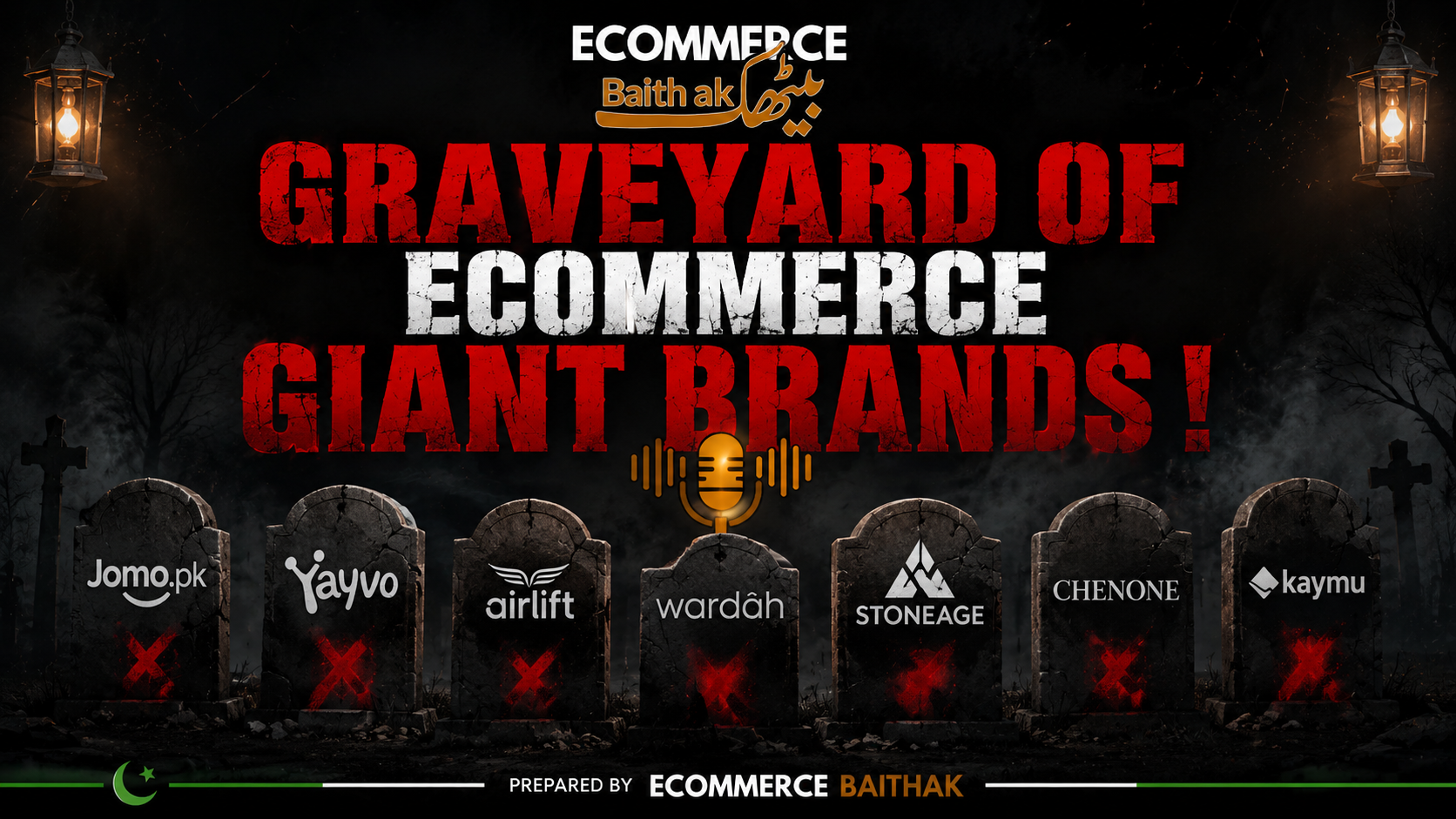
The Graveyard of Giants
How Pakistan's most promising retail and ecommerce brands lost the plot — and what every founder, CMO, and investor must learn before repeating the same mistakes.

StoneAge
"Pakistan's Premier Denim Authority" — 2004–present
⚠ Severely DecliningBrand Vitals
📖 Founding Story
StoneAge was born from Pakistan's export advantage. Crescent Bahuman Ltd — a leading denim exporter supplying Levi's, Mustang and Ben Sherman — saw a logical extension into domestic retail. If they were making world-class denim for international brands, why not sell it to Pakistanis? First store: Lahore, March 2006. The vertically integrated model was brilliant: own the fabric, own the manufacturing, own the retail. Original positioning: "world-class denim, made in Pakistan, for Pakistanis." The model worked. Backed by a manufacturing advantage no pure-play retailer could match, StoneAge priced aggressively while delivering quality that genuinely rivaled imports.
🚀 Growth Phase (2006–2013)
- 2006: Single Lahore store — immediate traction with urban youth
- 2008: Expanded to Karachi — 4 stores operational
- 2010: 13 flagship stores across Pakistan + Dubai expansion announced
- 2012: Peak brand awareness — StoneAge synonymous with "Pakistani denim"
- 2013: 25+ stores, revenue estimated PKR 1.2–1.5B
- Product range: Denim, Tees, Shirts, Outerwear, Footwear, Accessories, Jewelry
- Target: Urban youth 16–30, aspirational middle class
- Price Range: PKR 1,800–8,000 per item (accessible premium)
A. Internal Failures
- Brand identity frozen in 2010 aesthetics — no evolution
- Product design stopped leading; started following Outfitters
- Leadership prioritized export business over retail innovation
- Store design not refreshed in 8+ years — felt dated by 2018
- No significant digital channel investment until too late
- Loyalty program: essentially non-existent
- No brand extensions (lifestyle, sports, limited drops)
B. External Factors
- Outfitters overtook on brand coolness by 2015
- Zara/H&M/Uniqlo entered mental space via social media
- Gen Z moved from denim-first to athleisure + streetwear
- Fast fashion Instagram brands undercut price by 30–40%
- Daraz enabled copycats to sell StoneAge-style denim at PKR 900
- PKR devaluation raised material costs 40%+ by 2022
- Premium mall rents doubled 2016–2022
C. Digital Transformation Failure
- Website: basic, low UX — not mobile-optimized until 2020
- No dedicated ecommerce investment — relied on Daraz listing
- Social media: promotional-only, no community building
- SEO: almost no investment — losing to competitors organically
- No Meta retargeting strategy — losing customers daily
- Zero TikTok presence until 2022 — critical 3-year gap
- No CRM, no email marketing, no WhatsApp commerce
StoneAge — What Went Wrong
- Rested on manufacturing advantage — didn't build brand equity separately
- Ignored the social-first youth buyer — Instagram/TikTok generation
- Store experience: functional not experiential — no reason to visit over ordering online
- No brand collaborations, no influencer strategy until ~2020
- Ecommerce as afterthought: Daraz-listed but no D2C investment
- Missed the streetwear/sneaker culture that replaced pure denim
- Never solved the return/exchange problem online
Outfitters — What They Did Right
- Invested in brand storytelling from day one — lifestyle, not just product
- Early TikTok + Instagram presence — built community, not just audience
- Rapid seasonal collection launches — 6+ drops per year vs StoneAge's 2
- Student ambassador programs — campus-level brand activation
- Built clean D2C website — strong UX, easy checkout
- Introduced lifestyle categories: bags, caps, watches — average basket +40%
- Price positioning: slightly below StoneAge — same quality perception
StoneAge's Missing Digital Ads Blueprint — What Should Have Been Running
- Budget: PKR 3–5M/month minimum
- Catalogue ads for retargeting: viewed product → purchase funnel
- Lookalike audiences from top 10% buyers — expand reach
- Reels-first content: denim styling videos, 15–30 seconds
- Seasonal bursts: PKR 8–12M for Eid + Back-to-school
- Instagram Shopping integration — buyable posts in-feed
- Target: 18–34, urban Pakistan, Fashion interest + competitors
- KPI: CPM PKR 180–250 | CPC PKR 15–25 | ROAS 4–6x
- Shopping Ads for product-level visibility — missing entirely
- Branded search protection — own "StoneAge" keywords
- Competitor keywords: "Outfitters jeans", "denim Pakistan"
- YouTube pre-roll: 30-second brand stories, PKR 500K/month
- Google Display retargeting — cart abandonment recovery
- Target ROAS: 5x Shopping | 3x Display
- Monthly Google budget: PKR 1.5–2.5M
- Local SEO: "denim store near me" captures 40% of intent
- Spark Ads: boost organic influencer content with paid spend
- In-Feed Ads: styling videos, outfit-of-the-day format
- Hashtag challenge: #StoneAgeStyle — 10M+ views potential
- Creator marketplace: 50+ micro-influencers PKR 15–50K each
- TikTok Shop integration: direct purchase from video
- Monthly TikTok budget: PKR 2–3M
- Target CPV: PKR 1–3 | Engagement target: 8%+
- Best formats: GRWM, Day-in-Life, Outfit Transition
StoneAge treated digital as a distribution channel, not a brand-building engine. In 2020, when Pakistan had 76M social media users, StoneAge was still running static product posts with zero community engagement. Every PKR 1 invested in digital ads in 2018 would have been worth PKR 8 by 2023. They waited until the market crowded out and the opportunity cost became irreversible. A PKR 30–50M annual digital budget from 2016 onwards would have been transformative. Instead: effectively zero.
Decision Timeline
Could StoneAge Still Make a Comeback Today?
Verdict: Possible but requires PKR 500M+ in brand reinvestment. The manufacturing advantage still exists — Crescent Bahuman still exports denim to global brands. A comeback requires: (1) Complete brand identity refresh — new visual system, new tone, new store design; (2) TikTok-first content strategy with PKR 2M/month minimum for 12 months; (3) Full D2C ecommerce platform — not Daraz dependency; (4) Streetwear pivot — denim with sneaker/cap culture integration; (5) Limited edition drops to create scarcity and cultural conversation. Window: 18–24 months before brand equity becomes unrecoverable. The Crescent Bahuman manufacturing edge could still be a story if told correctly.

ChenOne
"Pakistan's Largest Luxury Lifestyle Brand" — self-proclaimed
⚠ Debt-Restructured / LimpingBrand Vitals
📖 The ChenOne Tragedy — A Conglomerate's Debt Kills a Retail Brand
Chenab Group was the Musharraf-era story of Pakistan's textile exports. They expanded aggressively into retail under the ChenOne brand — a multi-category lifestyle play covering apparel, home textiles, and bedding. At peak, ChenOne operated 48+ stores across Pakistan, UAE, and the UK. The fatal flaw was the financing model. Chenab Group took on massive debt — estimated at PKR 35 billion — during the easy-money era of the early 2000s. When the 2008 global financial crisis hit, the debt became unserviceable. The retail brand became collateral damage of a conglomerate-level financial crisis — not a brand failure per se, but an inability to invest, grow, or compete digitally while servicing impossible debt. For 15+ years, ChenOne was a zombie — still breathing, but unable to fight.
⚔ ChenOne vs. Khaadi — Capital Discipline Wins
- Khaadi: clean balance sheet, founder-led, zero debt-funded expansion initially
- Khaadi 2016 revenue: PKR 16B vs ChenOne estimated PKR 3–4B
- Khaadi 2022: 63 stores in 30 Pakistani cities + international
- Khaadi: Experience Hub opened December 2021 — 32,000 sq ft, Karachi
- Khaadi: full ecommerce website operational by 2015
- Khaadi: product innovation every season — ChenOne: static catalog
- ChenOne capex 2009–2020: effectively zero — all cash to creditors
- Management bandwidth: ChenOne in bankruptcy court, Khaadi building the future
A. The Structural Failure
- Over-leveraged expansion — debt-funded growth with no floor
- No separation of retail vs manufacturing balance sheets
- Manufacturing woes held retail brand hostage for 15+ years
- Management bandwidth spent on creditors, not customers
- Brand identity drift — couldn't decide: luxury or accessible?
- No private equity or strategic investor secured for ChenOne
- Failed to spin off retail as independent entity to attract capital
B. Market Missed While Distracted
- Pakistan apparel retail grew to $6.2B by 2022 (Research & Markets)
- ChenOne's share shrank while market expanded 4x
- Home textiles ecommerce: completely untapped by ChenOne
- Bed linen + home decor: high-AOV category, perfect for D2C
- Diaspora market: Pakistani-origin consumers abroad want ChenOne
- Premium positioning: brand had the equity, lacked the execution budget
- Competitors: Ideas by Gul Ahmed, Daaman captured what ChenOne abandoned
C. Digital Blackout
- Website: basic HTML-era design — still lagging peers by years
- Mobile app: nonexistent during peak adoption 2016–2020
- Social media: sporadic, no consistent strategy or budget
- Zero ecommerce investment — full Daraz dependency
- No digital advertising while Khaadi spent PKR 30–50M/year
- Email/WhatsApp list: essentially non-existent — zero CRM
- Lost entire digital-native generation of shoppers — permanently
ChenOne's Missed Digital Opportunity — What PKR 20M/Year Would Have Bought
- Budget: PKR 8M/month across Facebook + Instagram
- Video ads: "Home transformation" content — Pinterest-style interior inspiration
- Target: Married women 28–45, homeowners, SEC A/B
- Wedding season campaigns: June + November = PKR 4M burst each
- Facebook catalogue ads: home textiles + bedding collections
- Instagram Stories: interior design inspiration with shop-now links
- Expected ROAS: 4–6x home | 5–7x fashion
- Influencer collab: 10 interior design accounts × PKR 200K each
- Shopping Ads: "Pakistani bed sheets", "home textiles Pakistan"
- Monthly search budget: PKR 3M — captures high commercial intent
- YouTube tutorials: home decor authority content — trust building
- Google Display: retarget cart abandoners — 25% recovery rate possible
- Local SEO: dominate "home store Lahore/Karachi/Islamabad"
- Content: "home decor Pakistan" blog → 50K organic visits/month
- Branded keyword protection: prevent competitors bidding on name
- Target ROAS: 5x minimum on Shopping
- "Room makeover" format: highest engagement in home category globally
- Before/after transformation videos: 2–5M organic views potential
- Creator collaboration: interior design TikTokers × 20 accounts
- Monthly TikTok Ads budget: PKR 2M
- Home textiles: strong ecommerce category on TikTok Shop SE Asia
- Hashtag challenge: #ChenOneHome — user room reveal competition
- Target CPV: PKR 1.5–3 | View-through rate: 8–12%
- Festive content: Eid decoration + room styling — massive seasonal reach
ChenOne's product quality was never the issue. The brand genuinely made excellent home textiles. Its parent company's debt destroyed its future. The lesson for every founder: retail brands must be structurally ring-fenced from parent debt. A PKR 500M carve-out for ChenOne as an independent entity in 2010 — even if it meant diluting Chenab Group's ownership to 40% — would have changed everything. While Khaadi built its Experience Hub in 2021, ChenOne was still in Lahore High Court. The gap was never talent or product. It was capital structure.
Could ChenOne Still Make a Comeback Today?
Verdict: High Risk, Possible with External Capital. ChenOne's product quality was never the issue. A comeback requires: (1) Complete financial restructuring — retail entity fully separated from Chenab Group debt; (2) PKR 1–2B investment from a strategic PE partner; (3) Home textiles D2C ecommerce as the primary growth engine — high AOV, underpenetrated category; (4) Brand repositioning from "Pakistan's luxury brand" to "quality Pakistani craft for your home"; (5) Architect a 15-store experiential network vs chasing 50-store volume. The bones are there. The capital structure needs surgery.

Yayvo
TCS-backed marketplace with a golden last-mile advantage it never used
💀 Shut Down — October 2022Brand Vitals
"Yayvo had the most powerful unfair advantage in Pakistani ecommerce — TCS's logistics network. They wasted it completely." — Industry analyst, 2022
📖 The Yayvo Tragedy — A Squandered Moat
TCS — Pakistan's largest courier company with 35+ years of delivery trust — decided to build an ecommerce marketplace. The thesis was bulletproof: own the logistics, own the delivery experience, win the marketplace. In theory, Yayvo should have been untouchable. Daraz was dependent on third-party couriers; Yayvo owned its delivery network. But theory and execution diverged completely. The platform launched with an appliances and electronics focus when the market was moving to fashion and daily essentials. The website quality was consistently poor — "outdated layouts and features" noted by industry observers even at launch. The organization was built like a courier company's digital experiment, not a customer-obsessed tech company. By 2020 it had fallen out of Pakistan's top 10 ecommerce sites. By 2022, TCS wrote off PKR 1.2B and shut the platform with 17 employees remaining.
🔑 The Unfair Advantages Never Used
- TCS Last-Mile Network: 800+ cities — Daraz had nothing close in 2014
- TCS Brand Trust: 35+ years of delivery trust in consumer psyche
- Reverse Logistics: Could offer Pakistan's best return policy — for free
- COD Infrastructure: Could offer 30-minute COD confirmation at TCS outlets
- Corporate Relationships: B2B ecommerce completely untapped
- Physical Touchpoints: Drop-off, pick-up, returns at every TCS outlet nationwide
- Daraz spent PKR hundreds of millions building Daraz Express — Yayvo had it free
- The moat was real and defensible. The vision to exploit it was entirely absent.
Why They Lost to Daraz
- Category focus error: appliances vs fashion — wrong priority in 2014
- Website UX: consistently rated worse than Daraz in user testing
- No significant marketing investment — "zero growth last 3 years"
- Corporate culture: courier company mindset, not ecommerce mindset
- TCS parent financial troubles choked investment post-2018
- No venture backing — Daraz had Rocket Internet + Alibaba capital
- Seller acquisition: never matched Daraz's aggressive seller growth
- Failed to attract buyer: 3+ failed acquisition attempts before shutdown
The Numbers: PKR 2.5B to Zero
- PKR 2.5B over 8 years = PKR 312M average annual burn
- PKR 1.2B impairment = near-total write-off of asset value
- 17 remaining employees at shutdown (from hundreds at peak)
- Daraz by 2022: millions of sellers, billions in GMV across South Asia
- Yayvo GMV at closure: estimated PKR 1–2B/year (not disclosed)
- No growth for 3 consecutive years before shutdown
- Described as a "zombie" from 2019 onwards by industry practitioners
- Daraz spent more on marketing in 1 month than Yayvo in 1 year
Digital Strategy Autopsy
- Website design: 2012-era layout — never meaningfully refreshed
- Mobile app: launched late, poor ratings, low adoption
- SEO: minimal investment — losing every commercial keyword to Daraz
- Facebook Ads: irregular, no retargeting infrastructure built
- No affiliate marketing program — Daraz had thousands of affiliates
- Email marketing: sporadic, no segmentation or personalization
- Social commerce (Instagram/TikTok): never pursued seriously
- No loyalty program — zero customer retention infrastructure
Yayvo's Winning Strategy — "Pakistan's Fastest Delivery" Ads Blueprint
- Core message: "TCS delivers. Yayvo sells." — trust transfer to ecom
- Dynamic product ads: retarget based on browse + cart signals
- Video ads: "Ordered at 3pm, delivered by 6pm" — proof of speed
- Monthly Meta budget: PKR 15–25M (Daraz-competitive)
- Lookalike from TCS customer database — millions of trusted users
- Ramadan burst: PKR 30M — Pakistan's biggest shopping month
- "Easy returns at any TCS office" — trust-building ad creative
- KPI: ROAS 5x | CAC: PKR 300–500
- "Buy [product] online Pakistan" — capture purchase intent directly
- Shopping Ads with "Free same-day delivery" USP in headline
- Competitor keywords: "Daraz alternative", "online shopping Pakistan"
- Monthly Google budget: PKR 10–15M
- YouTube: unboxing + delivery experience content for trust
- 150K SKUs = enormous long-tail Shopping opportunity
- Target ROAS: 7–10x (logistics advantage = lower delivery cost)
- Local intent: "same day delivery Lahore/Karachi/Islamabad"
- TCS delivery driver content — authentic, trusted, relatable
- "Fastest delivery in Pakistan" challenge — viral potential
- TikTok Shop integration: Pakistan's fastest-growing social commerce
- Monthly TikTok budget: PKR 5M
- Pay 100+ TikTokers to feature Yayvo hauls with delivery timing
- Real-time delivery tracking content — transparency as brand identity
- Target CPV: PKR 1–2 | Aim: 20M+ monthly video views
- Proof videos: "ordered at 9am, at my door by 1pm" format
Yayvo had Pakistan's greatest ecommerce unfair advantage — TCS's 800-city logistics network — and never weaponized it. Daraz spent hundreds of millions building Daraz Express. Yayvo had TCS Express for free. If Yayvo had built its entire brand around "Pakistan's fastest delivery" with a TCS-powered same-day guarantee, it would have been unbeatable on the one metric that matters most in ecommerce: delivery speed and reliability. Instead, the platform competed as a generic marketplace with worse UX, less marketing spend, and the same delivery times as competitors. PKR 2.5 billion invested. The core strategic advantage of the business was never used. This is the single most wasteful case study in Pakistani business history.
Could Yayvo Still Make a Comeback Today?
Verdict: Yayvo brand is dead. TCS's logistics moat is worth PKR 10B+ in the right hands. A new TCS-backed ecommerce play should focus on: (1) Quick commerce (10–30 minute delivery) using TCS physical network as dark stores; (2) B2B ecommerce: corporate procurement platform — massive untapped market; (3) D2C brand platform: let fashion brands use TCS logistics as the differentiator; (4) Returns-as-a-service: charge brands PKR 50–100 per hassle-free return — no one does this well in Pakistan. The Yayvo brand is finished. The TCS logistics opportunity is more valuable today than it was in 2014.

Kaymu
Pakistan's C2C marketplace — absorbed by Daraz, defunct July 2017
💀 Absorbed → DefunctBrand Vitals
📖 The Rocket Internet Clone Story
Kaymu was not an original idea — it was Rocket Internet's copy-paste of eBay/Craigslist for South Asian markets. Launched as Azmalo.pk in January 2013 (shutting within 2 months), then relaunched as Kaymu — a consumer-to-consumer marketplace where individuals and small sellers could list any product. Rocket Internet's model: build fast, grow fast, exit or merge. By 2015, Kaymu was one of Pakistan's top ecommerce platforms competing directly with Daraz. But both Daraz and Kaymu were Rocket Internet ventures — the parent had a competition problem. The June 2016 merger announcement: "Daraz Group will get 360-degree ownership of the ecommerce market." Translation: two loss-making entities become one slightly-less-loss-making entity. Kaymu ceased operations officially on 5 July 2017.
⚠ Why Kaymu Couldn't Survive
- Counterfeit crisis: illegally copied games, replica products endemic on the platform with no enforcement
- Quality control failure: C2C model with no curation = trust destruction at scale
- Daraz had better UX: Kaymu's interface consistently clunkier
- No differentiation from Daraz: both Rocket Internet — why maintain two?
- Trust problem: retail ecommerce complaints "much higher than all other sectors" per industry analysis
- Cannot scale without trust: Rocket Internet prioritized growth over trust — fatal in a low-trust market
- Parent's exit strategy: consolidation of two entities was cheaper than marketing both
- Alibaba entry: once Alibaba acquired Daraz in 2018, Kaymu was irrelevant
The C2C Trust Destruction
- Pakistan's C2C model: zero fraud protection mechanisms at launch
- Fake products, counterfeit electronics common — became platform reputation
- No verified seller ratings — unlike eBay's sophisticated review system
- COD policy: receive fake product, dispute almost impossible
- Social media complaints about Kaymu products were a regular viral occurrence
- No buyer protection — each transaction was a trust gamble
- This destroyed the fundamental trust that ecommerce depends on
- Azmalo closed in 2 months — Kaymu lasted 4 years only due to Rocket Internet money
Kaymu vs. Daraz — The Sibling Rivalry
- Daraz: B2C marketplace, curated brands, quality control — trust foundation
- Kaymu: C2C marketplace, unverified sellers — trust destruction
- Daraz attracted Alibaba acquisition (May 2018) — Kaymu had no such exit
- Alibaba bringing: Alipay, AliExpress ecosystem, data analytics — game-changing
- Kaymu post-merger: all users transferred to Daraz — brand erased
- The lesson: in low-trust markets, B2C beats C2C until trust infrastructure exists
- OLX survived because classifieds ≠ transactional risk — different category
- Pakistan still needs a functional C2C platform — gap remains in 2026
Kaymu was a copycat of eBay without eBay's PayPal payment protection, buyer insurance, or the regulatory environment that makes C2C viable. It was a Silicon Valley model transplanted to a market with fundamentally different trust dynamics, regulatory gaps, and consumer behavior. The lesson for every founder: global platform models require local adaptation — not just translation. Kaymu translated the interface. It never translated the trust mechanisms. In ecommerce, trust is the product. Everything else is logistics.
Could Kaymu Still Make a Comeback Today?
Verdict: The brand is irrelevant, but the C2C opportunity remains live. OLX operates in Pakistan. Facebook Marketplace has become an informal C2C powerhouse. A modern "Kaymu 2026" would need: (1) AI-powered fraud detection on every listing; (2) Escrow payment system — release only after buyer confirmation; (3) Category focus: used electronics, books, fashion resale; (4) Brand as "Pakistan's trusted resale platform" — sustainability and circular economy angle resonates with Gen Z; (5) TikTok-native content: "thrift haul" culture growing globally. The market exists. The Kaymu brand name adds nothing — start fresh.
Airlift
Pakistan's most funded startup — gone in a week
💀 Shut Down — July 12, 2022Brand Vitals
"It felt like they were doing it all for valuation because there was no way that they could have ever thought of becoming profitable like this. It didn't make sense." — Former Airlift employee, Rest of World, 2022
📖 Transport → Quick Commerce → Oblivion
Airlift began in 2019 as a premium bus service — point-to-point, GPS-tracked, air-conditioned urban transit. COVID hit. Transport: dead overnight. Pivot decision: quick commerce grocery delivery. Build dark stores, promise 30-minute delivery, raise massive funding to subsidize growth. August 2021: Pakistan's largest-ever Series B — $85M led by Harry Stebbings (20VC) and Josh Buckley (Buckley Ventures). Valuation: $275M. Pakistan's most valuable startup. Monthly burn: $4–5M. The model required perpetual fundraising. In early 2022, expansion to South Africa began. In May 2022, 31% of workforce laid off. In July 2022, Series C1 financing fell apart when the lead investor pulled out. On July 12, 2022 — six days after the funding fell apart — Airlift announced permanent shutdown. 1,300+ people jobless overnight.
📊 The Unit Economics That Never Worked
- Business model: sell groceries at/below cost, subsidize delivery free
- Product margins: estimated 20% best-case by Q3 2022
- Delivery cost: rising fuel costs eroded margins quarterly
- Monthly burn: PKR 600–750M at operational peak
- Claimed achievement: 3 months from operating profitability at close
- Series C target: $100M — to run 18 more months before profitability
- The fatal question never answered: "Can we make money selling groceries in 30 minutes?"
- Free delivery: customers came for free delivery, not for Airlift
- South Africa: premature expansion drained capital at worst possible time
- $200M claim: unannounced "raise" damaged investor trust permanently
The Real Cause of Death
- Business model structurally required infinite external capital
- Quick commerce globally has a profitability problem — Gorillas, Getir, Zepto all struggled
- Pakistan's cold-chain infrastructure too underdeveloped for grocery-at-scale
- Zero cash flow resilience — no days of runway without new investors
- South Africa expansion: premature and capital-destroying
- Corporate culture: optimized for fundraising metrics, not business fundamentals
- 2022 global VC winter: Tiger Global, Softbank cut investments — Pakistan startup ecosystem frozen
What Airlift Did Right
- Product experience: genuinely best grocery delivery UX in Pakistan
- Marketing: clean, modern brand identity — aspirational positioning
- Talent: attracted Pakistan's best tech talent pool
- Operations: dark store model that functionally worked at city scale
- Fundraising: proved international VC would invest in Pakistan tech
- Order-level profitability: achieved before shutdown — margin positive per order
- Burn reduction: cut 66% before shutdown — showed discipline when forced
- Legacy: inspired Pakistan's entire startup generation of 2022–2026
Digital Ads Reality
- CAC (Customer Acquisition): estimated PKR 1,500–3,000 fully loaded
- LTV: unknown — churn rate post-subsidized-delivery too high to measure reliably
- Meta ads: heavy spend but ROAS negative when delivery subsidies factored in
- Referral programs: effective for growth but masked true acquisition cost
- Google UAC (app campaigns): primary acquisition channel — high installs
- Push notifications: high frequency → uninstalls → re-acquisition spend
- Real problem: marketing could acquire customers; product couldn't retain them profitably
- At PKR 200 delivery fee, economics could have worked — price sensitivity killed the option
What Airlift SHOULD Have Run — Profitable Quick Commerce Ads Model
- Stop: "Free delivery" as the primary ad hook — attracts zero-LTV users
- Start: "Delivered in 30 minutes, guaranteed" — speed not price
- Subscription model ads: "PKR 299/month — unlimited deliveries"
- Segment heavily: high-income neighborhoods only for dark stores
- LTV targeting: find users who order 3x+ per week — only serve them
- CAC target: PKR 800 max on PKR 150 delivery fee model
- Retention ads: "Your weekly essentials delivered" — habit formation
- Suppress: users who ordered once and never returned
- "Grocery delivery 30 minutes [city]" — own this search
- Hyperlocal targeting: only users within 3km of dark stores
- App install campaigns: Google UAC optimized for "3rd order" event not install
- YouTube: recipe content → "ingredients delivered in 30 min"
- Monthly Google budget: PKR 5M (hyper-targeted = low waste)
- Bidding strategy: target ROAS not max conversions — filter low-LTV
- Exclude: users who returned orders (high-cost signal)
- Local search: "groceries near me" + same-day extension
- Recipe + cooking content: "ingredients at your door in 30 min" format
- Behind-the-scenes dark store content — trust building
- Driver "day-in-life" content — authentic Pakistani storytelling
- Monthly TikTok budget: PKR 3M
- No promo codes in TikTok ads — attracts discount hunters, not loyalists
- Focus on premium neighborhoods: DHA Lahore/Karachi, Bahria Town
- Subscriptions as TikTok CTA: "Join 10,000 families — PKR 299/month"
- Creator partnerships: cooking/home management influencers, not fashion
Airlift's death is the definitive Pakistani case study in what happens when a startup is built for investor optics rather than unit economics. The company knew it was burning $4–5M monthly. It knew each delivery was being subsidized. It knew Pakistan's middle class would not consistently pay PKR 200 delivery fees. Yet it expanded to South Africa, pre-announced a $200M round before it was closed, and positioned itself as a unicorn on a path to profitability that required 18 more months of investor capital. A PKR 99 delivery fee from Day 1 plus a 15% product margin would have been a sustainable business. The free delivery was the business model's own murderer.
Could Airlift Still Make a Comeback Today?
Verdict: Not as quick commerce, but the talent and tech assets were real value. A comeback as "Airlift" faces reputational headwinds. More viable paths: (1) Pivot to B2B grocery/FMCG procurement — higher margins, less subsidization; (2) Subscription-first model: PKR 299/month unlimited delivery + PKR 12–15% product margins; (3) Dark store network for 3–4 cities maximum — not 8; (4) Raise PKR 500M max, not $85M — capital discipline as brand identity; (5) White-label the tech to brands doing direct delivery. Several Airlift alumni have already built successful companies. The people were the actual asset — not the quick commerce thesis.
Warda
Fashion brand caught in the fatal middle ground
📉 Market Share ErosionBrand Vitals
📖 The Middle-Ground Trap
Warda launched in 2006 with "elegant, affordable, distinct" positioning. For several years it held a respectable position in Pakistan's women's ethnic fashion market. The problem: it occupied the dangerous middle ground. Not aspirational enough to compete with Sapphire ($66M+ est. revenue) or Sana Safinaz. Not value-aggressive enough to compete with Limelight — which runs promotions year-round, maintains 85+ stores, generates 1.8M monthly website visits, and holds 5M Instagram followers. Limelight built a fast-fashion flywheel — near-daily new arrivals, Instagram-first content, PKR 590–12,990 price range. Warda stayed in the middle — and in Pakistani fashion retail, the middle is where brands go to become irrelevant.
⚔ The Competitor Benchmarks
- Limelight: 5M Instagram followers | 85+ stores | ~PKR 10B est. revenue | 1.8M monthly website visits | near-daily new arrivals
- Sapphire: $66M estimated revenue (2025) | premium positioning | aggressive ecommerce | TikTok-first campaigns
- Ethnic: clear handcraft + heritage positioning — owns a word in consumers' minds
- Khaadi: PKR 16B revenue (2016) | 63 stores (2022) | 32,000 sq ft Experience Hub
- Warda vs all: no clear digital positioning advantage | smaller footprint | weaker loyalty
- The fatal insight: In fashion, you must be #1 at something: premium, value, digital speed, or heritage. Warda was #5–10 at everything.
Warda's Recovery Ads Strategy — How to Fight Back Against Limelight and Sapphire
- Current spend: est. PKR 1–2M/month | Needed: PKR 5–8M
- Video-first: "Warda Women" brand campaign — lifestyle storytelling
- Retargeting: 7-day, 30-day, 90-day audience segments built properly
- Seasonal bursts: Eid PKR 15M | Summer lawn PKR 12M
- Instagram Reels: daily new arrival content — Limelight's winning formula
- Influencer seeding: 30–50 micro-influencers monthly × PKR 20–50K each
- Target ROAS: 5–8x | CAC target: PKR 400–600
- WhatsApp Business: 25% of Pakistan fashion orders close via WhatsApp
- SEO gap: losing "lawn suits 2026", "Pakistani women fashion" to Limelight/Khaadi
- Google Shopping: every new collection live same day as launch
- Branded protection: own "Warda" keyword — competitors bidding on it
- Content hub: "how to style" articles → capture fashion search intent
- Monthly PPC: PKR 2–3M (likely at PKR 300–500K currently)
- Target: Top 5 ranking for 50 high-volume fashion keywords in 12 months
- Email capture from organic traffic: build CRM database aggressively
- Shopping campaign: competitive CPCs PKR 12–25 for fashion keywords
- Current TikTok: near-zero meaningful presence — Limelight and Sapphire winning
- "Warda haul" videos: immediate credibility with young audience
- Outfit transition format: most-shared fashion TikTok content type
- TikTok Shop: set up and active — direct purchase from video content
- Monthly TikTok budget: PKR 2–3M catching up
- Creator program: 50 fashion TikTokers, exclusive first look at collections
- Target: 500K TikTok followers in 12 months from near zero today
- "Story of Warda Women" documentary series: brand-building content investment
Could Warda Still Make a Comeback Today?
Verdict: Yes — but requires complete strategic repositioning away from the middle ground. Three viable paths: (1) Value-fast-fashion: compete directly with Limelight on price + newness frequency — requires digital-first operations and daily product drops; (2) Heritage-craft: "Warda by Warda Saleem" — founder-led brand story, handcraft elements, limited editions at premium price; (3) Regional powerhouse: dominate 3–4 cities at 8–10 stores each rather than 30 stores everywhere at reduced investment. None work without PKR 3–5M/month in digital advertising and a rebuilt ecommerce platform. The brand has equity — it's fading annually without investment.
Jomo
Once Pakistan's trendy footwear contender — now marginal
📉 MarginalizedBrand Vitals
📖 How Stylo Outran Jomo
Jomo represented Pakistan's attempt at a fashion-forward women's footwear brand with aspirational positioning. For a period it held relevance as an accessible trendy option. But Stylo executed a masterclass in Pakistani retail scaling: aggressive physical expansion (200+ stores), fashion-forward product refreshed seasonally, aggressive digital marketing, and critically — ecommerce capabilities that converted offline customers to online buyers. While Jomo maintained a static store footprint and passive digital strategy, Stylo became Pakistan's largest dedicated footwear retail chain by almost any metric. The contrast: Stylo invested in technology, CRM, and digital advertising when footwear consumers moved to Instagram discovery. Jomo did not.
⚔ Stylo's Winning Formula vs Jomo's Inaction
- Store count: Stylo 200+ vs Jomo estimated 30–40 at peak
- Instagram: Stylo 2M+ followers — fashion-first, daily content
- Ecommerce: Stylo full D2C website — launched early, COD + returns
- Seasonal drops: multiple per month — high frequency discovery loop
- Price architecture: PKR 2,500–12,000 — broad appeal across tiers
- Social commerce: TikTok haul content drives millions of views for Stylo
- Men's expansion: added men's footwear — doubled addressable market
- Loyalty app: capturing purchase history — Jomo: no equivalent
- Influencer partnerships: annual brand campaigns with reach
- The gap summary: every dimension of retail excellence — Stylo leads
Could Jomo Still Make a Comeback?
Verdict: Possible with a niche-first strategy. Fighting Stylo head-on is unwinnable. Viable paths: (1) Artisan/handcrafted Pakistani footwear — target Khaadi's audience who buys handcraft; (2) International diaspora: Pakistani community in UK, UAE, USA wants authentic Pakistani brands — D2C with international shipping; (3) Collaboration model: design-forward limited drops with artists; (4) Luxury positioning: PKR 12,000–25,000 range with genuine craft story. Without clear differentiation, the brand continues losing ground annually.
The Definitive Comparison
Side-by-side analysis of every brand studied in this report
| Brand | Peak Strength | Failure Mode | Ecommerce Impact | Est. Value Lost | 2026 Status | Key Lesson |
|---|---|---|---|---|---|---|
| StoneAge | Pioneer denim brand, youth aspirational icon 2006–2014. Estimated 35+ stores. | Brand identity crisis: tried to grow up with its customer but failed to hold next-gen youth. No digital migration. | Entered ecommerce late. Website functionally poor. No performance marketing at scale. Lost discovery to Outfitters and fast-fashion newcomers on Instagram. | Est. 60%+ revenue decline 2016–2024. Value erosion: hundreds of millions PKR. | 📉 Declining — fighting for relevance in 2026 | Owning a customer moment means continuously re-earning it. Nostalgia has no ROAS. |
| ChenOne | Premium home + fashion, 48 stores in 3 countries. Chenab Group flagship. Export-quality retail. | Parent conglomerate debt crisis: PKR 35B Chenab Group liabilities. Retail became collateral for industrial lending. | Digital investment was near-zero. Zero loyalty programme. No CRM. Social presence weak. Completely outmanoeuvred by Khaadi's digital-first model. | PKR 35B Chenab Group debt. Lahore High Court restructuring. Dozens of stores shuttered. | 💀 Debt-restructured — shadow of former self | A retail brand needs a firewall from conglomerate debt. Digital neglect accelerates decline during crises. |
| Yayvo | TCS-backed ecommerce with real-time logistics moat. PKR 2.5B invested. Should have been fastest in Pakistan. | Failed to leverage logistics moat. Pivoted from marketplace to inventory to categories without committing. Identity never solidified. | WAS an ecommerce brand — but failed at ecommerce. Weak UX, low brand recall, catalogue confusion. Could not monetize TCS's 2,000+ touchpoints. | PKR 2.5B invested, PKR 1.2B impairment loss. Shut Oct 1, 2022. | 💀 Dead — shut October 2022 | Infrastructure advantage without brand advantage = expensive warehouse. Logistics moat is worthless without customer demand. |
| Kaymu | Pioneer C2C marketplace 2013. Pakistan's first real peer-to-peer ecommerce experience. 300 employees at peak. | Rocket Internet clone model: copy paste, no local insight. C2C trust problem never solved. Daraz sibling rivalry cannibalized growth. | Was ecommerce — but Daraz outpaced it on every metric. Mobile app quality, seller tools, and marketing investment lagged behind sibling brand. | Absorbed by Daraz June 2016. Operations ceased July 5, 2017. Brand dead. | 💀 Dead — absorbed and erased by Daraz 2017 | Two ecommerce brands in same portfolio with overlapping markets is a strategic error. The weaker brand always dies. |
| Airlift | $110M raised, $275M valuation (Aug 2021). Pakistan's most-funded startup. 30-minute grocery promise. | Unit economics never worked: LTV permanently below CAC. Burn rate $4–5M/month. Q-commerce is a global graveyard post-2022. | Digital-native — but digital spend was acquiring unprofitable customers at scale. CAC PKR 1,500–3,000 vs AOV PKR 800–1,200 = structural loss. | $110M raised → $0. Shut July 12, 2022. 300+ jobs lost. Pakistan's most expensive startup failure. | 💀 Dead — shut July 2022 | Growth metrics divorced from unit economics is not a business — it's a funded experiment. Pakistan's LTV can't support $275M Q-commerce math. |
| Warda | Mid-tier women's fashion with 30+ stores. Decent loyalty among 30–45 working women segment. | Middle-ground trap: too expensive for value seekers, not premium enough for Sapphire/Khaadi buyers. Identity blur. | Ecommerce present but under-invested. Social media ~600K vs Limelight's 5M. No influencer strategy. Digital ads sporadic, no always-on strategy. | Continued decline in market share. Limelight went from peer to category leader. Warda audience eroding annually. | 📉 Declining — trapped in the middle | In a polarizing fashion market, the middle is the most dangerous place. Choose premium or value — both require digital commitment. |
| Jomo | Fashion-forward women's footwear contender, aspirational positioning, ~30–40 stores at peak. | Stylo outscaled, outspent, and out-digitised on every vector. Jomo had no response to Stylo's 200+ store, full digital strategy. | Minimal ecommerce. No visible performance marketing. No TikTok strategy while Stylo built millions of views through footwear content. | Market share marginalized. Revenue trajectory unknown — estimated fraction of Stylo's PKR 5B+ estimate. | 📉 Marginalized — fighting for survival | In a category with a dominant incumbent, differentiation or death. Scale wars against Stylo are unwinnable without a niche strategy. |
Lessons Written in Blood and Bankruptcy
Every mistake below cost a Pakistani brand significant revenue, market share, or its existence.
🚫 10 Ecommerce Mistakes to Never Make
- 1. Launching ecommerce as an afterthought. Yayvo had PKR 2.5B and still launched a poor UX product. Budget is not strategy. Start with customer journey, not infrastructure.
- 2. Treating website as a digital brochure. Multiple brands had websites that couldn't convert. If your site can't sell 24/7 without a salesperson, it's not an ecommerce site — it's a catalogue.
- 3. Ignoring mobile-first UX. 85–92% of Pakistan ecommerce traffic is mobile. A desktop-designed site loses the majority before checkout.
- 4. No COD + easy returns. Pakistani ecommerce without Cash on Delivery is dead on arrival. Return rate on apparel: 20–35%. Build this into your economics from Day 1.
- 5. Zero cart abandonment recovery. Pakistan average cart abandonment: 72–78%. Without WhatsApp automation + email sequences, you're leaving 30–40% of recoverable revenue on the floor.
- 6. Launching ecommerce without a performance marketing budget. Organic alone cannot scale ecommerce. Minimum viable digital budget for a serious brand: PKR 5M/month.
- 7. No CRM or loyalty program. Retaining existing customers costs 5x less than acquiring new ones. Every brand in this report failed to capture customer data systematically.
- 8. Treating Daraz as your primary channel. Daraz dependence = no customer relationship, no data ownership, margin compression of 15–20%. D2C must be primary; Daraz secondary.
- 9. No seasonal inventory planning linked to digital calendar. Running Eid campaign ads without sufficient stock = PKR burned, customers lost to competitors forever.
- 10. Measuring ecommerce success by GMV alone. Airlift had incredible GMV. It also burned $110M. Track: contribution margin per order, LTV:CAC ratio (target 3:1+), repeat purchase rate.
🚫 10 Digital Ads Mistakes to Never Make
- 1. Running awareness campaigns without conversion tracking. If you can't track PKR spent to PKR earned, you're funding an experiment, not a business.
- 2. No Meta Pixel installed correctly. Without pixel data, Facebook's algorithm can't find your buyers. Install, verify, warm up before spending.
- 3. Boosting posts instead of running structured campaigns. Boosted posts = reach. Campaign Manager with objectives = revenue. Never confuse the two.
- 4. One creative for all audiences. A 45-year-old Lahori woman and a 22-year-old Karachi student need different creative, copy, and offers. Segment or waste budget.
- 5. Zero retargeting strategy. Most Pakistani brands run only top-of-funnel ads. Retargeting website visitors, cart abandoners, and past purchasers gives 3–5x ROAS vs cold traffic.
- 6. Ignoring TikTok entirely. Pakistan has 50M+ TikTok users. CPM PKR 80–180 vs Meta PKR 180–350. For product discovery — especially fashion and footwear — TikTok is underpriced inventory.
- 7. No Google Shopping campaigns. High-intent buyers searching "women's kurta online" or "casual shoes Pakistan" convert at 3–5% vs 0.5–1% on social. Shopping campaigns capture demand; social creates it.
- 8. Seasonal-only advertising. Brands that only run ads during Eid, Black Friday, and summer sale train their algorithm to forget them for 10 months a year. Always-on at base level: never go dark.
- 9. Ignoring video content for ads. Facebook video ads outperform static by 27–54% in Pakistan apparel category. Reels and TikTok are the top-of-funnel engine in 2026.
- 10. Not using WhatsApp Business API for conversion. Pakistan WhatsApp open rate: 85–92% vs email 18–22%. A PKR 10,000/month WhatsApp automation stack recovers more revenue than a PKR 200,000/month email platform.
✅ 5 Digital Moves That Actually Win in Pakistan
- 1. TikTok Shop + Meta combination: TikTok for discovery and virality (PKR 80–120 CPM), Meta for retargeting and conversion (PKR 200–280 CPM). Total blended CAC for fashion: PKR 300–600.
- 2. WhatsApp-first CRM: Build a subscriber list of opted-in WhatsApp contacts. Send: new drops, exclusive discounts, order updates, and post-purchase content. 85%+ open rate vs 18% email.
- 3. Influencer-to-retargeting pipeline: Influencer video content → add to Meta video views custom audience → retarget with conversion ad within 7 days. Cost-effective full funnel.
- 4. Google Brand + Shopping always-on: Never let competitors buy your brand keywords. PKR 8–12 CPC brand protection campaign + Shopping ads for high-intent category terms. Google ROAS 4–8x.
- 5. Daraz + D2C dual play: Use Daraz for new customer acquisition (marketplace visibility), convert them to D2C for repeat purchase with 10% loyalty benefit. Margin recovers over LTV.
📊 2026 Pakistan Digital Benchmarks — Know Your Numbers
- Meta CPM (fashion/apparel Pakistan): PKR 180–350
- TikTok CPM Pakistan: PKR 80–180 (40–60% cheaper than Meta)
- Google Shopping CPC (fashion): PKR 12–25
- Google Brand keyword CPC: PKR 8–15
- Blended CAC target (fashion ecom): PKR 300–700
- Pakistan ecom cart abandonment rate: 72–78%
- WhatsApp cart recovery rate: 15–25%
- Healthy ROAS (fashion ecom Pakistan): 4–7x; below 3x = unprofitable
- COD vs prepaid ratio Pakistan: 65–75% COD
- COD return/RTO rate Pakistan: 20–35% (bake into unit economics)
- TikTok Shop conversion rate: 2–4% vs 1–2% website
- Repeat purchase rate (healthy brand): 35–45% within 12 months
- WhatsApp open rate: 85–92% vs Email 18–22%
- LTV:CAC target: 3:1 minimum, 5:1 for healthy profitability
- Minimum viable monthly digital budget (serious brand): PKR 3–5M
The 20 Laws of Pakistani Retail Survival
Distilled from seven brand autopsies. Violate these at your brand's peril.
⚡ 5 Strategic Lessons
- S1 — Middle is a slow death. In Pakistan's polarising fashion market, the middle ground (too affordable to be premium, too expensive to be value) is the most dangerous position. Every brand stuck there lost. Pick a lane: premium craft or accessible fast-fashion. Build for that lane completely.
- S2 — Retail and a conglomerate's debt are incompatible. ChenOne died because Chenab Group's industrial debt consumed its retail capital. If you run a retail brand inside a conglomerate, firewall the balance sheet. Retail margins (8–15%) cannot service industrial loans.
- S3 — Infrastructure moat without brand moat = expensive warehouse. Yayvo had TCS logistics. It still died. Infrastructure advantage (logistics, stores, supply chain) is temporary. Brand is the only durable moat. Build brand first, leverage infrastructure second.
- S4 — First-mover advantage expires fast without investment. Kaymu was Pakistan's first marketplace. Daraz overtook it within 3 years. Being first gives 12–24 months of advantage. After that, only relentless investment maintains position.
- S5 — Growth metrics divorced from unit economics is not a business. Airlift's $275M valuation was built on GMV, not contribution margin. In Pakistan's LTV-constrained market (average AOV PKR 800–1,500 for groceries), Q-commerce math was never going to work. Build for profitability per order before scaling.
🛒 5 Ecommerce Lessons
- E1 — Ecommerce is not a channel — it's a capability. Multiple brands "launched ecommerce" by building a website. That's not ecommerce capability. Real capability: SEO-optimised catalogue, performance marketing team, CRM system, returns logistics, WhatsApp automation, and weekly creative production.
- E2 — Data ownership is competitive advantage. Every brand that depended solely on Daraz owns zero customer data. In 2026, customer data (purchase history, preference profiles, contact data) is worth more than physical stores. Build D2C from Day 1, even at low volume.
- E3 — COD economics must be modelled before launch. Pakistani brands repeatedly underestimated COD return rates (20–35% for apparel). RTO cost: PKR 200–400 per failed delivery. Model this: if 30% of COD orders return and each costs PKR 300 to handle, your contribution margin per order drops by PKR 90–120. Price accordingly.
- E4 — WhatsApp is Pakistan's email marketing. Pakistan email open rate: 18–22%. WhatsApp: 85–92%. Any brand spending more on email marketing than WhatsApp Business API is misallocating. Invest in conversational commerce infrastructure now.
- E5 — Speed of digital execution beats size of digital budget. Limelight overtook Warda not by spending more initially — by moving faster. Weekly drops, rapid content cycles, trend responsiveness. In digital retail, velocity of iteration is a competitive weapon that no amount of money can substitute.
🎯 5 Branding Lessons
- B1 — Brand equity evaporates without investment. StoneAge built genuine equity in the 2006–2014 era. Without annual reinvestment in brand building (campaigns, product innovation, culture relevance), that equity decays at roughly 10–15% per year in a growing market. Equity earned is equity that must be maintained.
- B2 — Social media presence is product sampling at scale. In 2026, Instagram and TikTok are where Pakistani fashion consumers try on brands mentally. A brand with 600K followers (Warda) versus 5M followers (Limelight) has 8x less "shelf space" in the consumer's consideration set. Invest in social as you invest in store design.
- B3 — Price architecture signals brand intent. A brand whose cheapest item is PKR 2,500 and most expensive is PKR 4,000 has no aspiration gap. Sapphire's PKR 3,000–18,000 range gives consumers something to aspire to within the brand. Price architecture should tell a story.
- B4 — The youth consumer must be re-acquired every 5 years. StoneAge's fatal error: it grew up with its 2006 customer but failed to recruit the 2016 generation. Youth brands must continuously invest in recruiting new cohorts. The brand identity should appeal to 18–25 year-olds permanently, not just when you're young.
- B5 — B2B export success does not translate to B2C brand equity. ChenOne and Warda both had manufacturing/supply chain strength. Consumers don't buy supply chains — they buy stories. Brand equity comes from emotional resonance, not production capability.
🧠 5 Leadership Lessons
- L1 — The founder's comfort zone is the brand's ceiling. Multiple brands stagnated when founding-generation leadership resisted digital transformation because it conflicted with their retail expertise. Digital capability must be recruited or acquired — it cannot be learned slowly while competitors sprint.
- L2 — "We're doing well offline" is a death sentence in retail. Every declining brand in this report had a period where offline metrics looked acceptable while digital warning signs accumulated. By the time offline suffered, digital recovery was already 3–5 years of work away. Watch digital share of mind, not just store traffic.
- L3 — International startup playbooks need local calibration. Airlift copied Q-commerce models from Gorillas, Jiffy, and Getir — all of which also died. Kaymu copied a Rocket Internet template. Pakistani consumer LTV, willingness to pay, and infrastructure realities require original strategic thinking, not imported frameworks.
- L4 — Vanity metrics destroy real businesses. Airlift celebrated order volumes. Yayvo celebrated GMV. Neither tracked contribution margin per order. When VC capital evaporated in 2022, the underlying economics were exposed. Track the metrics that survive when funding stops.
- L5 — Speed of decision > quality of decision in fast markets. Pakistan fashion is trend-driven. A decision to stock a trending fabric that takes 6 weeks in committee is worse than a fast, imperfect decision in 6 days. The brands that won — Limelight, Khaadi, Sapphire — are known for operational pace. Slow decision making is a structural disadvantage.
Questions That Will Break the Internet
Built for maximum engagement in Baithak discussions, live polls, and YouTube comments
🔥 10 Controversial Discussion Questions
-
"Airlift was Pakistan's most funded startup and its most spectacular failure. Was this incompetence, bad timing, or a fundamental misunderstanding of Pakistani consumer economics?"
Forces debate on VC culture, Q-commerce viability, and founder accountability. -
"StoneAge invented Pakistan's organised denim retail. Outfitters eventually dominated. Is this a failure of StoneAge — or a success of Outfitters? Who deserves more credit/blame?"
Explores innovation vs execution debate. -
"Yayvo had TCS's logistics, PKR 2.5B in capital, and Pakistan's most trusted courier brand behind it. If that combination still failed, can any Pakistani brand beat Daraz? Or is the marketplace already won?"
Challenges future of Pakistani D2C vs marketplace economics. -
"ChenOne went from a 48-store international brand to bankruptcy because its parent company borrowed too much for textile mills. Should retail brands ever be part of conglomerates? Or does the industrial logic always destroy the retail brand?"
Corporate structure vs brand independence debate. -
"Pakistani fashion brands are terrified of pricing too high. But Sapphire charges PKR 15,000 for a lawn suit and queues form outside stores. Is affordability a strategy — or a belief system that keeps Pakistani brands small?"
Price psychology and brand aspiration debate. -
"Every failed brand in this report blamed the economy, inflation, and competition. Not one blamed leadership. Is Pakistani business culture allergic to founder accountability?"
Leadership accountability and culture of blame. -
"Limelight went from a small brand to 85+ stores and 5M Instagram followers. Warda had similar starting conditions and went backwards. Both sell women's fashion. What explains the gap — talent, capital, or luck?"
Attribution of success: skill vs structural factors. -
"Pakistani startups raised $600M+ between 2020–2022. By 2024, most were shut or struggling. Is the problem the founders, the VCs, the market, or the macroeconomic environment? Who bears responsibility?"
Ecosystem responsibility and accountability. -
"Every brand in this report underinvested in ecommerce. But is digital the actual reason they declined — or a symptom of deeper strategic failures? Would a better website have saved Airlift or Yayvo?"
Cause vs symptom analysis, digital as solution vs distraction. -
"In 2026, should Pakistani fashion brands build their own D2C ecommerce or focus entirely on TikTok Shop and Daraz? Is owning your platform still worth the investment?"
Platform dependency vs independence — forward-looking strategic debate.
📊 10 Audience Poll Questions
-
Which brand's failure shocked you most?
🅐 Airlift ($110M gone) 🅑 Yayvo (PKR 2.5B gone) 🅒 ChenOne (48 stores → bankruptcy) 🅓 Kaymu (absorbed, erased) -
What killed most of these brands?
🅐 Bad leadership 🅑 Poor digital strategy 🅒 Wrong timing 🅓 External economy -
If you were investing PKR 10M in a Pakistani fashion brand today, where would you put it?
🅐 Physical stores + brand 🅑 Ecommerce + performance marketing 🅒 TikTok Shop + social commerce 🅓 Daraz + marketplace -
Can StoneAge make a real comeback in 2026?
🅐 Yes — denim is timeless 🅑 Only with a full rebrand 🅒 Too late 🅓 Don't care about StoneAge -
Was Airlift's failure inevitable — or could it have survived with different decisions?
🅐 Inevitable — math never worked 🅑 Could have survived with slower growth 🅒 Right idea, wrong market timing 🅓 Needed better team -
Which is more important for a Pakistani ecommerce brand in 2026?
🅐 Strong Meta ads strategy 🅑 TikTok content + TikTok Shop 🅒 WhatsApp CRM 🅓 Google Shopping -
Pakistani fashion brands vs Indian fashion brands: why are Indian brands (Fabindia, Manyavar) globally recognised and Pakistani aren't?
🅐 Funding gap 🅑 Vision gap 🅒 Political barriers 🅓 Quality gap -
Daraz vs building D2C — which should a new Pakistani ecommerce brand prioritise?
🅐 Daraz first, always 🅑 D2C first, Daraz secondary 🅒 Both simultaneously 🅓 Neither — social commerce only -
What's the biggest mistake Pakistani brands make with digital ads?
🅐 No budget 🅑 No strategy/just boosting 🅒 No creative quality 🅓 No tracking/conversion measurement -
In 5 years, which Pakistani brand do you think will dominate ecommerce?
🅐 Khaadi (if they go digital-first) 🅑 Sapphire 🅑 A brand not yet born 🅒 Daraz (marketplace wins) 🅓 A Chinese crossborder brand
🎤 10 Moderator / Deep-Dive Questions for Baithak Panels
- "Walk us through the exact unit economics of why Airlift couldn't work in Pakistan. At what basket size and repeat rate does quick-commerce become viable?" — Forces quantitative business case analysis.
- "Yayvo had TCS's 2,000+ touchpoints and still couldn't compete with Daraz. At what point does infrastructure stop mattering in ecommerce — and brand + UX take over?" — Explores moat theory and platform economics.
- "ChenOne was an internationally respected brand before the debt crisis. If you could go back to 2010 and advise the Chenab Group board, what single decision changes the outcome?" — Counterfactual strategic thinking.
- "Pakistan's total VC inflows from 2019–2022 were roughly $600–800M. What % do you estimate was wasted on unviable unit economics? And who bears responsibility — founders, VCs, or the ecosystem?" — VC accountability and ecosystem maturity.
- "Khaadi survived while ChenOne collapsed, despite both being mid-to-premium Pakistani fashion brands. What specifically did Khaadi do structurally, digitally, and strategically that ChenOne didn't?" — Comparative strategic analysis.
- "Stylo built 200+ stores and a major digital presence while Jomo stagnated. Was Jomo's failure a management failure, a capital failure, or a vision failure? What's the actual root cause?" — Root cause attribution.
- "If you're a Pakistani fashion brand with PKR 50M annual marketing budget, how do you split it across Meta, Google, TikTok, influencers, and offline? Walk us through the exact allocation and reasoning." — Practical, tactical media planning.
- "Most of the brands in this report stopped being culturally relevant before they stopped being financially viable. How do you measure cultural relevance — and how do you know when you're losing it?" — Brand health metrics and early warning systems.
- "Pakistani consumers shop on Daraz, discover on TikTok, and check out via COD. If you're building an ecommerce brand today, how do you actually own any part of this journey?" — Customer journey ownership and data strategy.
- "Every brand in this report failed in part because of slow digital transformation. What does 'fast enough' digital transformation actually look like — and who in Pakistan is doing it well today?" — Digital velocity, benchmarking against current leaders.
Research Transparency
Every claim in this report is classified by verification level. We distinguish between confirmed facts, credible estimates, and research assumptions.
✅ Verified Facts (Primary/Secondary Source Confirmed)
- Airlift Series B: $85M raised August 2021 — Bloomberg, TechCrunch, Rest of World
- Airlift valuation: $275M at Series B — multiple contemporary tech media sources
- Airlift shutdown date: July 12, 2022 — Rest of World, ProPakistani, TechCrunch
- Airlift total funding: ~$110M across all rounds — Crunchbase, verified press
- Yayvo shutdown date: October 1, 2022 — ProPakistani, Profit Pakistan
- Yayvo TCS investment: PKR 2.5B total — Profit Pakistan, TCS annual report references
- Yayvo impairment loss: PKR 1.2B — Pakistan Today, Profit Pakistan financial reporting
- Kaymu founding: January 2013 (as Azmalo.pk, renamed Kaymu) — Wikipedia, ProPakistani
- Kaymu-Daraz merger: June 2016 — ProPakistani, Dawn, Pakistan Today
- Kaymu cessation: July 5, 2017 — ProPakistani contemporaneous coverage
- Chenab Group debt: PKR 35B+ — Profit Pakistan, Business Recorder, Lahore High Court filings reported in press (2019–2020)
- ChenOne store count peak: 48+ stores in Pakistan, UK, UAE — Company website historical, Brandsynario
- Khaadi revenue 2016: PKR 16B — Economic Times Pakistan, Business Recorder
- Khaadi stores 2022: 63 stores — Khaadi official communications
- Limelight Instagram followers: 5M+ — live platform data at time of research
- Limelight stores: 85+ — Limelight official website
- Stylo stores: 200+ — Stylo official website, press coverage
- Pakistan apparel retail market size 2022: $6.2B — Research & Markets Pakistan Apparel Retail Report
- Pakistan apparel CAGR 2017–2022: 3.9% — same source
- StoneAge first store: March 2006 — Brandsynario, LCCI trade records
⚠️ Industry Estimates (Credible but Not Officially Published)
- Airlift monthly burn rate: $4–5M/month — industry analyst estimates, not official disclosure
- Airlift CAC range: PKR 1,500–3,000 — based on reported marketing spend / customer acquisition data in press coverage; not audited
- StoneAge revenue decline estimate: 60%+ 2016–2024 — analyst estimate based on store count reduction, social media attrition, market share proxies. Not company-disclosed.
- StoneAge peak store count: 35+ — industry sources, Crescent Bahuman Ltd references; exact number not officially confirmed
- Warda Instagram followers: ~600K — live platform data; subject to change
- Jomo store count: 30–40 at peak — retail trade estimate; no official disclosure
- Pakistan COD return rate: 20–35% — industry average from multiple ecommerce reports (NIC Pakistan, Karandaaz ecosystem reports)
- Pakistan Meta CPM: PKR 180–350 — practitioner benchmark data from Pakistan digital marketing community, not Meta official
- Pakistan TikTok CPM: PKR 80–180 — practitioner benchmark, not platform official
- Google Shopping CPC: PKR 12–25 — SEMrush Pakistan estimates + practitioner benchmarks
- Healthy ROAS benchmark Pakistan fashion: 4–7x — industry practitioner consensus; not a published standard
- Stylo estimated revenue: PKR 5B+ — retail industry estimate; no official filing available
- Limelight estimated revenue: ~$66M — ECDB/Deployers.pk estimate; not company-confirmed
📋 Research Assumptions (Informed but Unverified)
- BTW (Best Textile Wear) data: Insufficient public record available for full analysis. BTW is referenced in passing but full brand study was not possible due to limited documented history. This report acknowledges the gap.
- Unit economics modelling: Airlift and Yayvo unit economics are reconstructed from press data, investor commentary, and comparable market benchmarks. They represent analytical estimates, not audited figures.
- Digital ads performance data: All digital advertising benchmarks (ROAS, CPM, CTR, conversion rates) are based on industry practitioner data from the Pakistan digital marketing community, performance marketing agencies, and comparable market studies. Individual brand performance may vary significantly.
- Revenue trajectories: Where revenue figures are not publicly disclosed (StoneAge, Warda, Jomo), trajectories are estimated using proxy data: store count change, social media attrition, market share reports, and competitive displacement evidence.
- Consumer sentiment: Based on publicly available reviews, social media commentary, and press coverage at time of research. Represents observed sentiment at a point in time.
- Comeback assessments: Represent strategic analysis based on current market conditions, competitive landscape, and historical precedent. They are strategic opinion, not prediction.
Primary sources consulted: Profit Pakistan, ProPakistani, Business Recorder, Dawn Business, The News International, Pakistan Today, Bloomberg, TechCrunch, Rest of World, Crunchbase, Research & Markets, ECDB, Karandaaz Pakistan, NIC Pakistan ecosystem reports, Brandsynario, LinkedIn company pages, Meta Ads Library (Pakistan), Google Trends Pakistan, platform-level follower and engagement data.