Ecommerce Case Study on Apna Bazaar Lahore Prepared by Ecommerce Baithak
E-commerce brand & category case study
Apna Bazaar Lahore
A close read of a niche D2C storefront in Pakistan — what its merchandising gets right, where its model is exposed, and what it teaches founders, operators, and strategists watching the wider market.
01 · Executive Summary
A trending catalogue, or a durable brand?
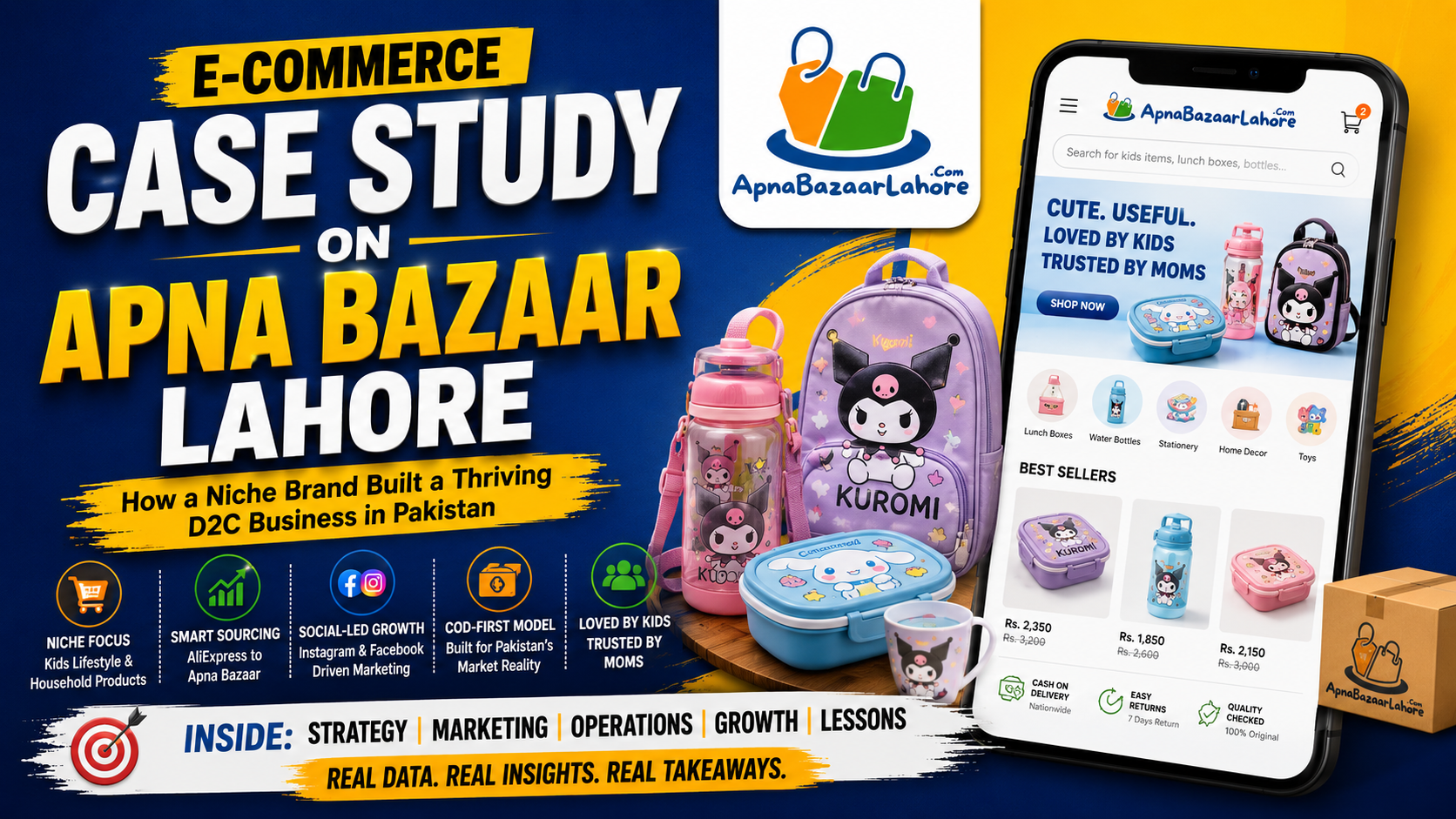
Apna Bazaar Lahore (apnabazaarlahore.com) is a Shopify-based direct-to-consumer store operating out of Lahore, selling kids' lifestyle and household products — lunch boxes, water bottles, school and stationery items, kitchenware, home décor, and character-licensed accessories spanning Sanrio, Hello Kitty, Powerpuff Girls, Minnie Mouse, and Marvel. It sits in a specific, high-volume corner of Pakistani e-commerce: cross-border sourced, impulse-priced, cash-on-delivery, Instagram-and-Facebook-led retail aimed largely at mothers and young women.
That makes it a useful case study — not because it is large or sophisticated, but because it is the dominant archetype of small-to-mid D2C commerce in Pakistan: a small team, Shopify plus social, dropship-to-light-inventory, COD-first, trend-led merchandising rather than owned manufacturing. What it does well and where it is structurally exposed is instructive for anyone building, evaluating, or competing against businesses like it.

02 · Brand & Category Snapshot
Reading the catalogue as strategy
| Platform | Shopify — theme structure, CDN asset paths, and "Quick view" UX all confirm this |
|---|---|
| Core sub-niches | Lunch boxes & bento sets (121 SKUs, the largest collection), water bottles, stationery, kitchen & drinkware, home décor (30 SKUs), educational toys |
| Positioning | "Your ultimate destination for top-quality kids' items" — affordable, cute, imported novelty goods |
| Price band | Roughly Rs. 1,250–6,500, almost every item shown marked down from a "regular" price |
| Sourcing signal | Product imagery and copy trace to AliExpress asset paths; several listings state "Origin: Mainland China" |
| Channels | Facebook, Instagram, YouTube, Snapchat — linked directly in the site footer |
What the SKU mix reveals
The heaviest category by count is lunch boxes — recurring, back-to-school-anchored, gift-adjacent, and endlessly variant-stackable by compartment count, character theme, and colour. Layering licensed-character aesthetics onto commodity houseware is the brand's core merchandising trick: it turns a generic import into an emotionally differentiated, giftable product without needing owned IP or manufacturing advantage.
03 · Business Model Analysis
What kind of business this actually is
Import-arbitrage retail, not manufacturing
Nothing in the catalogue appears designed or manufactured in-house. The brand sources trending SKUs — largely from Chinese wholesale/dropship marketplaces — and resells at a marked-up rate. The moat, such as it is, lives entirely in merchandising, marketing, and fulfilment speed, since the same items are available from many other resellers and from AliExpress directly.
COD-and-social-first, not marketplace-first
Rather than leaning on Daraz, the brand runs its own storefront and drives traffic through organic and paid social — full data ownership and margin control, at the cost of needing to build trust independently rather than borrowing a marketplace's reputation.
A permanent-discount pricing architecture
Nearly every SKU shows a struck-through "regular price" against a "sale price." Used selectively, that's a proven anchoring tactic. Used on almost the entire catalogue, it becomes background noise — customers stop believing the anchor is real.
At least three or four separately run Pakistani businesses use "Apna Bazaar" in their name — with no clear evidence any are the same entity as apnabazaarlahore.com. In a market where trust is the biggest conversion blocker, a shared, generic name is a real liability.
04 · What's Working
The positives
- Sharp niche selectionKids' lunch boxes and school goods are recession-resistant, repeat-purchase, gifting-friendly, and seasonally anchored — a natural, low-cost demand calendar.
- Emotional merchandising over commodity merchandisingWrapping ordinary houseware in Sanrio, Disney, and Marvel aesthetics converts price-sensitive commodities into shareable, gift-worthy items.
- Benefit-led product copyListings consistently go beyond specs into use-cases and gifting angles — a fundamental most small Pakistani D2C stores skip.
- Video embedded on product pagesSeveral listings carry demo videos directly on the PDP, reducing the "does this really work" doubt that drives COD refusals.
- Accessible price pointsSub-Rs. 3,000 pricing keeps the barrier to a first purchase low — important where customers are wary of prepaying an unfamiliar brand.
- Focused hero categoriesLunch boxes and home décor anchor the catalogue rather than leaving it flat and undifferentiated, helping both SEO structure and merchandising clarity.
05 · What's Not Working
The negatives and risks
- No visible brand moatNothing is exclusive or brand-owned. Any competitor with a Shopify store and an AliExpress relationship can list near-identical SKUs within days.
- Discount fatigueMarking down almost the whole catalogue trains customers to distrust "regular price" and compresses realised margin over time.
- Thin trust signalsNo visible founder story, quality-control narrative, or independent certification — this matters more for products that touch children, like feeding items and lunch boxes.
- Unlicensed IP exposureExplicit use of Disney, Marvel, and Sanrio branding — with claims like "Official Disney Design" — is the single biggest structural vulnerability: ad accounts, payment gateways, and the storefront itself can be suspended over it.
- Brand-name confusionMultiple unrelated Pakistani sellers use "Apna Bazaar," diluting reviews, search visibility, and word-of-mouth recall.
- Single-channel acquisitionReliance on Meta social alone leaves the business exposed to rising CPMs and account bans, with no visible retention or SEO hedge.
06 · Category & Market Context
Where this sits in Pakistani e-commerce
Pakistan's e-commerce sector is growing quickly but remains COD-dominant, trust-constrained, and highly fragmented at the small-seller level. Shopify-and-Instagram storefronts like this one make up a large share of active sellers, sitting well below larger funded platforms — Bazaar Technologies, for instance, raised $70 million in 2022 to digitise Pakistan's roughly $170 billion offline retail economy, illustrating how much capital is flowing into adjacent infrastructure even as small D2C stores remain almost entirely bootstrapped.
The proliferation of near-identically named "Apna Bazaar" sellers reflects a broader pattern here: low barriers to entry mean names, niches, and catalogues get copied fast, and long-term winners are the ones who build defensible trust and retention — not just the ones who find a trending catalogue first.
07 · Lessons
For founders, operators, and strategists
For aspiring D2C founders — what to copy
- Pick a hero category with a built-in purchase calendar — seasonal, recurring, gift-adjacent.
- Merchandise emotion, not specs. A themed product has a story and share-appeal; a plain one doesn't.
- Write PDP copy that sells the moment of use, not just the item.
- Put video on the PDP — it directly reduces COD refusal risk.
For experienced operators — what not to replicate
- Don't discount everything, all the time — reserve markdowns for real promotional moments.
- Never make unlicensed IP a core merchandising strategy; it works until one takedown ends it.
- A generic or duplicated brand name compounds as a cost — invest early in a name you can own.
- Diversify beyond Meta ads with WhatsApp, SMS, email, and SEO before you're forced to.
- Build trust infrastructure proportional to product risk, especially for anything touching children.
For strategic and enterprise e-commerce leaders
- Competitive lens: your real online competition for attention is often these low-overhead, high-agility sellers, who can list and kill products in days — speed-to-trend and content velocity matter more against this set than traditional retail playbooks assume.
- Partnership lens: niche stores with strong SKU-level demand data can be attractive bolt-on categories or vendor partners for larger retailers extending into adjacent verticals without building sourcing relationships from scratch.
08 · Strategy
Recommended future strategy
- Consolidate identity — secure a unique, trademark-able name and handles distinct from every other "Apna Bazaar," and clarify to customers how to spot the real store.
- Move from pure resale toward semi-private-label on the top-selling SKUs, commissioning custom colourways or branding from the same manufacturers.
- Resolve IP exposure proactively — phase out unlicensed character branding on ad creative and hero listings.
- Rebuild the discount architecture around a smaller set of everyday-price SKUs plus clearly time-boxed campaigns.
- Invest in retention infrastructure — WhatsApp broadcast lists and post-purchase SMS/email flows.
- Add trust signals proportional to child-safety risk: material certifications, a visible return policy, and real customer content.
- Diversify acquisition — add a Daraz storefront and light SEO content to reduce dependence on Meta CPMs.
- Track and publish internal KPIs — COD refusal rate, repeat-purchase rate, CAC by channel, category contribution margin.
09 · Conclusion
The pattern behind the brand
Apna Bazaar Lahore is a well-executed example of Pakistan's dominant small-D2C archetype: a sharply chosen, emotionally merchandised niche sold through a self-owned storefront with above-average copywriting and video support. Its weaknesses — commodity sourcing with no real moat, unlicensed IP exposure, discount fatigue, name confusion, and single-channel acquisition — are shared by most small operators in the market.
The brands that graduate from "trending catalogue" to "durable company" are the ones that convert commodity sourcing into owned brand equity, resolve legal exposure before it resolves them, and build retention infrastructure before rising acquisition costs force the issue.
For an experienced operator, the value of this case study isn't in what Apna Bazaar Lahore sells — it's in recognising this exact pattern across hundreds of similar Pakistani sellers, and knowing precisely which structural fixes separate the ones that will still exist in three years from the ones that won't.