Potential of Fruite Leather Business - Ecommerce Case Study of Khasoaam.com - Khas O Aam
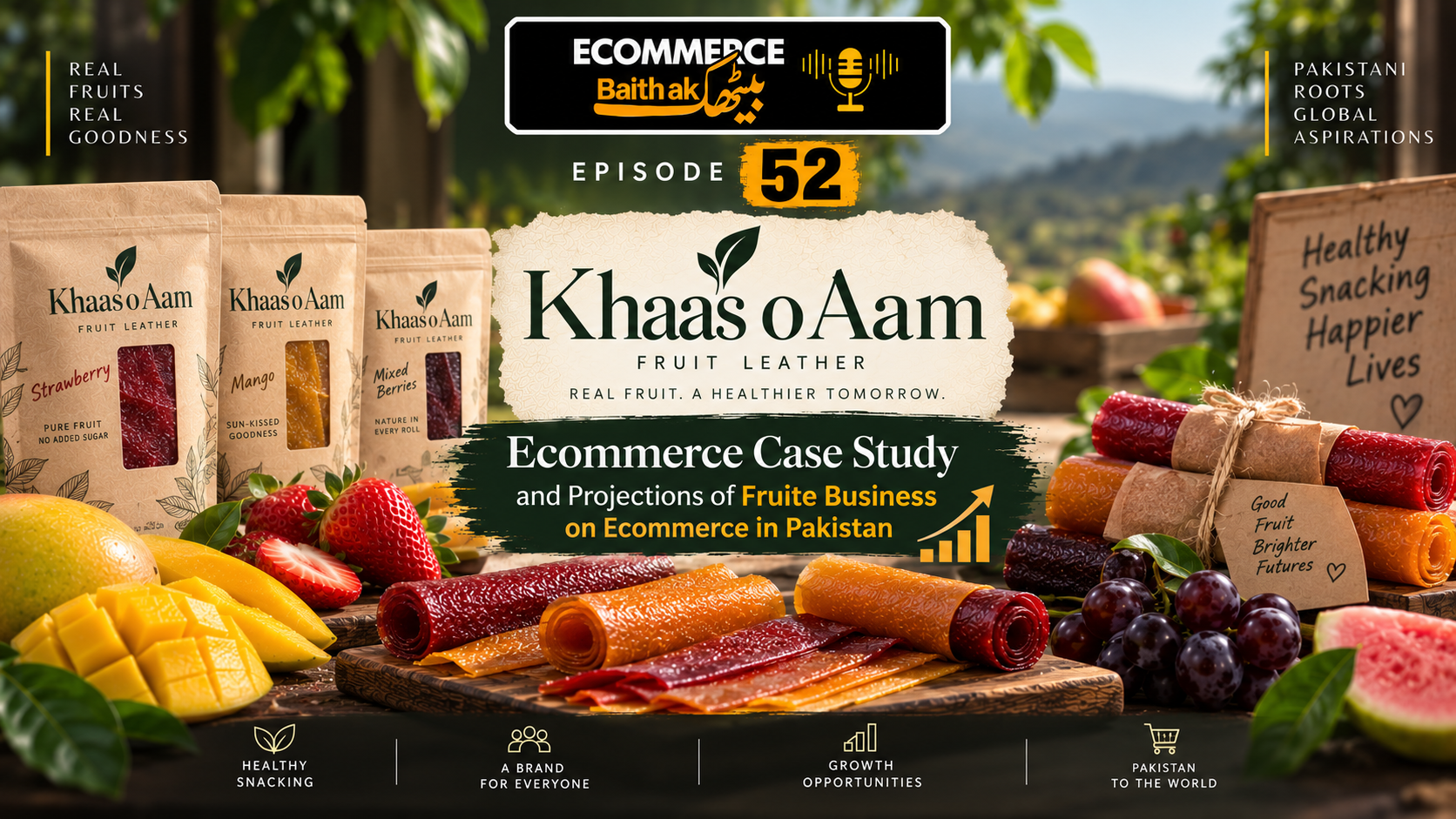
MARKET & ECOMMERCE CASE STUDY — SEPTEMBER 2026
Fruit Leather: Global Business Potential & the Khasoaam.com Case Study
What the dried-fruit-snack category is worth worldwide, why Pakistan is positioned to supply it, and how one Rawalpindi-based Shopify brand is running the playbook.
01 — CATEGORY
What "fruit leather" is, as a business
Fruit leather (aam papad, fruit roll-ups, fruit bites) is dried, pureed fruit pulp pressed into sheets, strips, or bite-sized pieces. It sits at the intersection of three growing consumer trends: clean-label snacking, low or no-added-sugar treats, and shelf-stable "farm-to-pantry" positioning.
It's also a low-capex product to manufacture — fruit pulp, a drying line, and packaging — which is exactly why it works as a small-batch ecommerce business: margins can be strong and minimum order quantities low.
02 — MARKET SIZE
Global market size and growth
Estimates vary by research vendor depending on how narrowly "fruit leather" is scoped — some reports blur the line with the unrelated bio-based vegan-leather materials industry, a completely different category worth keeping separate when comparing sources.
| Source | Base value | Forecast value | Year | CAGR |
|---|---|---|---|---|
| Growth Market Reports | $1.22B (2024) | $2.28B | 2033 | 7.1% |
| Dataintelo | $1.24B (2024) | $2.29B | 2033 | 7.1% |
| MarketIntelo | $2.8B (2025) | $5.1B | 2034 | 6.9% |
| Future Market Insights (functional sub-segment) | $449.8M (2026) | $1,135.2M | 2036 | 9.7% |
Reading it: treat $1.2–2.8 billion as the realistic 2024–2025 global market band. None of these figures come from a single authoritative government body, so use the range directionally. Growth is consistently modeled at 7–10% CAGR — roughly double the growth rate of packaged snacks overall.
Regional breakdown (2024)
- North America — largest and most mature market, ~38% of global sales, ≈ $463–471 million.
- Asia Pacific — ≈ $305 million in 2024, but the fastest-growing region at ~9.4% CAGR through 2033.
- Europe — consistently the #2 market; a 2026 EU front-of-pack nutrition-labeling law is expected to further favor cleaner-label snacks like fruit leather.
The channel shift that matters most
Ecommerce has meaningfully lowered the barrier to entry: small-batch producers can now reach national or global distribution digitally without needing traditional retail shelf space — exactly the playbook Khasoaam is running.
03 — SUPPLY SIDE
Pakistan's raw-material advantage
Khasoaam's core input (mango, plus stone fruit and berries) sits on top of one of the world's largest mango-producing bases:
- Pakistan is the 4th-largest mango exporter and 6th-largest producer globally, growing ~1.4–1.8 million metric tons/year.
- Only ~6–7% of production (130,000–135,000 tons) is exported — the rest is domestic, so raw-material supply for a processing brand is abundant, not export-constrained.
- 2024 mango exports: ~135,000 tonnes worth ~$119 million. 2025 target: 125,000 tonnes / ~$100 million.
- ~75% of Pakistan's mango exports go to GCC countries — almost exactly where a Pakistani diaspora-facing snack brand finds its easiest first export market.
- February 2026: Pakistan's first direct mango shipment (120 tonnes) reached the Netherlands after EU approval, opening a formal, non-Dubai-routed path into Europe.
For Khasoaam, this means input-cost risk is about climate and water variability, not scarcity of exportable-grade fruit — mango, plum, peach, guava, and falsa are all grown at commercial scale across Punjab and Sindh.
04 — CASE STUDY
Khasoaam.com
Business snapshot
- Platform: Shopify — custom theme, Shopify Payments and checkout.
- Location: Rawalpindi, Pakistan, positioned as farm-adjacent to Punjab's Chaunsa mango belt.
- Range: 50+ SKUs across two lines — Fruity Bites (Mango Chaunsa, Mango Langra, Mango Chilli, Mango Tamarind, Strawberry, Guava Chilli, Falsa, Plum, Peach) in 40g/80g/100g pouches, and Fruity Roll Sheets in the same flavors.
- Free shipping threshold: Rs. 2,200, delivered nationwide in 3–5 working days.
- Trust signals: "1 million+ customers," 5+ years trading, 50+ products, customer photo reviews, active Facebook / Instagram / TikTok presence.
Pricing structure (PKR)
- 40g pouch Rs. 300–400
- 80g pouch Rs. 450–550
- 100g pouch (spicy/premium up to Rs. 700) Rs. 550–700
- Fruity Roll sheet (regular / discounted) Rs. 1,000–1,800
Bundling — the core merchandising strategy
| Bundle | Price range | Discount |
|---|---|---|
| Pack of 4 (100g) | Rs. 1,900–2,280 | 5% off |
| Pack of 6 (100g) — "Most Popular" | Rs. 2,790–3,350 | — |
| Pack of 8 (100g) | Rs. 3,600–4,320 | 10% off |
| Pack of 5 (40g) | Rs. 1,425–1,900 | 5% off |
| Pack of 10 (40g) | Rs. 2,790–3,720 | 7% off |
| Pack of 15 (40g) | Rs. 4,050–5,400 | 10% off |
The free-shipping threshold (Rs. 2,200) sits just below the entry bundle price — a deliberate AOV nudge that pushes customers toward the next tier.
What the model gets right
- Bundling over single-SKU selling. For a low unit-price snack (Rs. 300–700), single-item checkout economics are brutal once a Rs. 200–300 courier cost is factored in. Forcing bundle purchases solves the AOV problem at the merchandising layer.
- Free-shipping threshold engineering. Set just above the entry bundle, it's a textbook nudge into the next tier.
- Origin story. Leading with "Chaunsa mango orchards" and "direct from farmers" plays into provenance and support-local sentiment — echoed almost word-for-word in the on-site reviews.
- Flavor-led expansion. Savory-spiced variants (Guava Chilli Zing, Mango Tamarind Spicy, Falsa Peri Punch) tap the South Asian "chatpata" flavor profile a Western fruit-roll-up brand wouldn't have — a genuine differentiator.
Gaps and risk areas
Stock-outs on flagship SKUs. Several Fruity Roll SKUs — the highest-price format — are sold out simultaneously, pointing to a drying-capacity or working-capital bottleneck. This is likely the single biggest revenue leak on the site today.
No visible export checkout. PKR-only pricing and domestic-only policies leave an obvious diaspora export market (UK, UAE, Saudi Arabia, US, Canada) untouched, despite it being the same corridor that already imports Pakistani fresh mangoes at scale.
No subscription mechanism. A shelf-stable snack with a natural 30–45 day household consumption cycle is a strong subscribe-and-save candidate, currently unaddressed.
05 — UNIT ECONOMICS
Ecommerce case study — modeled numbers
Khasoaam doesn't publish traffic or financial data. The figures below are benchmark-based modeling for a Pakistani Shopify DTC food brand at Khasoaam's apparent scale — a planning framework, not the company's reported financials.
Reference benchmarks (Pakistan ecommerce, 2025)
Illustrative funnel — per 100,000 monthly visitors
| Funnel stage | Rate | Volume |
|---|---|---|
| Visitors | — | 100,000 |
| Add to cart | ~9.8% | 9,800 |
| Checkout started | 28% of ATC | 2,744 |
| Orders completed (COD-confirmed) | ~85% of checkouts | ~2,330 |
| Visitor → order conversion | ~2.3% | |
At an average bundle order value of ~Rs. 2,800 (between the Pack-of-4 and Pack-of-6 tiers — the site's own "Most Popular" pick):
Rough cost stack
| Cost line | % of revenue |
|---|---|
| COGS (fruit, processing, packaging) | 30–38% |
| Courier / fulfilment (COD-heavy) | 8–12% |
| COD failed-delivery / return leakage | 3–6% |
| Paid marketing (Meta / TikTok / Google) | 15–25% |
| Platform + payment fees | 2–3% |
At the midpoint, contribution margin lands around ~29.5% — of the ~Rs. 78M annual run-rate, roughly Rs. 23 million (~$81,000) is available for overhead, team, and reinvestment before profit.
What moves the needle most, ranked
- Fixing stock-outs on Fruity Rolls — the highest-AOV SKUs. Even a conservative 15–20% lost-revenue estimate outweighs any marketing optimization.
- Cutting COD dependency — every 10-point shift toward prepaid typically improves realized revenue 3–5% from eliminated refusal/return leakage.
- Subscription mechanism — converting even 10% of customers to a 45-day auto-reorder smooths demand and lowers blended CAC.
- Export / diaspora expansion — see below.
06 — EXPANSION
Global expansion potential
The lowest-risk path isn't competing with Western fruit-leather brands cold — it's following the existing Pakistani mango export and diaspora corridor, where trust, taste familiarity, and demand already exist.
| Market | Why it fits | Data point |
|---|---|---|
| UAE / GCC | ~75% of mango exports already flow here; large diaspora | Top-2 export destination by value |
| United Kingdom | Large, established Pakistani diaspora | #1 revenue market — $13.2M (2024) |
| Saudi Arabia | Large labor-diaspora population, strong halal/clean-label demand | Part of 70% GCC-directed 2025 target |
| North America | Largest fruit-leather category overall | ~38% global share, ~$463–471M (2024) |
| EU (post-2026) | New direct export lane; labeling rules favor clean-label | First direct shipment: 120t, Feb 2026 |
Rough sizing: capturing even 0.05–0.1% of the global $1.2–2.8B category through diaspora and export-adjacent channels within 3–5 years works out to a $600,000–$2.8 million incremental revenue band — realistic for a well-executed export/DTC hybrid, not a moonshot.
07 — AT A GLANCE
Summary numbers
*Modeled/illustrative, not Khasoaam's disclosed financials. Market-size figures come from multiple independent research vendors whose scope definitions differ — treat ranges as directional. Pakistan trade figures are drawn from PFVA statements and Pakistani/international business press (2025–2026). Khasoaam-specific figures are read directly from the live storefront (September 2026).