How to start Ecommerce Business in Pakistan from Zero - Case Study on Rivaaj Mahal
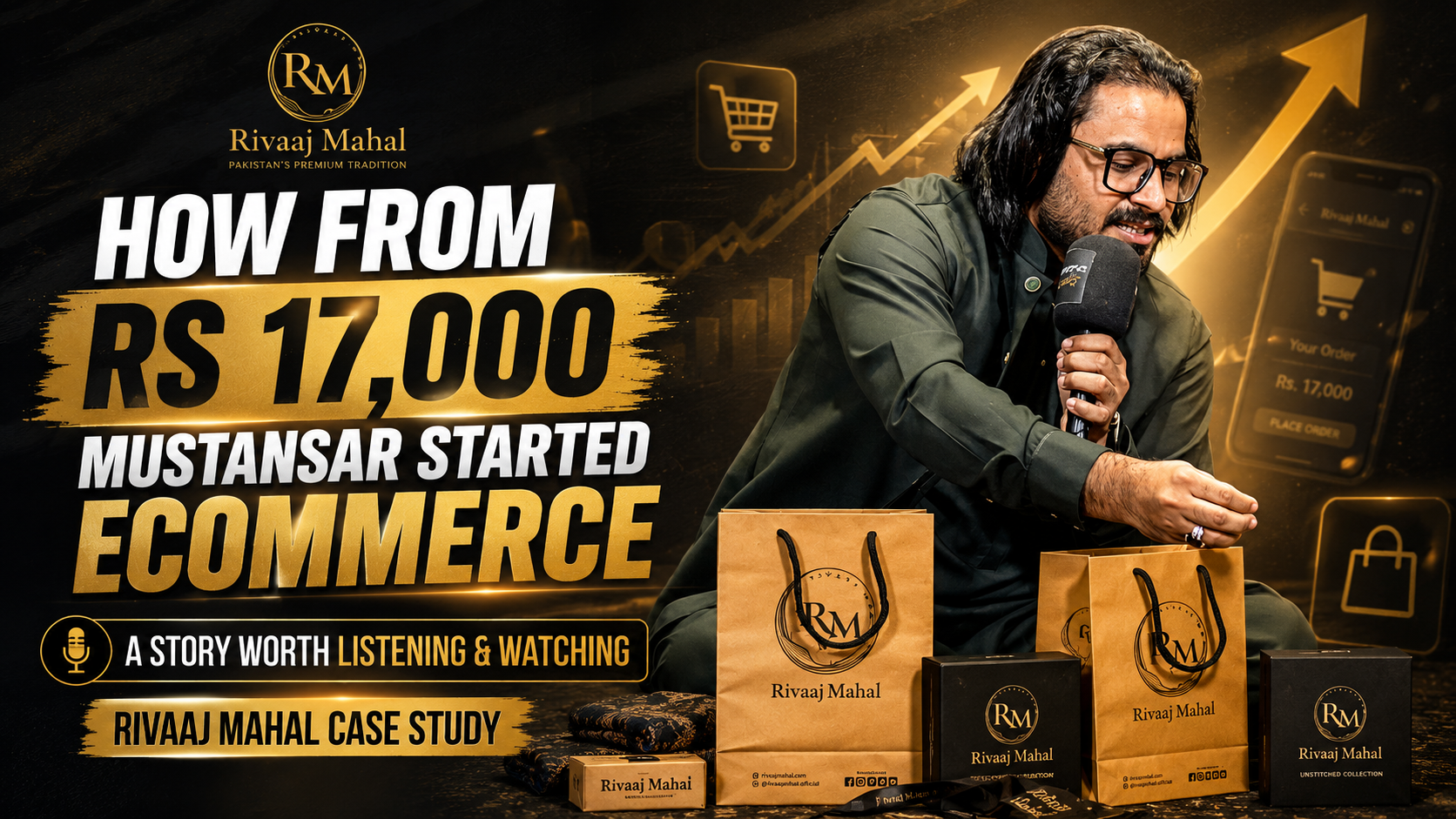
Rivaaj Mahal: How One Man Turned a Rs. 17,000 Phone Into Pakistan's Busiest Parcel Brand
No investors, no studio, no marketing degree — just a hakeem's hair-oil formula, a secondhand Android, and a refusal to wait until things were perfect. This is the inside story of how Mustansar Hussain built Rivaaj Mahal from a single bottle sold without even a sticker into a 140-person company that TCS says moves more parcels than almost anyone else in the country.
"Don't delay work chasing perfection. Start the work — perfection will come on its own."— The line Mustansar Hussain built his entire company around
A Factory Wage, and a Job Offer That Went the Other Way
In 2021, Mustansar Hussain walked into the office of Ali — a Gujranwala e-commerce operator who hosted this episode of Ecommerce Baithak — hoping to get hired at a modest salary. Ali had no open position, but he remembers something clicking: "I had a gut feeling this guy could sell."
There was no job that day. So Mustansar went back to what he already knew: he was working a factory floor for around Rs. 18,000–20,000 a month, the kind of daily-wage labour most people never expect to leave. Around the same time, a friend told him people were making money selling SIM cards on TikTok Live.
His first sale took roughly three and a half minutes and earned him Rs. 1,500 in commission — more than he made in a full eight-hour factory shift. "I thought, there's something in this online business," he recalls. That single thought is the entire origin of Rivaaj Mahal.
A customer in Karachi told him something simple: "If someone brought a genuinely good hair oil to this city, it would sell itself — the demand is huge." Seven friends were sitting together when that comment landed. Only one of them acted on it.
From Kitchen Batch to National Brand — Step by Step
A home-made oil that wasn't good enough
Mustansar tried making the oil himself first. It didn't work — the formulation wasn't right. By his own account, Allah then sent him a formula through a hakeem: a recipe originally passed down from an Indian hakeem to the man's own grandfather. That hand-me-down formula, refined through repetition, became the base of Rivaaj Mahal's signature hair oil.
Content shot on a Rs. 17,000 Android phone
With no equipment and no experience being on camera, Mustansar bought a cheap Chinese phone for Rs. 17,000 and started filming. He chased "channels" in Lahore and Gujranwala hoping for a big break that never came the way he expected — so he borrowed iPhones from friends instead, begging them not to delete the footage because he didn't have storage of his own.
An Indian video, his own voice-over, and a 4-million-view moment
The breakthrough wasn't original footage — it was a reused Indian reel of a girl letting her hair down, with Mustansar's own voice-over added on top, cut together on CapCut (a tool he taught himself by trial and error, without knowing how to make a clean audio cut, often re-recording a 30-second voice-over for two hours because a passing street vendor's call ruined the take). That first viral post hit roughly 4 million views — and generated about 1,500 orders in a single day, against a starting stock of just 50 units.
Fifty bottles, borrowed money, and a five-month wait
With no capital, he negotiated his way into buying just 50 bottles from a wholesaler who normally sold cartons of 150. When it came time to package, the branded sticker cost Rs. 3,500 — money he simply didn't have. So the very first units of what is now Pakistan's most-copied oil brand shipped with no sticker at all, in a plain brown TCS flyer. The first order didn't arrive until nearly five months after launch; the unsold stock sat visibly in a corner of the house the whole time, a daily reminder from family to "do something with that stuff."
The first COD payment: Rs. 21,000 in, Rs. 13,000 straight back into oil
Where many first-time sellers spend their first big cash-on-delivery payout on themselves, Mustansar put almost two-thirds of his very first payment straight back into raw material for the next batch — a discipline he credits directly for the brand's early survival.
From ~1,200–1,300 orders a month to ~11,000
Organic growth eventually plateaued near 1,200–1,300 orders. That's when Rivaaj Mahal moved into paid advertising across Meta, Instagram and TikTok — pushing monthly order volume to roughly 11,000. Ad spend today sits around 23–25% of revenue, with a hard rule behind every price: at least Rs. 1,000 of clear profit must remain on every unit after every cost — ad spend, courier, packaging — is accounted for.
"You have to become the moon of Eid — everyone works, watches, waits and struggles for it. Don't aim to be the moon of the 14th, already full and easy to see."— On why "overnight success" in e-commerce is a myth
"Throw It in the Trash If It Doesn't Work"
Rivaaj Mahal's signature pitch line, used across its content and repeated on-air during this episode, is disarmingly blunt: use it once, and if your hair isn't visibly silky, shiny and smooth after a single wash, throw the bottle in the bin. Mustansar says this level of confidence is only possible because the formulation is real — a cooked, herbal recipe using ingredients like amla, reetha, sikakai, henna leaves and rosemary, deliberately excluding onion, which he argues is a market fad with no real hair-growth benefit once separated into its actual active compounds.
He is equally direct about what hair oil can't do: it strengthens and nourishes existing hair and scalp follicles — it does not regrow hair on a bald scalp, and any brand that claims otherwise, he says, is lying. That honesty, delivered in plain Punjabi-inflected street language rather than clinical jargon, is core to why customers trust the brand enough to reorder.
From One Oil to a Full Routine
Rivaaj Mahal expanded deliberately — never chasing product count, always following what its own hair-oil customers were already buying elsewhere.
Herbal Hair Oil
The original hakeem-formula oil. Cooked in small batches, no fixed onion/scent recipe, no machine-line mass production — which is why colour and aroma vary slightly batch to batch. Reportedly the highest-reorder product in the range.
Herbal Shampoo
Light-lather formula built to clean without stripping the scalp's natural oils — positioned as a "clean, not cosmetic" shampoo, sold as a companion to the oil rather than a replacement for it.
Face Wash
Deep-cleansing, oil-control formula built around the same "no false promises" approach — marketed on what it removes, not on an unrealistic transformation.
Skin Serum (Aug. 2026)
An all-in-one, "multivitamin" style serum built for skin repair rather than whitening — formulated by one of the same specialists behind Rivaaj Mahal's earlier skincare work.
Influencer Marketing Without Spending a Rupee
Long before Rivaaj Mahal ran a single paid campaign, Mustansar was securing influencer placements from creators who normally charge tens of thousands of rupees — for free. His method: a short, respectful, personal outreach message ("I'd consider you my sister, would you try this product?") instead of a transactional pitch deck. One influencer with roughly 3 million followers, who was in the early days of her own career at the time, cried when he addressed her as "sister" — and has been organically promoting the brand ever since, whenever she needs product, always sent free.
He is candid that this approach outperforms paid influencer deals precisely because it isn't transactional: "speak from the heart and it reaches the heart; speak from the tongue and it only reaches the ear." Products have also reportedly reached the homes of major Pakistani TV producers and channel owners — including one of the country's longest-running morning-show hosts — through the same organic, relationship-first approach.
Rivaaj Mahal's popularity created an entire underground economy of counterfeiters selling near-identical "coal-cooked" copycat oils out of Shalimar Market — some running fake ad libraries claiming 497 simultaneous live campaigns to pressure genuine sellers into thinking they were being out-marketed. Mustansar's read on it: the counterfeiters' unpaid marketing of "Rivaaj Mahal-style" oil ended up driving buyers to search out and discover the real thing.
Honesty as a Growth Strategy
Mustansar repeatedly frames Pakistani e-commerce as an unusually open playing field: unlike a saturated market like the UK, where brands compete on incremental features, in Pakistan the bar to clear is simply delivering exactly what you promised in the video — something he says most sellers still fail to do. He is openly critical of couriers who take advances and disappear, and of sellers who blame couriers for return rates that are, in his experience, overwhelmingly caused by customer behaviour rather than logistics failure.
On customer service, the team runs a "quality over quantity" model: reps are told to fully and properly answer twenty inbound messages rather than half-answer fifty, on the logic that eighteen well-handled conversations convert and deliver better than fifty rushed ones. Every message that lands on WhatsApp — even a stray "hello" — is treated as a live customer.
International Markets, a Major New Project — No Physical Store
Asked where Rivaaj Mahal goes in the next five to six years, Mustansar was clear: international expansion is coming, but a physical retail footprint is not a priority. His reasoning is pragmatic — in Pakistani retail, a shopkeeper will haggle a price down and still let a customer walk away owing money; in e-commerce, payment lands the moment the product does. He also teased a large, as-yet-unnamed new product line already in development, expected to surface on social media soon.
His closing advice to anyone still sitting on an idea was simple and specifically aimed at people starting from nothing: don't dream of lakhs on day one — aim for what a modest job pays, then let it compound. "Even three orders a day is likely better than most people's job. Start there."