Ecommerce Case Study on Herbal Solution - Selling Shilajit Online ! High Demand
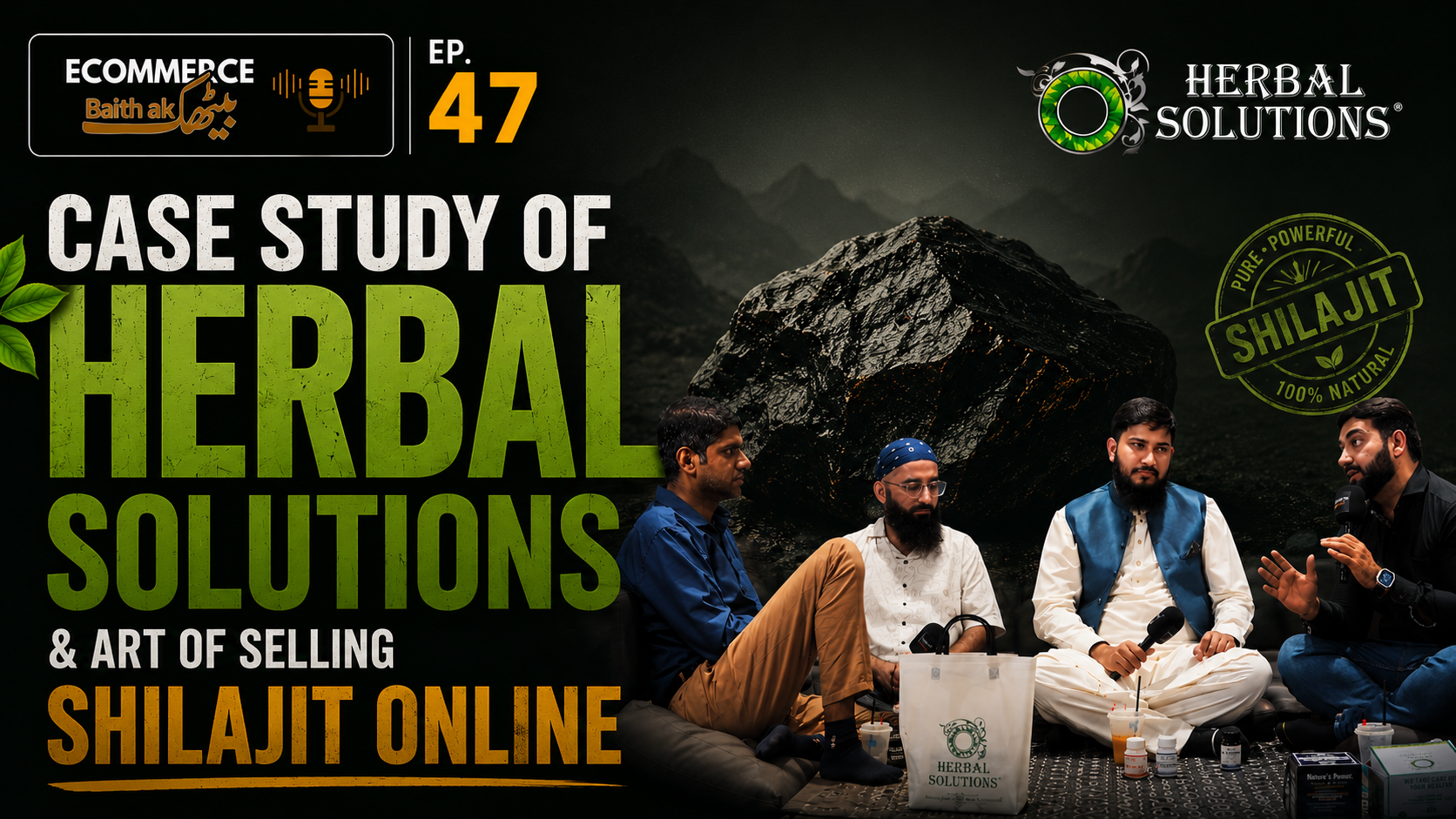
Herbal Solutions: How a Faisalabad Hikmat Family Business Built a 10-Year Digital Brand in Pakistan's Most Distrusted Category
Featuring Abdul Rehman Jami (CEO & Founder) and Waheed Ahmed (COO & Marketing Manager) — a deep dive into scaling herbal and Hikmat products online, from a Facebook boost button to certified, research-backed treatment courses.
Brand Snapshot
Herbal Solutions is a Faisalabad-based Hikmat (traditional herbal medicine) brand that sells research-backed, problem-solution herbal courses online across Pakistan — covering fertility, hair and biotin care, child growth/height, and diabetes management, among others. It operates alongside four other parallel e-commerce ventures run by the same founding team, including an Amazon services arm and a private-label/third-party manufacturing business for other herbal brands.
The Origin Story: From Newspaper Ads to a Dead Response Rate
Herbal Solutions traces its roots back to the late 1990s, when Jami's father — referred to respectfully as "Hakeem-ul-Ummat" Dr. Muhammad Ashraf Bhatti — moved to Faisalabad and set up a research-based Hikmat institute. For years, the brand grew through the classic offline playbook: newspaper listings and TV commercials drove a steady stream of walk-in and phone-order customers.
That worked well until roughly 2017, when the response from traditional media essentially flatlined. Jami, an IT graduate, turned to Waheed Ahmed — a senior colleague from an internship at a Faisalabad software house who had since built his own background in the space, including a Homeopathy qualification — to figure out what came next.
Why Faisalabad Is Pakistan's Hikmat Capital
Jami explains that Faisalabad's dominance in the Hikmat/herbal category isn't accidental — it comes down to deep-rooted generational knowledge combined with a historic gap in modern platforms.
The old model vs. the modernized model
- Old guard: Experienced Hakims and doctors sitting on decades of knowledge, but without a digital platform or a modern go-to-market approach — an "old-school mentality" as Jami describes it.
- Herbal Solutions' shift: A structured team of doctors and Hakims, research-based product development, and a "problem → solution" framing for every product rather than vague wellness claims.
This same regional strength is also why counterfeit and unregulated herbal products flood the market — anyone can claim to be a Hakim, package a mixture, and sell it online with no certification, no lab testing, and no accountability.
Building the Digital Storefront
Offline-first growth via newspaper classifieds and TV commercials. Heavy advertising spend, strong walk-in response.
Traditional media response collapses. Jami and Waheed decide to move online with almost no budget. First website is built on WordPress, with Waheed personally handling front-end, hosting, and design — unpaid, purely on partnership and belief in the brand.
Response is weak. The team is still learning: domain and hosting issues, frequent site downtime, and design limitations on WordPress hold growth back.
The store is rebuilt on Shopify, and response improves significantly. Herbal Solutions still runs on Shopify today at herbalsolutions.com.pk.
~10 years into the online journey, with a live physical store in Faisalabad in addition to a full e-commerce operation, a trained in-house doctor/Hakim consultation team, and a growing private-label manufacturing arm.
Product Philosophy: Slow, Research-First Launches
Unlike many herbal sellers who list a product and hope it sells, Herbal Solutions treats every launch as a multi-month R&D project. The team says it has launched 17+ research-backed course/bundle products to date, with more in the pipeline.
Flagship product lines
Fertility Bundles (Male & Female)
The brand's single best-selling category. Herbal Solutions reports 23,500+ registered patients whose infertility issues were resolved through its courses — a number driven almost entirely by word-of-mouth and repeat/referral orders rather than paid advertising.
Children's Height-Growth Powder
Launched after ~18 months of testing. When it was finally introduced — quietly, to existing repeat customers — order volume was strong from day one, with no dedicated ad campaign behind it.
Hair Oil + Biotin Combo
Rather than selling a standalone topical hair oil (the industry norm), the brand pairs it with an ingestible biotin-related supplement, treating hair health as a nutritional issue rather than a purely cosmetic one.
Diabetes Support Course (Dia Control)
A recently launched product designed as a 90-day dietary supplement regimen, paired with lifestyle guidance rather than positioned as a replacement for allopathic medicine on day one.
The "Prescribe Before You Ship" Model
Perhaps the most distinctive part of Herbal Solutions' operation is that it refuses to treat itself as a pure e-commerce seller. Every order is filtered through a consultation step before dispatch.
This is enabled by an in-house team of trained doctors and Hakims — branded internally as "Herbalist" consultants — who review incoming orders via the website and WhatsApp, recommend the right course and usage, and follow up. The team also prints and distributes physical brochures with diet and lifestyle instructions (e.g., a 30-minute daily walk for the diabetes course) so results aren't left to chance.
Why lifestyle compliance matters to the business model
Jami is candid that results vary with compliance: patients who follow the paired diet/exercise guidance alongside a course see strong outcomes and become repeat buyers; those who ignore the guidance (junk food, no exercise) may still see benefit, but "results drop to around 10%." The brand treats this honestly with customers rather than overselling.
Compliance & Certification: The Real Moat
In a category flooded with unregulated sellers, Herbal Solutions leaned into regulatory compliance as its core differentiator and defense against both fake competitors and platform bans.
| Requirement | Detail |
|---|---|
| Certifications held | 13 different types of certificates accumulated over time |
| Testing body | PCSIR (Pakistan Council of Scientific & Industrial Research) — offices used in Lahore and Islamabad |
| Regulatory forms | Form 6 (facility/manufacturer registration) and a separate Form 7 per product |
| Testing timeline | Up to 1.5 years for a single new product before public launch |
| Approx. investment | Roughly PKR 1–2.5 crore invested in certifications over the years |
| Product-level QA | Batch/lab testing on every raw ingredient, with expiry dates marked on every product — a direct contrast to unregulated "pansar store" herbs sold loose, with no expiry labeling or hygiene standards |
Because ad platforms and courier companies both require proof of registration/certification for health-adjacent products, this compliance investment doubles as the brand's ticket to sustained access on Meta Ads and reliable courier onboarding — something most informal competitors in the category can't produce.
Marketing: Meta-Only, No TikTok, ~3x ROAS
Herbal Solutions' entire paid marketing budget runs on Meta (Facebook/Instagram) — deliberately avoiding TikTok, which the team says repeatedly bans this product niche due to platform restrictions on health/herbal claims.
Protecting ad accounts
Account bans and restricted ad access were a recurring early struggle. The fix, according to the team, wasn't a growth hack — it was documentation: keeping certifications ready to submit whenever Meta flagged the account, and maintaining a direct line with Meta's support agents to resolve restrictions faster.
Logistics, COD Culture, and a Near-Zero Genuine Return Rate
Herbal Solutions reports that its product return rate is effectively negligible — and draws a sharp line around why.
The team also flags a category-specific customer behavior: because fertility and similar health products carry social stigma in Pakistan, a share of customers order under altered names or try to keep their identity discreet from the courier — occasionally creating delivery confirmation friction that the in-house consultation team has learned to manage proactively.
Day-to-day, though, Jami is candid that operations aren't glamorous: "Every single day is a new challenge — courier team issues, customer support, all of it. It's not that we're sitting comfortably; it's a genuine headache. But if you carry it as a passion rather than just a business, you push through."
A Second Revenue Line: Private-Label Manufacturing
Roughly six months before this recording, Herbal Solutions began quietly offering third-party manufacturing / private-label services to other herbal brands and local Hakims across Pakistan — leveraging the certifications, testing infrastructure, and formulation expertise it had already built.
- Partner brands (e.g., a brand called "Royal Herbal," cited as an example) get their own logo and branding on the front of the packaging.
- Herbal Solutions remains the registered manufacturer on record — meaning if a Drug Inspector or DRAP official ever checks, the manufacturing entity is fully compliant even if the storefront brand is someone else's.
- This lets new entrants skip the 1.5-year testing timeline and multi-crore certification cost entirely, launching under their own brand name at a fraction of the cost and time.
This service line effectively turns Herbal Solutions' biggest historical cost center — regulatory compliance — into a monetizable asset for the broader industry.
The Bigger Challenges
Fake & unregulated competitors
The team repeatedly flags that "every other person" now poses as a Hakim online, selling untested mixtures with real health risks — including cited cases of kidney failure. This erodes category trust for legitimate players and is why certification-first positioning matters so much.
Platform & regulatory friction
Meta ad account restrictions, TikTok bans on the entire niche, and courier companies demanding proof of certification before onboarding are recurring operational hurdles unique to this category.
Supply chain exposure
Some raw ingredients are sourced from India. Border closures tied to regional tensions in the past year created sourcing difficulty, which the brand weathered mainly because it had built up herb stock in advance.
Category stigma
Fertility and similar sensitive health categories carry social stigma in Pakistan, affecting how openly customers are willing to transact — requiring extra discretion in packaging, courier communication, and customer support.
Key Takeaways for Founders Entering Regulated / Health-Adjacent Niches
- Invest in the product before the ad spend. A single product launch took 1.5 years of testing before Herbal Solutions would put it in front of customers — a stance the founders credit for their high repeat-purchase rate.
- Certification is a growth lever, not just a compliance cost. 13 certificates and PCSIR testing didn't just keep them legal — it kept their Meta ad accounts alive and unlocked a new private-label revenue stream.
- Customer service can be the actual product. A doctor consultation before every shipment — sometimes resulting in "don't buy this, adjust your dosage instead" — builds the kind of loyalty that produces 50%+ repeat orders without discounting.
- Diversify platform dependency early. Losing TikTok access entirely, this brand still runs a healthy business on Meta alone — but actively protects that single channel through documentation and platform relationships.
- Treat "returns" and "stigma" as operational design problems, not customer complaints. Discreet packaging, proactive courier communication, and treating courier failures separately from customer intent all reduce friction in a sensitive category.
- Purpose-first framing can outlast pure-profit motivation. The founders describe running the brand closer to a low-margin, mission-driven service than a maximized-profit operation — and credit that mindset with their near-decade of consistency.
Closing Note
Herbal Solutions' story is less about a single viral growth hack and more about compounding trust in a category where trust is in chronically short supply. A decade of consistent product testing, a doctor-led consultation layer wrapped around every order, and a certification portfolio that most competitors can't match have turned a Faisalabad Hikmat family business into one of the more credible players in Pakistan's herbal e-commerce space — and, increasingly, into infrastructure that other herbal brands now build on top of.