Solutions to All Ecommerce Problems in Returns, COD and Online Orders: The J's Brand Ecom Case study
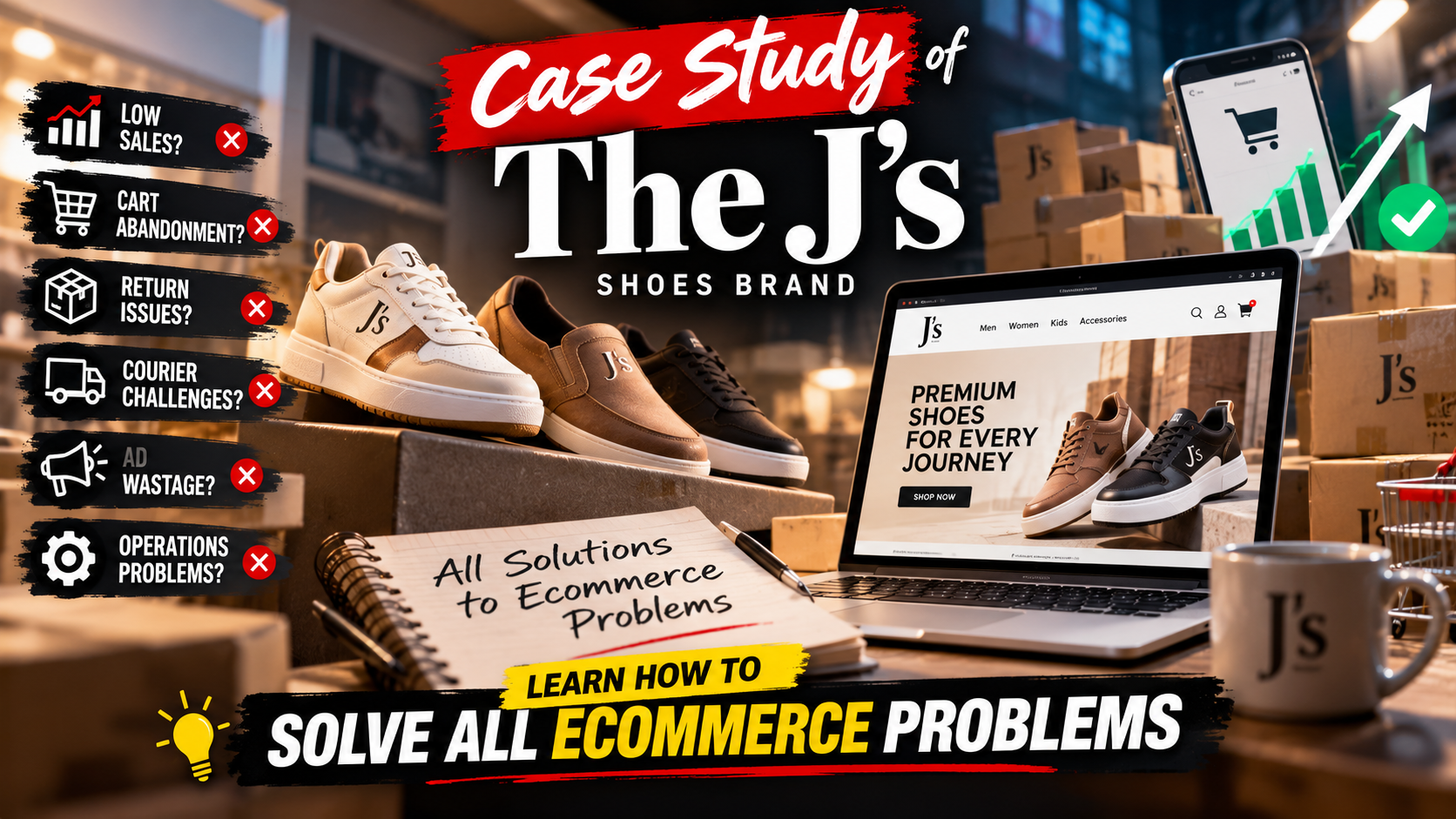
Case study: custom leather footwear in Lahore
Most online shoe sellers compete on price and fight returns. The J's Store does the reverse: the team measures the customer's foot, makes each pair to order and charges a premium for the whole experience. Here is how the founders built it, what their numbers look like, and which parts you can borrow.
Based on the Ecommerce Baithak conversation with co-founder Aseez Jamal. About 12 minutes to read.
Figures are as stated by the guest on the show. They have not been independently audited.
In this case study
- From a refused visa to four brothers in business
- The pivot to shoes, with no shoe knowledge
- Escaping the wholesale trap
- Premium pricing without discounts
- Customisation is the moat
- Speed and founder-level attention
- A trust model that skips the advance
- Fixing the last mile
- Turning complaints into repeat orders
- Retention before acquisition
- The ad account hack that cost Rs. 7 lakh a day
- The Joker shoe: a returned parcel becomes a bestseller
- What may not transfer to your store
- Ten moves to borrow
- Questions people ask
From a refused visa to four brothers in business
Aseez Jamal studied computer science and was teaching at a university when this story begins. His younger brother is a surgeon with the UK's NHS. Two of the brothers planned to open a restaurant in Australia, completed the whole visa process, and were refused. Back in Pakistan, they decided to build something together instead.
All four brothers had spent about ten years in separate jobs. Their first product was leather accessories: belts, wallets and watch straps. Aseez taught during the day and spent his evenings in a factory, learning how things were made.
The route from a refused visa to 5,000 customers
- The refusalA planned restaurant in Australia falls through when the visa is refused. The brothers return to Pakistan.
- Leather accessoriesFour brothers start with belts, wallets and watch straps. Aseez teaches by day and learns in a factory by evening.
- Late 2023: the pivot to shoesAccessories cannot carry the whole family. Aseez visits Lahore's Anarkali market to learn how a shoe is made.
- Two to three months laterProduction moves from Bahawalnagar to Lahore, where leather and labour are easier to find.
- The wholesale lessonLate payments push the founders to build their own brand, stamped on every pair from the first production stage.
- About 18 months of branded sellingMore than 5,000 active customers, and prices roughly doubled from Rs. 6,000 to Rs. 12,000–13,000.
The pivot to shoes, with no shoe knowledge
Within a month or two the brothers could see that accessories would not support a business the whole family could depend on. Shoes were the bigger opportunity. There was one problem: nobody on the team knew how to make a shoe.
Aseez remembers his first day in Anarkali, toward the end of 2023, asking a craftsman how a shoe is made. He was told it starts with a farma, the shoe last, and that every pair passes through an upper maker, a bottom maker and a finisher. He memorised those three roles and reported back to his brothers. That was the full extent of their shoemaking knowledge at the time.
They began in their home city, Bahawalnagar. But leather skins and buckles had to come from Lahore, skilled labour was scarce, and the trips back and forth became a drag. After two or three months they moved the operation to Lahore.
Escaping the wholesale trap
In Lahore they sold through the wholesale market and ran straight into delayed payments. They supplied stock on credit to larger buyers, then spent weeks after Eid phoning to chase the money. The founders decided the fix was to stop being a supplier and build their own brand.
The first decision sounds tiny. Until then they had not put their name on shoes, for fear the pairs would not sell. They changed the rule: every pair would carry the J's stamp from the very first production stage, and no pair would be made without it. Within about a year and a half the brand had more than 5,000 active customers.
Takeaway. Brand the product before you are sure it will sell. Once your name is on every pair, quality stops being optional.
Premium pricing without discounts
Once the brand was visible, the team worked on everything a customer touches: a better box, butter-paper wrapping, a thank-you card, a discount card for the next order, and tighter quality control. Shoes that had been hard to sell at around Rs. 6,000 began selling at Rs. 12,000–13,000.
What the same kind of shoe sold for
One customer's comparison
The brothers argued over pricing at the start, because some of them feared nothing above Rs. 5,000 would sell online. Aseez's view now is that the first test is value for money in the buyer's eyes. If the customer cannot find the same shoe in their size, design or leather anywhere else, price becomes a smaller question.
Positioning also helped during a slow season. When the shoe market went quiet for three or four months last year, the factory kept running day and night, including through Muharram, and the founders say skilled workers from well-known companies came looking for work. About 30% of customers say they used to pay far more elsewhere.
Customisation is the moat
Doorstep measurement
When an order comes in from Lahore, a designer visits the customer's home or office. The designer studies both feet (left and right are rarely identical), explains which size to buy, and records the session. Clients include company directors and CEOs. The founders say no other brand in Lahore offers this. The customer feels the company is making a shoe for them, not selling them one.
Updates at every stage
The team sends photos on WhatsApp at each production stage. Aseez believes an informed customer waits patiently, and will not walk away if something goes wrong. The finished pair arrives with a short reel of how it was made. For customers outside Lahore, the team works from video measurements, and for some busy clients the client has paid the designer's travel and stay.
Sizes other brands skip
The J's Store makes sizes up to 48–49. Its regular big-size orders are 46–47, which are hard to find online, and many stores stop at 45. In the founder's words, people who need these sizes often have money but nowhere to spend it. Urgent delivery on these sizes carries an extra charge of about Rs. 2,000, and customers pay it. One family near Johar Town ordered two pairs in different leather colours, received them in three days, and then ordered six more pairs for their sons.
Where the shelf runs out and the workshop begins
- 44–45. Many stores stop at about size 45.
- 46–47. Regular big-size orders, hard to find online.
- 48–49. Made to order here, the brand's speciality.
Aseez has a personal reason for caring about fit. His feet are length size 8 but fit width size 6, so he could never buy shoes off the shelf and had them made in his own factory.
The cost of customisation
Every pair is a different design in a different size, so the daily production list is messy. If a material is missing, the team spends a day sourcing it. The workers dislike it too: an upper maker finds five different articles in one size harder than one article in five sizes. The founders accept the friction because it is the product.
On materials, the brand works only in leather, with a strong focus on suede, and uses Italian suede. The brothers sometimes disagree on how far to push quality against cost, but the leather itself is not up for compromise. The website lists 30+ colours, and the warehouse holds up to ten shades per colour family, with 40–50 colours in suede.
Speed and founder-level attention
The marketing team generates leads, and the founders own the conversation after that. A customer who orders at 3 a.m. gets a phone call within about 30 seconds. One customer told Aseez it was the first company he had seen call him that quickly.
The founders also call abandoned checkouts themselves. Aseez's rule is simple: the more you listen to a customer and understand the requirement, the more certain the sale.
What happens to 10 abandoned checkouts when the founder picks up the phone
Takeaway. Speed costs little when your order volume is moderate and your ticket size is high. Calling within a minute can be a product feature.
A trust model that skips the advance
The brand normally takes advance payment. For trusted or hesitant customers, though, the team ships a "zero amount" parcel: no cash on delivery and no advance. The customer opens the box, tries the shoes, and transfers the money afterwards.
The founder points to two benefits. Cash on delivery carries a 4% tax on receipts, which a bank transfer avoids. And money that would normally take ten days to reach the account arrives in about three.
How the zero-amount model changes the money
Days until the money arrives
Customers who paid on trust
The result is striking. Out of more than 5,000 customers, the founder says only two have ever failed to pay. Twice a customer has returned an old pair instead of the new one, and he treats that as the cost of trust. Customers can open, wear and test the shoes before paying, because the founders believe in the product they make.
Returns average about 10–12%. When the founder reviewed them, most were not complaints about quality or fit. They were failed deliveries, where the customer was simply not available. Custom sizing removes the usual wrong-size return, and trust-based or advance payment removes the usual no-commitment return.
Where the returns come from
- About 10–12% returned. Mostly failed deliveries, where the customer was not available.
- About 88–90% kept. Few complaints about fit or quality.
Where this works. The hosts pointed out that zero-amount delivery suits low volume and high ticket value. At thousands of parcels a day it would be impractical.
Fixing the last mile
Courier problems dominated earlier episodes of the show. The J's Store's answer is to manage the last mile itself. Couriers earn little per parcel, so a rider has little reason to go the extra step unless someone pays for it. The team sends riders Rs. 300–500 directly through a mobile wallet and asks for two extra checks at the doorstep.
How a parcel is handled between the factory and the customer
- Parcel leaves the factoryThe support team starts tracking it and updates the customer at each stage.
- Support gets the rider's numberAs soon as the parcel is out for delivery.
- Support calls the rider and the customerEach is given the other's number, so they can connect directly.
- The customer tries the shoes with the rider presentThe rider is paid Rs. 300–500 through a mobile wallet for the extra care.
- Delivery is completedIf something needs fixing, the rider handles it on the spot and sends a video.
One example: a customer in Sargodha received two pairs worth Rs. 22,000, and a part of one shoe came loose on the first wear. Instead of arranging a return, the founder sent the rider Rs. 300, asked him to take the pair to a repair shop, and had him film the repair and test. The fixed pair reached the customer at 8 a.m. the next day. On some routes the team also ships through intercity bus terminals, where a parcel can reach the customer in hours instead of days.
The logic is simple. At around Rs. 15,000 per parcel, a Rs. 300 nudge to the rider is cheap insurance.
Turning complaints into repeat orders
Aseez periodically asks his team for a list of the last two months of customers and contacts them directly, starting with a standard message that asks for feedback on their last purchase. Some reply by placing another order straight away.
The harder story is the customer who replied that his experience was so poor he had given the shoes to his driver. Aseez asked him for a voice note, listened, and learned that the sole did not match what had been agreed and that the support team had not responded properly. After a conversation of about 15 minutes, the customer placed a new order worth Rs. 50,000.
Aseez's belief is that an owner should hear criticism of the company directly. A bad experience that you repair can create your most loyal customer. Buyers who angrily threatened the brand have later referred friends, once the founder offered a free replacement or a refund and stayed reachable.
The brothers also borrowed a complaint-management system from another brand. Every complaint gets a number, a point of contact, the department responsible and a resolution time. The founder says this removes most of the anger, because customers can see their complaint is being handled. In another case, he called a customer who had reported a problem earlier and remembered the details. The customer was pleased, asked for a small discount, and added orders for his brothers.
Retention before acquisition
The brand spent roughly Rs. 7–8 million on marketing last year, which is a large figure for a business its size. Reducing it is a stated goal, and these are the tactics the founders use.
- Best discounts go to existing customers. Acquiring a customer costs more than keeping one, and a repeat buyer has already shown trust.
- A next-order card in every parcel. Each box carries a card for 15% off the next order, and an unused card costs nothing.
- Clear dead stock with phone calls. Size changes leave pairs in the factory. When a size 43 order arrived, support called the customer and offered those in-stock size 43 pairs at a steep discount. One customer who ordered a single pair left with four.
- Invite buyers to the factory. Existing customers in Lahore get 50% off a pair that fits. Visitors rarely buy only that pair, and usually add two items at full price, with zero marketing cost.
- Try at home. A team member can bring five pairs to the customer's door. Rarely does more than one come back.
Why the next-order card is cheaper than finding a new customer
The ad account hack that cost Rs. 7 lakh a day
In 2025, the brand's return on ad spend looked healthy and its cost per order was low. The ad account had been shared by link with six or seven people, including distributors and the ads manager. One of them was compromised.
The attacker ran their own ads on the account with a daily spend of Rs. 7 lakh, charged to a card owned by Aseez's elder brother in the UK. The brother saw the charges, assumed they were the brand's own growth and approved them. Two payments went through before the team understood what had happened.
The attacker's daily spend against the brand's normal pace
About 32 to 36 times a normal day
Afterwards Aseez removed access for everyone. He built an in-house ERP dashboard so teammates can see ad spend and results without admin rights, and he still messages the ads team daily for numbers. Some colleagues push back and ask for master access. His answer is that security comes first.
Security habits the founders recommend
- Create a fresh email address for your Meta account. Do not use the public one printed on your visiting card or website.
- Turn on authenticator-app two-factor login for Gmail, Facebook, Instagram and WhatsApp Business.
- Use long passwords: 16–18 characters with capitals, numbers and symbols.
- Run ads from an identity that is separate from your personal one, so a hacked personal ID cannot open the ad account.
- Keep admin access to the smallest possible group and share data through dashboards.
- Verify your Facebook business account or page by submitting an ID. It helps with recovery when something goes wrong.
- Vet third-party and open-source connectors, including AI and MCP tools, before linking an ad account. The hosts flagged these as easy routes for data leaks.
- Clean up your Business Manager memberships. A policy breach inside one can block your ID from running ads anywhere.
The Joker shoe: a returned parcel becomes a bestseller
A customer in Spain sent the team a design for a custom shoe. Aseez quoted Rs. 30,000, the customer transferred Rs. 25,000, and the pair was made and dispatched. The customer's flight was on 27 October, but by 20 October the shoes had still not arrived. The courier told the team the customer was refusing the parcel. Aseez found that hard to believe from a man who had already paid, so he called him.
His response was to make a new pair immediately and send it by TCS. It arrived on time. The original parcel came back about 15 days later and sat in inventory for ten days. Meanwhile the team was shooting new designs, and the returned pair, which had taken a lot of work on colour combinations, went into the shoot and onto the website at Rs. 20,000.
Orders started arriving that night, three or four at a time, and have not stopped. The brand now makes five to eight pairs of the shoe every day, and calls it the Joker. Competitors asked who would buy something so bold. The answer turned out to include company CEOs and political figures.
Takeaway. The Joker began as a logistics mistake. Because the team treated the returned pair as content instead of dead stock, it became the brand's biggest talking point.
What may not transfer to your store
The hosts were careful to say the model has limits. The J's Store sells an expensive product to an educated customer base and handles a manageable number of orders, so personal calls, zero-amount parcels and doorstep fittings are possible. That said, 5,000 customers in about 18 months at an average basket near Rs. 15,000 is not small volume either.
The lesson for a high-volume store is not to copy every tactic. It is the principle behind them: find what drives your biggest costs, such as returns, courier failures or discounts used to acquire customers, and change the product or the promise so the cost never arises.
Ten moves to borrow
- Stamp your name on every unit from the first production stage.
- Upgrade packaging and quality before you raise prices.
- Find the sizes or specifications nobody else serves and own them.
- Make fit a service. Measure the customer instead of leaving sizing to chance.
- Answer every new order within minutes, including at night.
- Call abandoned checkouts yourself, at least on high-ticket items.
- Use trust-based payment only where ticket size is high and volume is manageable.
- Pay riders directly for the extra checks you want at the doorstep.
- Give existing customers your best offers, and put a next-order card in every box.
- Lock down ad account access: separate identities, two-factor login and dashboards instead of master access.
Questions people ask
What is The J's Store?
The J's Store is a Lahore-based brand that makes custom leather shoes to order, with a focus on suede and large sizes. It sells online and through direct customer contact, and its team measures customers at their door in Lahore or by video elsewhere.
How does The J's Store keep returns low?
Customers are measured before the shoe is made, payment is taken in advance or on trust, and the support team tracks each parcel with the rider. The founder reports returns of about 10–12%, mostly failed deliveries rather than complaints about fit or quality.
What is a zero-amount parcel?
It is a parcel shipped with no cash on delivery and no advance. The customer tries the shoes first and then transfers payment to the brand's account. The founder says only two customers out of more than 5,000 have not paid.
How was the ad account hacked?
Access had been shared by link with several people. One was compromised, and the attacker ran ads at about Rs. 7 lakh a day on a card linked to the account. The team has since removed shared access and uses a dashboard to view results.
Watch the full conversation
This article covers the main lessons, but the episode has more stories, including how the founders think about pricing and what they learned from running their own factory. Ecommerce Baithak is a podcast where Pakistani ecommerce founders share what works in their businesses.
Watch the full episode on YouTube