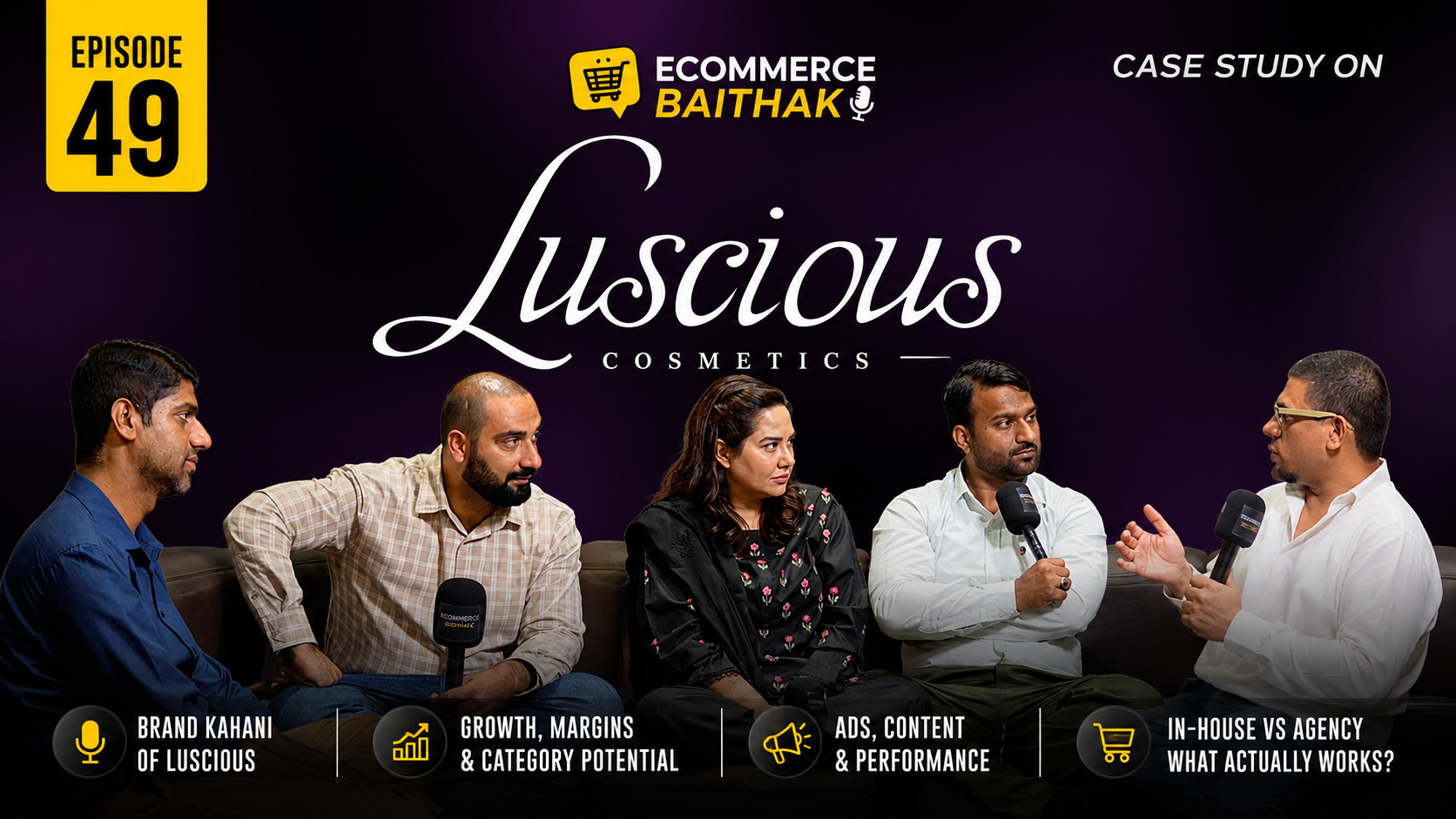
Ecommerce Case Study on Luscious Cosmetics and Freshlabs - Hear From CEO & Founder Mehrbano Sethi
Case Study — Pakistan Ecommerce
Built From Nothing: How Luscious Cosmetics Cracked a Code No One Else Could
In 2007, Mehrbano Sethi launched a cosmetics brand into a country with no ecommerce, no digital payments, and no domestic beauty industry to speak of. Nineteen years later, she's doing it again — this time for Gen Z, and this time with AI in the room.
Every category has one brand people point to and say, "if they could do it, why can't we?" In Pakistan's beauty and personal care space, that brand is Luscious Cosmetics. What's less well known is the story behind it — a founder who built a website with a five-minute load time, packed her own parcels to the post office, and later found herself explaining cosmetic safety standards to foreign governments. This is that story, drawn from a rare, long-form conversation between Mehrbano Sethi and the hosts of Ecommerce Baithak.

01 / Origin: Starting a Brand Before the Market Existed
Mehrbano launched Luscious Cosmetics in 2007. She was 25, freshly back from college in the US, and — by her own account — "very optimistic." The market she was stepping into had almost none of the infrastructure a beauty brand needs today: no reliable supplier directories, no Alibaba as we know it now, and definitely no ecommerce.
The mission, as she frames it, was never just to move product. "Amazon sells products. Coca-Cola sells a brand," she says. "The mission was to build Pakistan's first modern beauty brand." That distinction — brand versus product — becomes a throughline for everything that follows in her career.
The early days were, in her words, "very cute and funny." She built a website that took nearly five minutes to load. There was no digital payment infrastructure to speak of. When customers outside Karachi and Lahore asked whether a product was available, she didn't have a system to answer — so she packed parcels herself and drove to the post office in Gulberg to fulfil orders directly.
At the time, retail was king. Ecommerce demand simply hadn't arrived yet — she places the real "boom" for Pakistani ecommerce around 2016–2017, nearly a decade after she started.
02 / The WhyFamily, a Gap in the Market, and No Domestic Brands
Mehrbano traces part of her interest to her grandmother's makeup collection and her mother's own business background. But the more specific trigger came from a comparison she couldn't stop making: her friends studying abroad had access to international brands like Lakmé from India — and Pakistan had nothing equivalent. What existed locally, she says, was largely rejected international stock — product that had failed lead-testing abroad and was dumped into the Pakistani market.
"We didn't have any brands... [what was available was] rejected stock, dumped here, that failed lead testing elsewhere." Mehrbano Sethi, Founder, Luscious Cosmetics
That gap — no credible local brand, in a market otherwise flooded with big international names or rejected stock — became the wedge Luscious was built into. Her point to founders today is blunt: very few people who start a brand actually set out with the intention of building something that can go toe-to-toe with international standards. Most either replicate or aim smaller. Luscious was built, from day one, to compete at the top.
03 / Then vs. NowStarting a Brand in 2007 vs. Today
One of the more striking parts of the conversation is how directly Mehrbano contrasts the barriers she faced with the near-total absence of those barriers today. In 2007, there was no ChatGPT, no Claude, not even a functioning search ecosystem — she recalls using IRC chat and Ask Jeeves. Every piece of the business — sourcing, naming, packaging, positioning — had to be worked out manually, often over one or two years of trial and error.
Today, she points out, a founder can describe a brand idea to an AI tool and get a product line, naming direction, and business model outline in minutes.
2007
No AI, no reliable supplier search, five-minute website load times, manual order fulfilment, no domestic ecommerce demand.
2026
AI-generated business plans in minutes, mature ad platforms, established logistics — but far higher customer acquisition costs and saturated content feeds.
Her challenge to founders who still hesitate is pointed: the barrier to entry has never been lower, and yet a lot of people still aren't starting. Her own brand logo, for context, was made by a graphic designer on IRC for twenty dollars — a detail she offers as proof that resourcefulness, not resources, was always the real constraint.
04 / PhilosophySustainable, Not Just Risky
Despite starting a business in a market with none of today's tools, Mehrbano is careful to separate risk-taking from recklessness. Her framing: risk is unavoidable in entrepreneurship, but the game plan for sustainability has to be pragmatic.
She points to a structural reality in Pakistan that's easy to overlook: there's no real ecosystem for collateral-free credit lines, and in nearly two decades in the space, she says she's never seen a genuinely credible angel investor network the way founders elsewhere take for granted. That absence of a safety net is exactly why she pushes founders toward sustainability over aggressive scaling — many businesses "keep going" without ever becoming profitable, and eventually the ground runs out from under them.
Her advice, distilled:
- Pick one niche and invest in learning it properly before expanding
- Prove a single product can sustain itself before adding a second or third
- Resist scaling into multiple products before the first is stable — "sustain, then move" is her exact framing
05 / EcosystemThe Courier Industry Synergy Lesson
A tangent in the conversation turns into one of its sharpest business lessons. Discussing Pakistan's courier industry, the hosts and Mehrbano note a pattern: every new courier company treats existing players as competitors and starts a price war rather than expanding into underserved cities. The result is a race to the bottom — rates so low (₹40–50 per parcel) that companies can't sustainably cover both delivery and return legs of a shipment, eventually burning through VC funding and shutting down, stranding merchants' cash in the process.
The alternative, as the group frames it, is synergy: two courier companies serving different cities can partner rather than compete head-on in the same city, expanding total coverage instead of fighting over the same customers. "One plus one doesn't equal two," as it's put in the conversation — "one plus one becomes eleven" when businesses work with each other instead of against each other.
06 / AI in PracticeWhat AI Can — and Can't — Replace
Khaleeq ur Rehman, Luscious's Director of Ecommerce, brings a logistics background and a hands-on relationship with AI tools like Claude and ChatGPT into the day-to-day running of the brand. But both he and Mehrbano are unusually candid about where AI's usefulness ends.
"Judgment and taste will never be superseded by AI." Khaleeq ur Rehman, Director of Ecommerce, Luscious
Khaleeq shares a story that captures this well: he ran an ad campaign, wasn't seeing results, and asked Claude for a new plan. He implemented it faithfully for a month and a half — cycling through Claude's suggested changes each time results stalled — only to have the AI, after all that iteration, ultimately suggest going back to exactly what the team had been doing two months earlier, which had actually been working.
The lesson both of them draw isn't that AI is useless — it's that AI has no visibility into context it was never given. It didn't know their actual return rate. It didn't know their specific cash cycle constraints. It optimized for a generic "good environment" rather than their real one. As Mehrbano puts it elsewhere in the conversation, AI is not a decision-maker: it's a suggestion engine. The decision still has to come from the founder's own judgment and operating experience.
07 / Category EconomicsReturn Rates: Cosmetics vs. Shoes vs. the World
One of the more data-driven threads in the conversation compares return rates across categories and markets — numbers most founders never get to hear from someone who's operated across both. In the US, shoes sold on Amazon can run as high as a 62% return rate. In Pakistan, the shoe category typically averages 40–45% for larger brands, sometimes climbing higher for newer entrants still calibrating sizing.
Luscious, by contrast, operates in a much healthier band — Khaleeq puts their return rate around 9%, sometimes lower, well under the general ecommerce average of roughly 15–18% across categories like clothing, shoes, and organic products.
Shoes — US (Amazon)
Up to 62% return rate, largely driven by sizing uncertainty in a category with no physical try-on.
Shoes — Pakistan
40–45% average for established brands; newer brands often see lower rates simply because customers haven't calibrated sizing expectations yet.
General ecommerce average
Roughly 15–18%, spanning clothing, shoes, medicine, and organic goods.
Luscious Cosmetics
Around 9%, sometimes lower — a category advantage cosmetics genuinely holds over apparel and footwear.
08 / New ChapterLaunching Fresh Labs for Gen Z
After nineteen years building Luscious into a recognizable name across mainstream demographics, Mehrbano's newest venture is a deliberate departure: Fresh Labs, a skincare-first brand built specifically around Gen Z — ages roughly 18 to 32. Her framing is unapologetic: "If your age is above that, we don't want to talk to you. We're very focused on Gen Z."
The branding, tone, and even the shade philosophy differ sharply from Luscious. Where makeup shade ranges were traditionally simple, she notes that Gen Z customers have become "touchy" and specific about shades — what used to be one red is now effectively ten different reds. Fresh Labs also skews notably male-inclusive for a beauty brand: roughly 52% of purchases, by her account, come from men, largely through channels like a branded AI WhatsApp assistant nicknamed "Freshmo" that lets male customers ask questions privately rather than going into a physical store or calling a saleswoman.
Even with strong early product reception, Mehrbano is candid that awareness costs — simply "getting it out there" — are consuming a disproportionate share of budget, which is exactly why she argues newer brands need a hyper-focused segment rather than trying to appeal to "everyone," even though makeup, unlike skincare, can technically serve almost anyone.
09 / MarketingWhy "Ugly Ads" Are Winning — And Why Luscious Can't Use Them
Perhaps the most quotable segment of the conversation is a genuine, unresolved disagreement about ad aesthetics. The hosts make the case that platforms like Meta reward raw, unpolished, UGC-style content with better organic reach — precisely because audiences have grown fatigued by obviously staged, overly lit, overly "TVC" style ads. A rough, authentic-feeling ad, they argue, reads as trustworthy: "this is real." Mehrbano pushes back, at least for her own category: "I can't post ugly ads. I'm in the makeup business." For Fresh Labs specifically, she says the honest answer is that content there is "probably going to be comedy" — something different, not the org's usual polish, but still not deliberately rough either.
"It's called D2C — you have to embrace 'ugly ads.'" Ecommerce Baithak hosts, in discussion with Mehrbano Sethi
The best story in the episode
Khaleeq and one of the hosts share a real case from an earlier employer: a branding team refused to approve rougher, in-house-made ad creative, insisting it would damage the brand. The team built and ran the ads anyway — and they broke sales records. The branding team, alarmed, escalated it to the CEO, presenting the ads as a disaster in a meeting. When the results were shown alongside the complaint, the CEO's instruction was simple: keep doing exactly this.
Storytelling as differentiation
A related idea raised in the conversation: in ecommerce, product usually comes last in the customer's attention, not first — unlike a retail shop where the product is the first thing a shopper picks up. Online, audiences engage with story and description before they engage with the product itself. The example given is Ufone's advertising, remembered specifically for its comedic storytelling at a time when almost no one else in Pakistani advertising was doing that — proof that a genuinely different creative approach can dominate recall for years.
10 / Platform MechanicsThe UGC and Algorithm Rabbit Hole
Khaleeq shares a granular, slightly unusual observation from testing content while traveling: photos of generic or widely-recognized subjects (his example: an image of the Kaaba) tended to get comparatively little organic reach, while personal photos he took and uploaded himself — even simple selfies — earned four to five times more reach. His working theory: platforms are increasingly able to detect AI-generated or previously-circulated content, and reward genuinely new, "digital-fingerprint" original content with better distribution.
The group also unpacks what UGC (user-generated content) is actually meant to do — explain the product simply and credibly, the way a friend would — versus how many Pakistani brands attempt it: staged, over-produced content that mimics UGC's format without its substance, which Khaleeq bluntly calls low quality regardless of concept.
11 / Product & SafetySourcing, Clinical Testing, and Halal Certification
This section of the conversation is where Mehrbano's depth of category knowledge is most visible — she notes she has, at points, advised foreign governments on cosmetic safety standards, and describes having effectively memorized cosmetic safety manuals "forwards and backwards."
She's direct about common misconceptions in Pakistan's local skincare and cosmetics scene:
- Animal fat myth: A common claim among Pakistani skincare brands is that a product is free of animal fat as a headline safety claim. Mehrbano's point: animal-derived ingredients in cosmetics are rare to begin with — most waxes and oils (soybean oil, carnauba wax, synthetic waxes) aren't animal-derived in the first place, so the claim is often more marketing than meaningful differentiation.
- Halal ≠ safe: Following halal certification standards tends to correlate with meeting safety standards, since both restrict certain animal-derived and contamination-prone inputs — but halal certification alone doesn't test for heavy metal contamination (like lead) in pigments and dyes, which requires separate, dedicated testing.
- Real clinical testing is rare and expensive: Mehrbano states plainly that, to her knowledge, not a single Korean-inspired skincare brand operating in Pakistan currently conducts proper three-month consumer clinical testing — the kind of documented testing that, for example, allows a product to be legally sold in Dubai because the health ministry recognizes the consumer testing behind it.
She connects this directly back to churn: poor product safety creates allergic reactions and skin issues, which damages both quality perception and the returning-customer relationship — the two metrics she says matter more than almost anything else in a beauty ecommerce business.
12 / Pricing PsychologyThe Truth About "Fake" Discounts
One of the episode's more provocative threads centers on strikethrough pricing — showing an inflated "before" price next to a discounted "after" price. Mehrbano states that Luscious deliberately avoids using a constant strikethrough price on its website, calling the practice not illegal in Pakistan (since there's no regulator enforcing it) but ethically "a bit scammy."
She cites a striking data point sourced through an AI research agent: roughly 98% of websites in Pakistan that use strikethrough pricing are showing a bare price — meaning the "original" price shown was never a real, sustained selling price to begin with, just a number invented to make the discount look larger.
"Hume chaar sau rupay ki cheez jab aath sau dikha ke chaar sau ki bikti hai, tab hum us mein interest lete hain." — We only get interested in a ₹400 product when it's shown as ₹800 marked down to ₹400. Discussion on Pakistani consumer pricing psychology
Rather than moralizing the whole industry, the group settles on a more useful framing: you can't change pricing norms across the entire ecosystem, but you can choose how your own brand behaves inside it — and there are legitimate reasons to run sales that have nothing to do with inflating a fake baseline:
- Seasonal reality moves: Some months genuinely see less purchase intent (Mehrbano calls this the "real sale," dictated by the ecommerce calendar) and a promotional push there is a legitimate demand-smoothing tool, not a trick.
- Trial-driving discounts: A real example is shared — a dermatologist-style skincare brand resisted discounting, assuming loyal customers wouldn't need it, but a 25% sale actually pulled in an entirely new customer base, driving their returning-customer rate above 80%. The catch: some customers over-ordered to stockpile a full year's supply at the discounted price, so the "new customer" read on the data needs a second look.
- Inventory-clearing discounts: Products moving slowly are legitimate candidates for markdowns aimed at moving stock, not manufacturing urgency.
13 / Trend WatchThe Korean Beauty Wave
The conversation turns to K-beauty's growing dominance in global beauty retail — including the fact that Sephora in the US has been closing roughly half its stores while bringing in Olive Young, sometimes described as "the Sephora of Korea." Mehrbano attributes Korean beauty's edge specifically to a more rigorous, science-forward approach to formulation — an area she feels American brands have fallen behind on.
She highlights a Korean product category she's genuinely enthusiastic about: five-minute "power facials" that deliver a visible skin-polishing effect in a short window, a format she says resonates strongly with Gen Z users on her own team. She also notes rising interest in unisex beauty products — Fresh Labs' newest sub-brand launch is explicitly unisex, and she points out that older-generation men (her own father, around 60, is her example) can be just as receptive to Korean-style skincare routines as younger consumers.
14 / OperationsLocal Sourcing and the Unboxing Moment
Both brands are actively working to move more of their supply chain into Pakistan. Mehrbano describes deliberately commissioning custom, product-specific packaging for Fresh Labs rather than reusing generic bottles — down to bottle-cap mechanisms that differ meaningfully by formula and function, something she says most customers notice even if they can't articulate why a bottle "feels" premium.
She extends the same logic to a detail most founders overlook entirely: scent as a first-unboxing signal. Her advice — echoed with an apparel-industry example about pre-washing garments before shipping — is that the very first sensory impression of a product, out of the box, should read as premium, because that moment does disproportionate work in shaping repeat-purchase intent.
15 / Manufacturing RealityHow Skincare Actually Gets Made in Pakistan
This is one of the most technically candid parts of the conversation. Mehrbano walks through how most local skincare is formulated: a cosmetic pharmacist (not a trained cosmetic chemist, a role that essentially doesn't exist domestically) sources or purchases a formula off the internet and adapts it — frequently substituting ingredients because base cosmetic ingredients simply aren't locally available, which she says would surprise most consumers.
She contrasts this with high-end international skincare, citing La Mer as an example of a product whose price (roughly $600 a bottle) is a direct function of the billions spent on R&D behind it — a level of investment no Pakistani skincare brand is currently positioned to match.
Her closing point on this topic is a caution rather than an accusation: without independent, documented clinical testing, a product can very plausibly be free of animal fat and reasonably halal — and still not actually be safe. Halal and safety are correlated, not identical.
16 / Vendor ManagementAgency Horror Stories
Mehrbano is unusually direct about her experience working with performance marketing agencies, including a specific US-based agency she names — Mute Six — which she engaged at a reported $20,000/month retainer and which, in her account, failed to deliver results within the first month.
Her broader critique of the agency model: an agency is effectively "an ecosystem of people" — an account manager incentivized to promise big outcomes, and a delivery team that may or may not be equipped to hit them. Her own approach, and the one she pushes on Khaleeq, is to keep as much execution in-house as is practical, and use external help only for narrowly-scoped, judgment-free tasks that can be systematized — like having a virtual assistant handle repetitive ad-upload tasks so Khaleeq's time stays focused on strategy rather than data entry.
She also flags a specific pattern in Pakistan's agency landscape: some newer AI-driven "build your brand for you" offerings essentially package product creation and agency hand-off as a full-service bundle — pitched confidently, sometimes even with fully built-out three-month plans, but without the operating discipline to actually execute against them once the retainer is signed.
17 / ToolingThe AI Stack Behind the Scenes
Beyond ChatGPT and Claude for planning and copy, the team names two more specific tools in active use:
Claude Code
Used for internal build work — including building "Freshmo," a branded WhatsApp AI agent with its own cartoon persona, designed specifically so male customers can ask sensitive product questions privately rather than approach a saleswoman in-store.
Supermetrics
Used to consolidate ad and analytics data across six brands' Google Ads, Meta, and other accounts into a single command-line-style reporting flow, cutting down on manual cross-platform reporting.
But the episode's clearest statement on AI comes from Mehrbano directly, and it's worth closing this section with it in full: AI is not a decision-maker. It can only offer suggestions — the actual decision still has to be made using a founder's own judgment, ethics, and operating experience. Her warning to younger founders specifically is that AI can empower a business, but it cannot substitute for character, judgment, and hands-on experience in using the tools responsibly.
What This Case Study Teaches Founders
- Brand beats product, every time. Mehrbano's original mission wasn't to sell lipstick — it was to build Pakistan's first modern beauty brand. That framing shaped every decision that followed.
- Pick one niche, prove it, then expand. Sustainability, not aggressive scaling, is the real safety net in a market without accessible credit or angel investment.
- Treat competitors as potential collaborators. The courier industry's price-war spiral is a warning; synergy across adjacent players compounds growth instead of eroding margins.
- AI gives suggestions, not decisions. Every AI-assisted workflow in this case study — ad planning, WhatsApp agents, analytics — still required human judgment to catch what the tools couldn't see.
- Authenticity now outperforms polish. Raw, real content is winning on the algorithm — but each brand still has to decide how far it can push that without compromising its own brand promise.
- Safety comes before certification claims. Halal, cruelty-free, and other claims matter — but without real testing, they don't guarantee a product is actually safe to use.
- The unboxing moment is a retention lever. Custom packaging, scent, and first-impression quality directly shape whether a customer becomes a repeat buyer.